© Baek Seung-Kwang, Birds Korea
Author: Dr Nial Moores
Report: Link
Appendix: Link
Shy, rare and exquisitely-patterned, the Scaly-sided Merganser Mergus squamatus is effectively restricted for most of the year to rivers in eastern and northeast Asia. Research this century has helped to map their summer and winter distribution in more detail. In the boreal summer, the species nests in riverine forests often shared with Tigers, from the slopes of the Baekdu/ Changbai massif east to Primorsky Krai. In autumn, as rivers freeze, these globally Endangered fish-eating ducks then move south and southwest, with the vast majority (revealed by surveys conducted by hundreds of birdwatchers and researchers) to spend the winter mostly along rivers in eastern China. Until recently, however, there has been very little information with which to identify and conserve rivers used by these same birds during their 2-3,000 km-long migration.
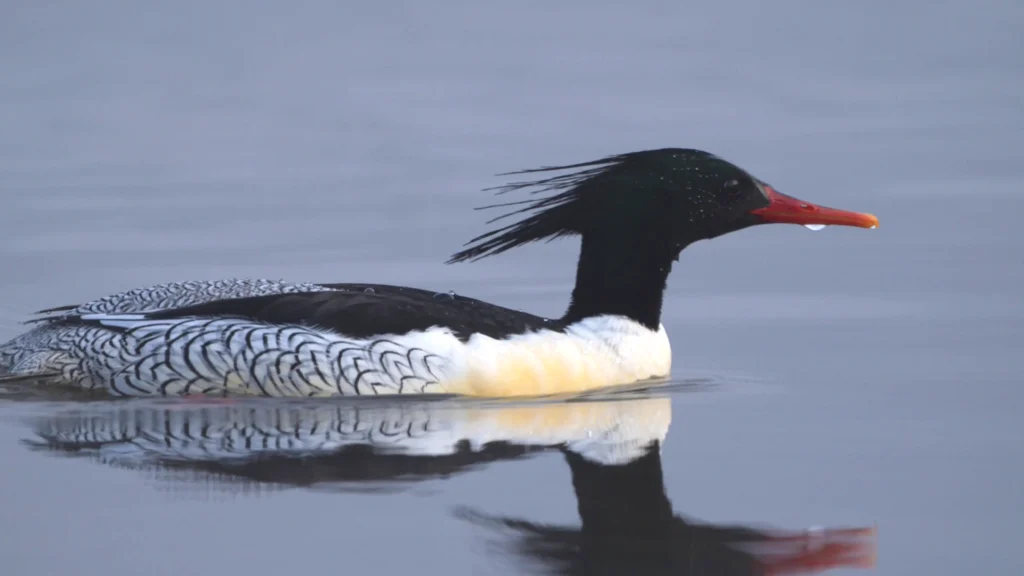 Scaly-sided Merganser © Kim Eojin
Instead, insights have had to be pieced together from a few scattered observations (most notable of which was flocks seen in November and again in the following March from a moving car along the Chongchon River in the DPR Korea twenty years ago) and from a few birds that had been specially fitted with geolocators in Russia a few years later. These indicated that most birds stopped-over on their migrations; and that an unknown number staged somewhere on the Korean Peninsula. But where? And for how long?
Birds Korea is a small, specialized Korean NGO that is dedicated to the conservation of birds and their habitats. As such, we are an active NGO member of the Scaly-sided Merganser Task Force. Small grants from the EAAFP earlier helped us to conduct nationwide single-species surveys and resulted in our estimate of 200–250 individual Scaly-sided Merganser over-wintering every year in the Republic of Korea (ROK) – approximately 5% of the global population. From counts made along several rivers in different months, we were also able to confirm that Scaly-sided Mergansers arrive in the ROK in October; that numbers build steadily to peak in mid-winter, often with unexplained fluctuations, however; and that numbers start to decline again in February or March, with very few birds remaining past April 10th. Perhaps some of these fluctuations in our counts in November and December were due to what is known as “migratory turnover”– with some birds arriving for the winter even as others departed further south?
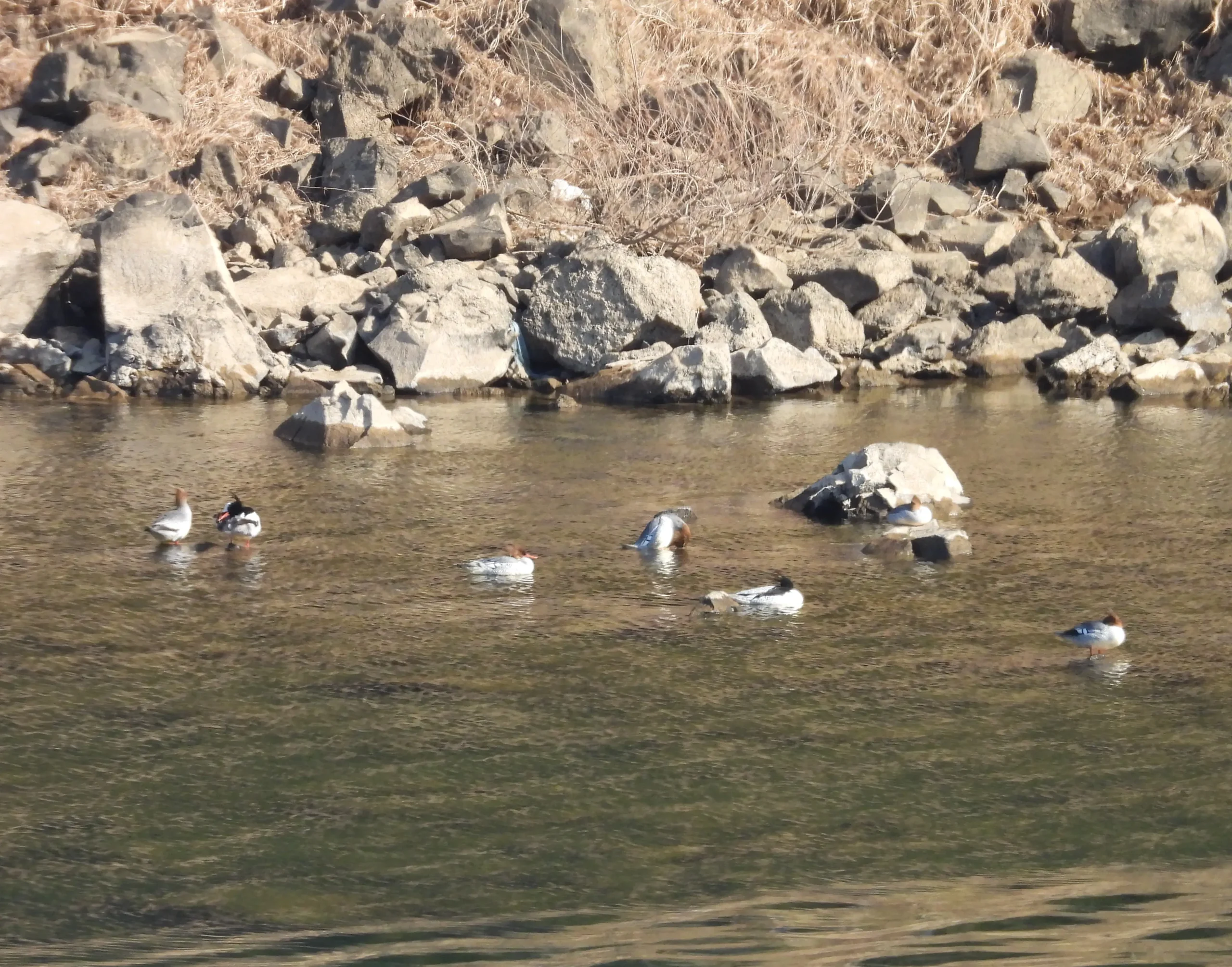
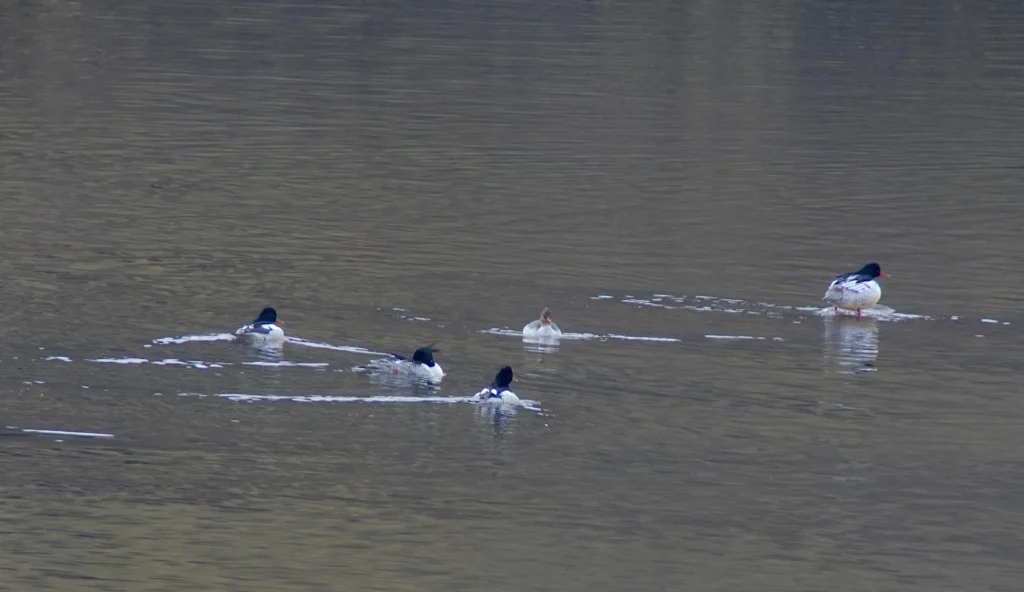
In November 2021, we received our first contract from Yeoncheon County for research on biodiversity in the recently designated Yeoncheon Imjin River Biosphere Reserve [EAAF156]. Although our occasional surveys had previously found very small numbers of Scaly-sided Merganser in mid-winter there, we were genuinely thrilled to find multiple flocks along the Imjin River. Our highest day count that month was 144-150 individuals: even now the highest single day count of Scaly-sided Merganser along one river recorded anywhere on the Korean Peninsula! The counts that followed revealed a series of peaks and troughs in number, with almost all birds gone by mid-December. Conclusion: the Imjin River in Yeoncheon was very likely a major staging area for the species.
 © Birds Korea
In the years that have followed, as part of our research on an increasingly wide diversity of species found in the Biosphere Reserve (including geese, cranes, Long-billed Plovers, raptors and River Otters), we have tried to maintain frequent counts of Scaly-sided Merganser each migration season, organized into twelve well-defined count sites. Happily, this research has already been used to support the designation of the Yeoncheon Imjin River Flyway Network Site in 2024; and is now being used in discussions by Yeoncheon County on the possible designation of a Ramsar site.
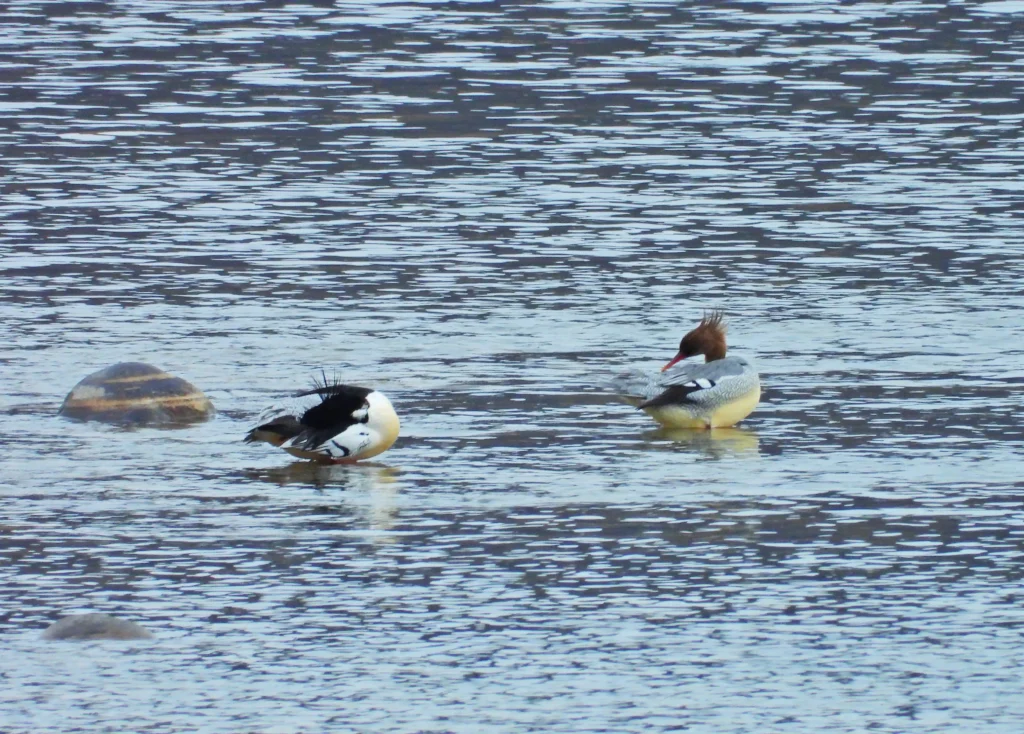
This latest EAAFP small grant enabled Birds Korea, and more specifically Birds Korea Hantan-Imjin Representative Baek Seung-Kwang, to complete our fifth year of frequent counts of Scaly-sided Merganser during both migration periods, and to review our count data. This means that we can now confirm the international importance of this Flyway Network Site for Scaly-sided Merganser fully in accordance with Ramsar Convention guidance, with a 5-year geometric mean based on highest day counts alone of 53 individuals during northward migration and 106 individuals during southward migration – equivalent to 1% and 2% of the population respectively. In addition, our research allows us to confirm that these highest day counts really do not represent the total numbers of Scaly-sided Mergansers present during a whole migration period. Instead, because of migratory turnover we estimate a 4-year geometric mean of Scaly-sided Merganser in the Flyway Network Site of 1%–2% of the population during northward migration; and a 3-year geometric mean of 3.6%-6% of the population during southward migration.
 © Baek Seung-Kwang, Birds Korea
This small grant was also used to support designs for signboards that feature the Scaly-sided Merganser for placement by Yeonchon County. Thanks to the work of three members of Birds Korea Yeoncheon, a class of schoolchildren was first able to learn about this remarkable bird and this remarkable river – and then help to create the design that has been used. A second design has also been commissioned, and will be available later this year.
 © Birds Korea
 © Birds Korea
 © Birds Korea
Many more details of our work for Scaly-sided Merganser and in the Yeoncheon Imjin River Flyway Network Site can be found in our main report and on our blog (Birdskoreablog.org)