Author: Thiri Sandar Zaw (BANCA)
Report: Link
Since the Pyu Dynasty, which is older than the Bagan period, water has been stored in man-made wells in central Myanmar for agricultural purposes. In the late 1860s, man-made wells were converted into reservoirs, dams, and lakes to store more water for agriculture and for agricultural development in central Myanmar and flood control from the highlands. Reservoirs/ponds created for such purposes have transformed into natural habitats for biodiversity and wetlands that can support both humans and biodiversity. Among such unique wetland ecosystem services for humans and biodiversity, there is a wetland that provides food and habitat for the globally endangered species of waterfowl and other rare waterbird species in central Myanmar. This man-made wetland is called Pyu Lake and located at Pyu kan village, in Tada U Township, Mandalay region and the main irrigation dam for the Pyu Lake wetland is the KinDa reservoir. The KinDa reservoir is located on the Panlaung River in eastern Shan State and is a reservoir that can provide irrigation water to the irrigated areas (20,1500 acres) of Kyaukse Township, Myittha Township, Tada U Township, and Wandwin Township in Mandalay Region.
Among the (22) inland wetlands including pond & Inn in central Myanmar, the Pyu Lake’s wetland ecosystem services provide a unique wintering habitats for the Critically Endangered species, Baer’s Pochard (Anthya baeri) (2%) of the global population, which has only about (600) individuals left in the world and other globally threatened rare duck & pochards and waterbird species. In addition, other ecosystem services of the wetland serve not only other species (plants and fish) present in the wetland, but also the agricultural and livestock water supply of the local people from the (10) villages living around the Pyu Lake wetland. The Biodiversity And Nature Conservation Association (BANCA) envisions working with the local communities to ensure that these most valuable inland wetland ecosystem services for sustainable use not only by biodiversity but also by the local people in Mandalay region. Therefore, BANCA formed a community – based conservation group, named the Shwe Kantharyar Nature Conservation, with the farmers living around the Pyu Lake wetland. SKNCA is recognized as township level non – state actor for the biodiversity conservation and sustainable wetland utilization at Pyu Lake in the Tada Oo township, Mandalay region. The main objective of establishing the community-based conservation groups in BANCA is to enhance the capacity of all community-based conservation members and to foster a strong sense of community stewardship among them, leading them to engage with neighboring local farmers in their areas for sustainable wise use the inland wetland ecosystem services to both biodiversity and human well – being in their region.
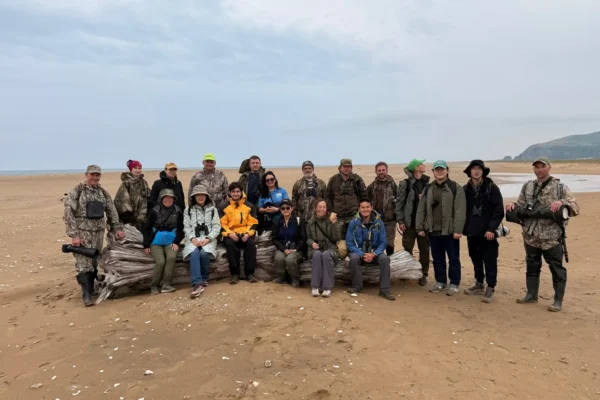
The community – based conservation members (SKNCA) carried out the monitoring of migratory waterbird and duck species at the priority wintering grounds of Baer’s Pochard with other Pochard and global threatened the migratory waterbird species at Pyu Lake, Paleik Lake and Banaw Inn (Lat taung Inn) in Mandalay region in January (Asian Water Bird Census) and March 2025. The survey was conducted with 25 participants, SKNCA members and Paleik Lake Nature Conservation Association members (PLNCA) and BANCA. In Pyu Lake, (27) migratory waterbird species with (5622) population were found, in Paleik Lake, (42) species of waterbirds with (1639) population, and in Banaw Inn (Lat taung Inn), (24) water bird species with (1146) population.
In addition, SKNCA members held the first-ever “World Wetlands Day” at the Pyu Lake Flyway Network and Ramsar Site, and led CEPA program on the conservation of inland wetlands in the Pyu Lake wetland region, involving local farmers from seven (7) villages irrigated by Pyu Lake on 28th to 2st February 2025. The (399 local villagers: (Man – 171, Women – 228) from the (7) villages within (4) village tracts use irrigated water from Pyu Lake for their agriculture which is the main occupation around the areas in Tada Oo Township, Mandalay region. SKNCA members set up the inland wetland conservation awareness signboard at (4) villages and the bank of the Pyu Lake Flyway Network and Ramsar Site in July 2025 to raise the awareness of the local villagers about the values of Pyu Lake wetland ecosystem services for their communities and its recognition as the first international importance wetland sites (Ramsar Site & EAAFP FNS) in Mandalay region, central Myanmar.
Furthermore, the community – based conservation group (SKNCA) led the Pyu Lake Ramsar Site Conservation Plan (2026 – 2028) within SKNCA members living Pyu Kan village, Yaw Taw Lay village, Moe Nan Chon village, Kyauk Kan and Taung Kan village around the Pyu Lake and contributed to village authorities. The Plan’s vision is “By 2028, wetlands sustainably support wildlife needs, and the Pyu Lake, Ramsar Wetland is conserved through the leading of Shwe Kanthayar Nature Conservation Association, collaboration with local villagers from 7 villages” in Tada Oo township, Mandalay region. The conservation action plan has (5) objectives as follows. The SKNCA members are firmly committed to fulfilling all objectives with (3) years from (2026 to 2028).
Objectives:
- To conserve and protect the wetland as a sustainable ecosystem
- To restore and enrich natural aquatic resources (fish, prawns, aquatic plants)
- To promote sustainable, nature-based ecotourism
- To mitigate and adapt to climate change impacts
- To improve local livelihoods through sustainable income-generating activities.
In the future, the Community-based conservation group (SKNCA) will be able to monitor the migratory waterbirds in the wintering period to increase awareness about the existence of global threatened waterbird species in their wetland and work together to effectively reduce the fragmentation of wetland habitats.
In planning for the Pyu Lake resource management, the strong commitment of local communities is reflected in their statements. They shared that they are proud of their villages, believe that the members of SKNCA can do this, and are willing to work together with them, and to participate in the wetland conservation activities led by SKNCA.
Not only SKNCA members, but also all residents living in the irrigation villages, will participate to formulate the right decision and actions. Through this they will be able to take greater responsibility and support the Pyu Lake Ramsar Site management committees.