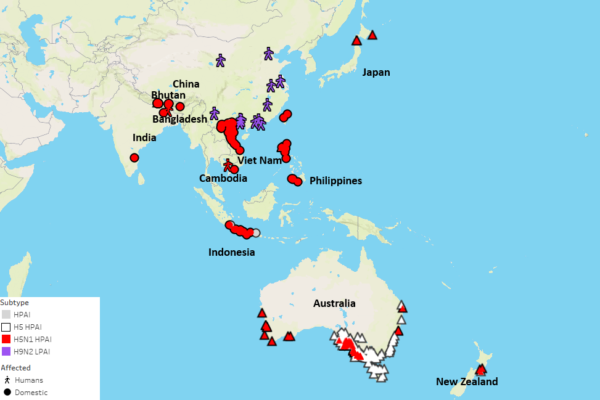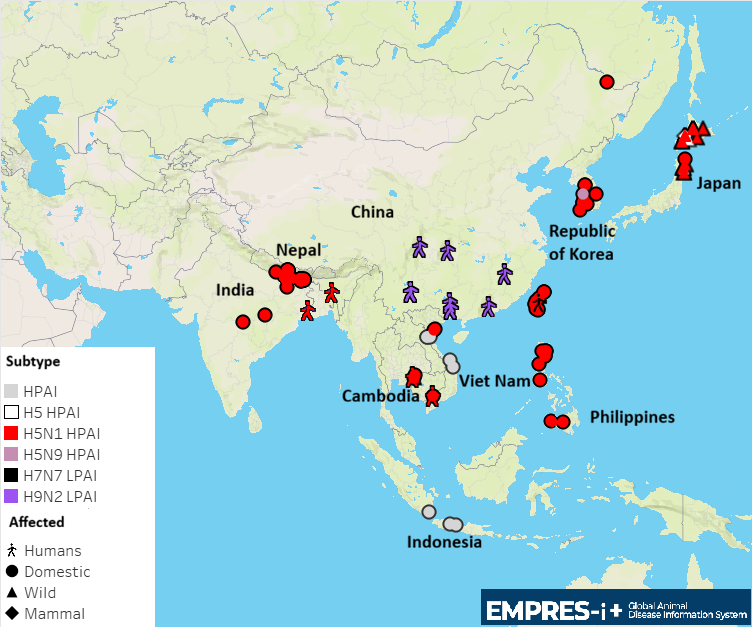
Map. Distribution of avian influenza events reported in animals and humans from 3 March 2026 to 8 June 2026.
Note: The H5 HPAI virus detection of Heard Island, Australia is not included on the map.
Disclaimer: The boundaries and names shown and the designations used on these map(s) do not imply the expression of any opinion whatsoever on the part of FAO concerning the legal status of any country, territory, city or area or of its authorities, or concerning the delimitation of its frontiers and boundaries. Dashed lines on maps represent approximate border lines for which there may not yet be full agreement. Dotted line represents approximately the Line of Control in Jammu and Kashmir agreed upon by India and Pakistan. The final status of Jammu and Kashmir has not yet been agreed upon by the parties.
Source: United Nations Geospatial. 2020. Map of the World. [Cited June 2026]. Modified with Emergency Prevention System Global Animal Disease Information System (EMPRES-i), the World Organisation for Animal Health (WOAH) and National Authorities data, 2026.
During the period from 3 March 2026 to 8 June 2026, at least two high pathogenicity avian influenza (HPAI) virus subtypes (H5N1 and H5N9) and two low pathogenicity avian influenza (LPAI) virus subtypes (H7N7 and H9N2) have been reported in East, South, and Southeast Asia. H5Nx HPAI viruses continue to circulate in Asia and are well established in certain areas of the region.
Cambodia reported four H5N1 HPAI outbreaks in domestic birds in Banteay Meanchey (2), Otdor Mean Chey (1) and Prey Veng (1) provinces, and one in unspecified wild birds in Banteay Meanchey Province.
China reported ten H5N1 HPAI outbreaks in domestic birds in Taiwan Province across Changhua (1), Pingtung (2) and Yunlin (2) counties and Taipei (3), Kaohsiung (1) and Taichung (1) cities.
India reported six H5N1 HPAI outbreaks in domestic birds in Bihar, Chhattisgarh, Maharashtra and Sikkim states, including in a government farm and a regional hatchery.
Indonesia reported five HPAI outbreaks in domestic birds in March 2026 in Central Java (2), Lampung (2) and in West Java (1) provinces, affecting both chickens and Muscovy ducks.
In Japan, H5 HPAI circulation in domestic birds has significantly decreased despite multiple detections in wild birds. During this period, Japan reported a total of 79 events across Aomori (1), Fukushima (1), Hokkaido (67), Iwate (8), Miyagi (1), and Toyama (1) prefectures affecting domestic birds (4), wild birds (72), and wild mammals (3). Of these, 61 events were attributed to H5N1 HPAI. H5N1 HPAI outbreaks in domestic birds occurred on chicken farms in Aomori and Hokkaido prefectures and a duck farm in Miyagi Prefecture. Wild mammalian species affected with H5Nx HPAI include Common raccoon (Procyon lotor) and an unspecified fox (Vulpes sp.). Wild bird species reported during this period include Carrion crow (Corvus corone), Eastern buzzard (Buteo japonicus), Mountain hawk-eagle (Nisaetus nipalensis), Ural owl (Strix uralensis) and Large-billed Crow (Corvus macrorhynchos), the latter species involved in 66 out of the 72 HPAI detections in wild birds.
Nepal reported 51 H5N1 HPAI events, marking a significant activity during the reporting period. Of these, 50 H5N1 HPAI outbreaks were reported in domestic birds across Bagmati (10), Koshi (37), Lumbini (1), and Madhesh (2) provinces. Additionally, one H5N1 HPAI detection was reported in a House Crow (Corvus splendens) in Bagmati Province.
The Philippines reported 13 H5N1 HPAI outbreaks in domestic birds in Cordillera Administrative Region, Ilocos Region (Region I), Cagayan Valley (Region II), Central Luzon (Region III), Calabarzon (Region IV-A), Mimaropa (Region IV-B), and Zamboanga Peninsula (Region IX) and Maguindanao del Sur (Bangsamoro Autonomous Region in Muslim Mindanao).
The Republic of Korea reported 5 H5N1 HPAI outbreaks in domestic birds in Chungcheongnam-do (1), Jeonbuk State (2), Jeollanam-do (1), and Gyeongsangbuk-do (1). A total of 26 detections in wild birds were reported including H5N1 HPAI virus detections in Chungcheongnam-do (1), Gangwon-do (7), Gyeonggi-do (3), Gyeongsangnam-do (1), Jeollabuk-do (1) and Busan (1), Incheon (1) and Seoul (3) municipalities involving species such as Bean Goose (Anser fabalis), Common Teal (Anas crecca), Cinereous Vulture (Aegypius monachus), Great White Egret (Ardea alba), Greater White-fronted Goose (Anser albifrons), Grey Heron, Whooper Swan, and other unspecified wild bird species; and 8 H5N9 HPAI virus detections in Chungcheongnam-do (3), Gyeongsangnam-do (1), Jeollabuk-do (1), Jeollanam-do (3) in Cinereous Vulture, Common Teal, Grey Heron, and other unspecified wild bird species.
Viet Nam reported at least nine H5N1 HPAI outbreaks in domestic birds in Dien Bien, Ha Tinh, Ninh Binh, Quang Ngai, and Thanh Hoa provinces. HPAI presence was also reported in other provinces such as Nghe An and Da Nang provinces.
AI viruses continue to circulate extensively in some parts of Asia, resulting in occasional human cases. During the reporting period, Bangladesh and India reported one influenza A(H5N1) human case in Sylhet Division and West Bengal State, respectively. Cambodia reported two influenza A(H5N1) human infections in Banteay Meanchey, Oddar Meanchey and Svay Rieng provinces. China reported a total of ten influenza A(H9N2) human infections in Guangxi Zhuang Autonomous Region (3), and in Guangdong (2), Jiangxi (1), Sichuan (1), and Yunnan (3) provinces. In addition, China reported one influenza A(H7N7) human infection in Taiwan Province. Highly pathogenic H5N1, H5N2, H5N5, H5N6, and H5N8 viruses have demonstrated the ability to spread via migratory water birds. We consider avian influenza activity to be lower in the period from March to June, therefore reports of outbreaks in poultry or detections in wild birds and humans are expected to decrease over the coming months in the region.
The list of bird species affected by H5Nx HPAI globally is available HERE with the new species reported since 2021 highlighted in orange.