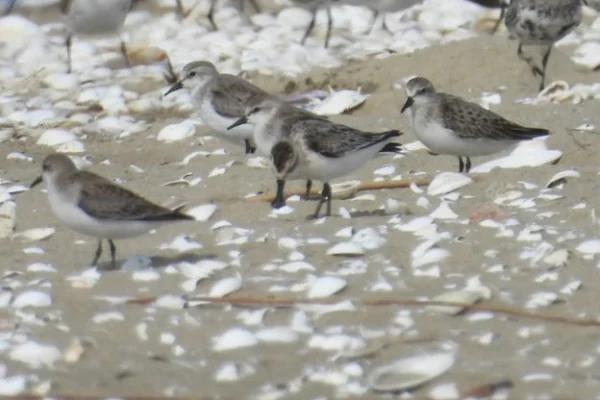
Great Knots and Eurasian Curlews at Toe beach, Daydaye Township, Ayeyarwady Region, Myanmar recorded in November 2025 © Ye Min Aung – NCS-Myanmar
Authors: Pyae Phyo Aung, Saw Moses, Ye Min Aung and Thura Soe Min Htike
Report: Link
Myanmar lies along the East Asian–Australasian Flyway (EAAF), one of the world’s major migratory bird routes, and supports numerous migratory bird species, with seven designated Ramsar Sites. Its 2,800-km coastline is divided into three regions: the Tanintharyi Coastal Region, the Ayeyarwady Coastal Region, and the Rakhine Coastal Region. Along this coastline, estuaries and intertidal mudflats provide critical wintering habitats for migratory shorebirds, including threatened species such as the Critically Endangered Spoon-billed Sandpiper, the Endangered Nordmann’s Greenshank, and the Endangered Great Knot. However, amid the multiple crises following the 2021 military coup, some important sites in the Rakhine and Tanintharyi coastal regions could not be monitored due to insecurity, logistical constraints, and ongoing conflict.
With financial support from the EAAFP Small Grant Fund for Working Group/Task Force, NCS-Myanmar conducted wintering shorebird surveys at nine historically important sites along the Ayeyarwady Coastal Region and the Gulf of Mottama between November 2025 and February 2026. The surveys aimed to assess the current wintering distribution of the Critically Endangered Spoon-billed Sandpiper, update the conservation importance of coastal wetlands for migratory shorebirds, identify current threats through rapid Key Informant Interviews (KIIs), and promote conservation awareness through vinyl posters and educational pamphlets distributed during the surveys.
Surveys were conducted around spring tides, when shorebirds are most active on exposed mudflats and roosting areas. Teams of two to three surveyors spent two to three days at each site covering key feeding and roosting habitats. Across the nine sites, we observed three main groups of birds: shorebirds, wetland-dependent birds, and terrestrial birds. The number of shorebird species ranged from 12 to 22 per site, wetland-dependent species from 17 to 38, and terrestrial birds from 20 to 82. We recorded Spoon-billed Sandpipers at two sites, Nordmann’s Greenshanks at six sites, and Great Knots at four sites. Importantly, eight of the nine sites met two to three Ramsar criteria, confirming their significance for migratory shorebird conservation.
Rapid assessments using KIIs revealed ongoing bird hunting at four of the nine surveyed sites, highlighting a serious and continuing threat. To increase conservation awareness, we installed 140 vinyl posters in public areas across the nine sites and distributed 700 educational pamphlets to local communities and partners during bird surveys and awareness events.
Although the surveys covered only a single high-tide period at each site, the findings suggest the need for more regular monitoring during the wintering season—ideally two to three times between December and February—to better understand changes in species composition and population size. Several sites showed high conservation value but currently lack formal protection and regular monitoring.
At the same time, bird hunting remains widespread in nearly half of the surveyed sites, posing a major challenge to local and international conservation efforts. These important coastal wetlands should be safeguarded through protected areas or Other Effective Area-based Conservation Measures (OECMs) to protect threatened migratory birds and maintain the ecological value of Myanmar’s mudflats. Our findings show that Myanmar’s coastal wetlands are globally important for migratory birds, but urgent conservation action is needed to secure their future.