On 9 February, the EAAFP Secretariat visited Cheorwon Basin [EAAF027], a site within the East Asian–Australasian Flyway Site Network. The visit included observing cranes within the Civilian Control Zone and meeting local community members who have dedicated themselves to crane conservation. It was a valuable opportunity to learn about Korea’s historical background, the conservation of cranes, and the commitment and cooperation of local residents who have worked tirelessly to protect them.
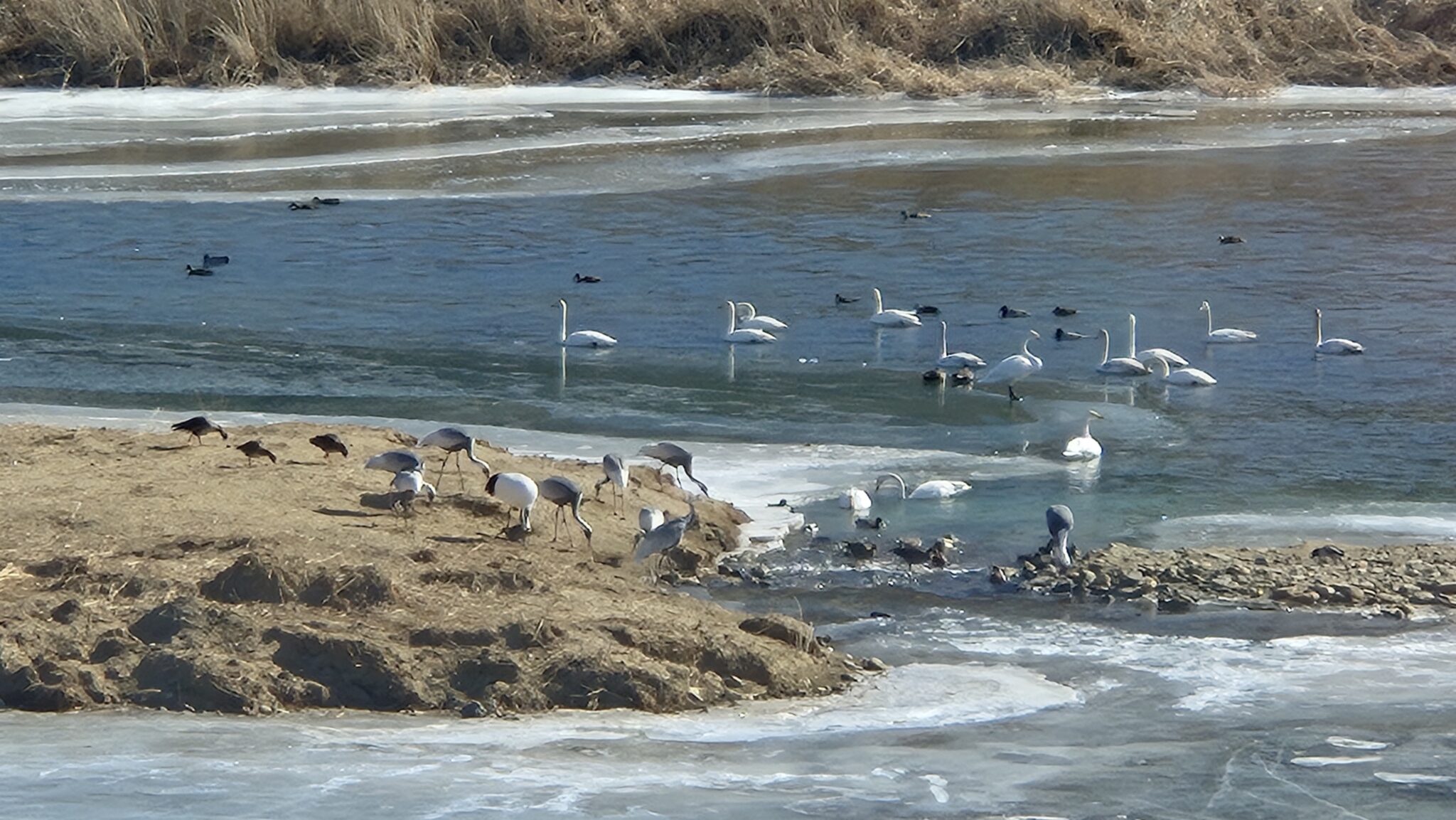
At the Hantan River Crane Observatory, hundreds of White-naped Cranes and Red-crowned Cranes were resting. Against the vivid blue winter sky, a flock of cranes quietly descended onto the riverside, where geese and ducks had already gathered. Watching them settle and communicate in their own language was a powerful reminder of the preciousness of all life that forms part of the natural world.
The Secretariat also met Mr Jong-han Baek and Mr Jong-hyun Yoo of the Cheorwon Crane Conservation Council, who have long been engaged in crane conservation in the region. Mr Baek shared the history of crane conservation in Cheorwon. Before the Korean War, his mother regarded the cranes that visited the area as honoured guests, just as her ancestors had done, and provided them with food. During the war, the cranes disappeared, but they returned to Cheorwon once it had ended. In the years that followed, Mr Baek continued feeding the cranes despite facing opposition from some local residents.

Despite initial resistance, efforts to find a path towards coexistence gradually led to the protection of crane habitats, resulting in an increase in crane populations. Crane watching developed into a form of eco-tourism, and participation in the rice straw retention project expanded, generating additional income for the village. Mr Baek remarked, “Crane conservation has brought greater economic benefits than a factory ever could; ecology is economy.”
Cheorwon has continued to develop tourism and educational programmes centred on crane conservation. These sustained efforts have become a model for conservation practice. In 2025, the Cheorwon Crane Conservation Council of the Republic of Korea was named the 31st recipient of ‘The Asian Environmental Awards’, jointly organised by The Chosun Ilbo and The Mainichi Newspapers.
A member of the secretariat who saw a crane for the first time recalled, “The sight of cranes gathered in flocks along the Hantan River has stayed with me.”
What, then, does a single crane and a single wetland ask of us? In a world where development is often equated with economic gain and growth, the case of Cheorwon offers a different narrative. It demonstrates that aligning conservation efforts with the natural rhythms of the land can, in fact, foster mutual prosperity within local economies. Rather than standing in opposition to development, ecological stewardship can become a foundation for sustainable regional revitalisation.
This approach resonates with the vision set out in the Kunming–Montreal Global Biodiversity Framework (GBF), adopted at the 2022 Conference of the Parties to the Convention on Biological Diversity. Its guiding vision ‘living in harmony with nature’ need not remain an abstract global aspiration. As Cheorwon illustrates, it can begin in a single village.
Conservation, in this sense, extends beyond the protection of habitats and species. It is also a commitment to safeguarding a region’s history, traditions and ecological culture, ensuring that the relationship between people and place endures for generations to come.
Photos of the Cherwon Basin: https://www.flickr.com/photos/eaafp/albums/72157627229135551