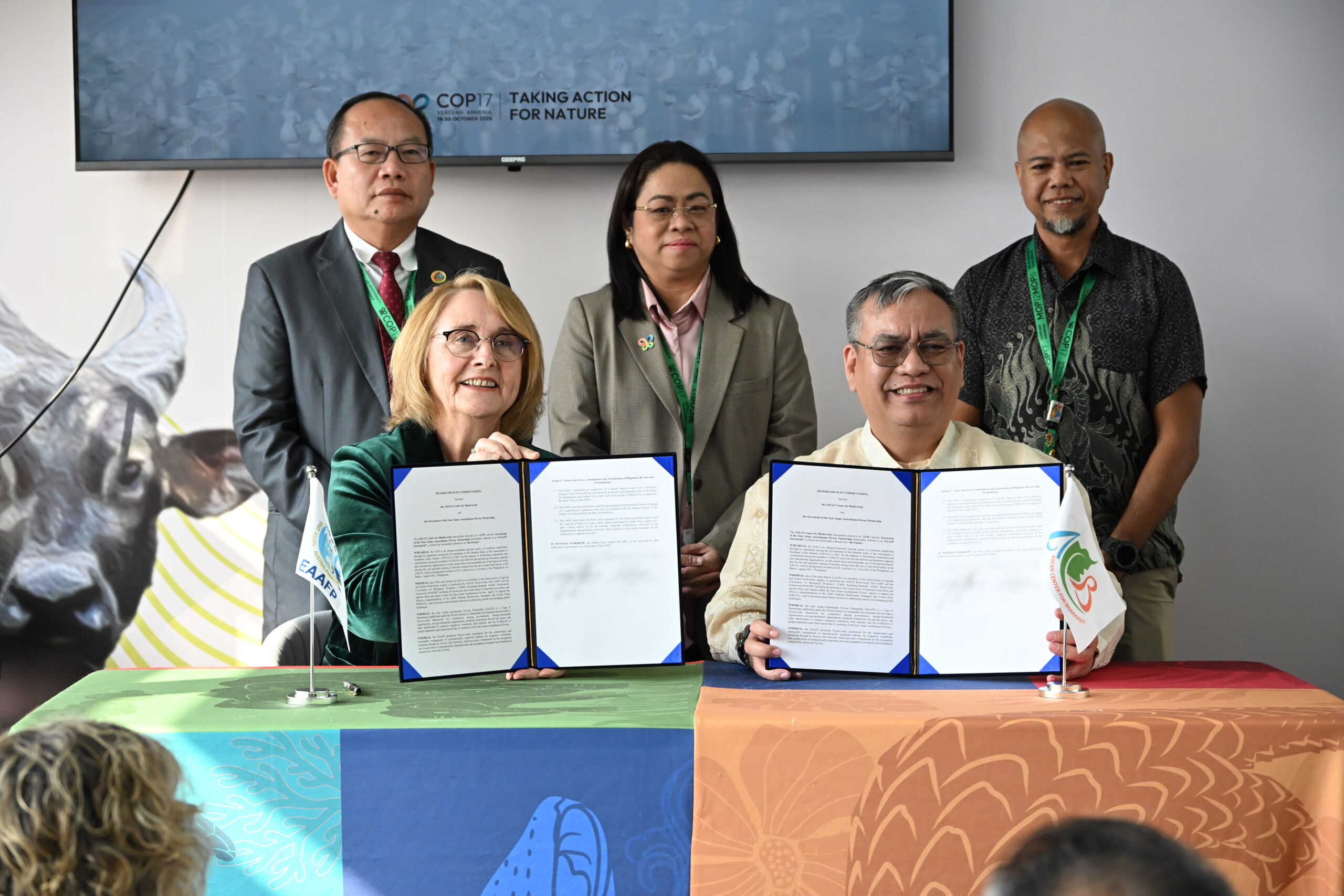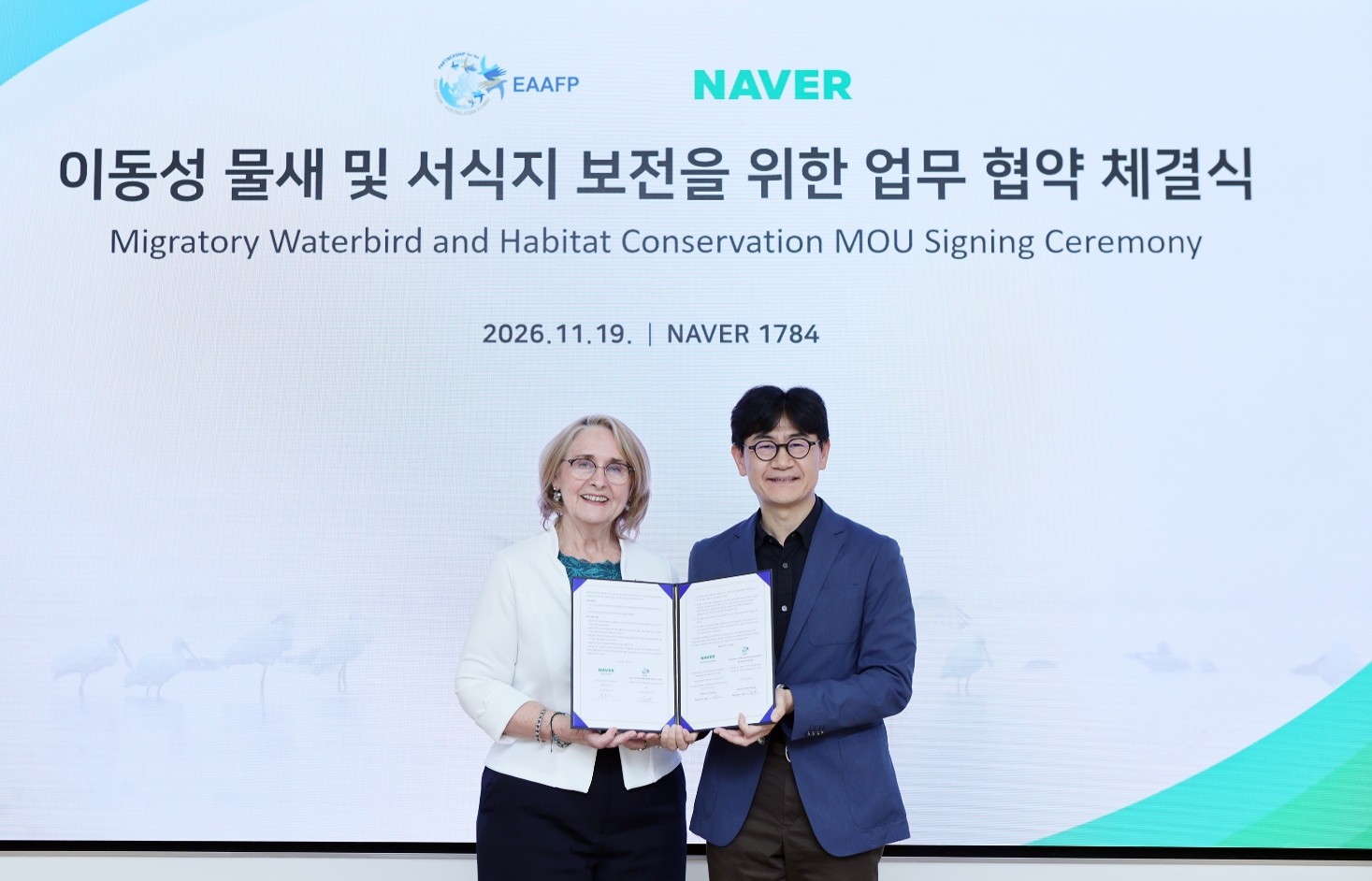
(Left) Jennifer George, Chief Executive of the EAAFP Secretariat and (Right) Dong A Lim, Senior Vice President, ESG/External Policy at NAVER Executive Vice President in charge of ESG at NAVER, sign an MOU on cooperation for migratory waterbird and habitat conservation at NAVER 1784 in Seongnam, Republic of Korea, on 19 November 2026. ©NAVER
Operator of the Republic of Korea’s leading search platform to explore how its digital reach and technological expertise can support biodiversity conservation
NAVER, a technology company headquartered in the Republic of Korea and operator of the country’s leading search platform, has signed a Memorandum of Understanding (MOU) with the East Asian–Australasian Flyway Partnership (EAAFP) Secretariat to support the conservation of migratory waterbirds and their habitats.
Founded in 1999, NAVER is a major gateway to online information in the Republic of Korea. Its services span online search, shopping, digital content, payments and cloud computing, alongside artificial intelligence technologies.. This extensive digital reach offers opportunities to bring information about migratory waterbirds and biodiversity conservation to a broad public audience.
The agreement aims to raise public awareness of migratory waterbirds and their habitats and strengthen cooperation on biodiversity conservation across the East Asian–Australasian Flyway.
The signing ceremony took place at NAVER’s headquarters, known as NAVER 1784, in Seongnam, Republic of Korea. It was attended by Dong A Lim, Senior Vice President, ESG/External Policy at NAVER Executive Vice President in charge of ESG at NAVER, and Jennifer George, Chief Executive of the EAAFP Secretariat.
Established in November 2006, EAAFP is an international partnership dedicated to conserving migratory waterbirds and their habitats along the East Asian–Australasian Flyway. It brings together 43 Partners, including governments, intergovernmental organisations and international non-governmental organisations, to support cooperation across national borders.
Under the MOU, NAVER and EAAFP will explore cooperation in four areas:
Sharing ecological information about migratory waterbirds and their habitats.
Providing technical support and connections with relevant networks to strengthen NAVER’s approach to biodiversity management.
Collaborating on conservation activities for threatened and other protected migratory waterbirds.
Supporting EAAFP conservation programmes through participation and the provision of digital workplace services.
The agreement builds on NAVER’s collaboration with the Republic of Korea’s National Institute of Ecology, which began with an MOU signed in August 2025. That cooperation has focused on digitising and sharing ecological knowledge and supporting ecosystem conservation.
Through its collaboration with EAAFP, NAVER aims to extend its biodiversity efforts internationally and explore how its services and technological expertise can contribute to the conservation of migratory waterbirds and the habitats they depend on.
“Nature sustains us all — people, businesses and the remarkable migratory waterbirds that connect our countries. Take the Bar-tailed Godwit, which travels thousands of kilometres between New Zealand, where I come from, and the Yellow Sea coast of Korea and China. Along with Black-faced Spoonbills, Red-crowned Cranes, seabirds, ducks and geese, these birds remind us just how closely our futures are linked, and how much we all depend on healthy natural places. By working with NAVER, we hope to connect more people with nature and inspire them to play a part in protecting it.”
– Jennifer George, Chief Executive of the EAAFP Secretariat
“This agreement with EAAFP establishes a foundation for international cooperation on biodiversity conservation,” said Lim. “We will continue exploring ways to apply NAVER’s services and technological capabilities to these efforts as part of our commitment to environmental, social and governance leadership.”
– Dong A Lim, Executive Vice President in charge of ESG at NAVER