

Masked Finfoot Task Force
Background
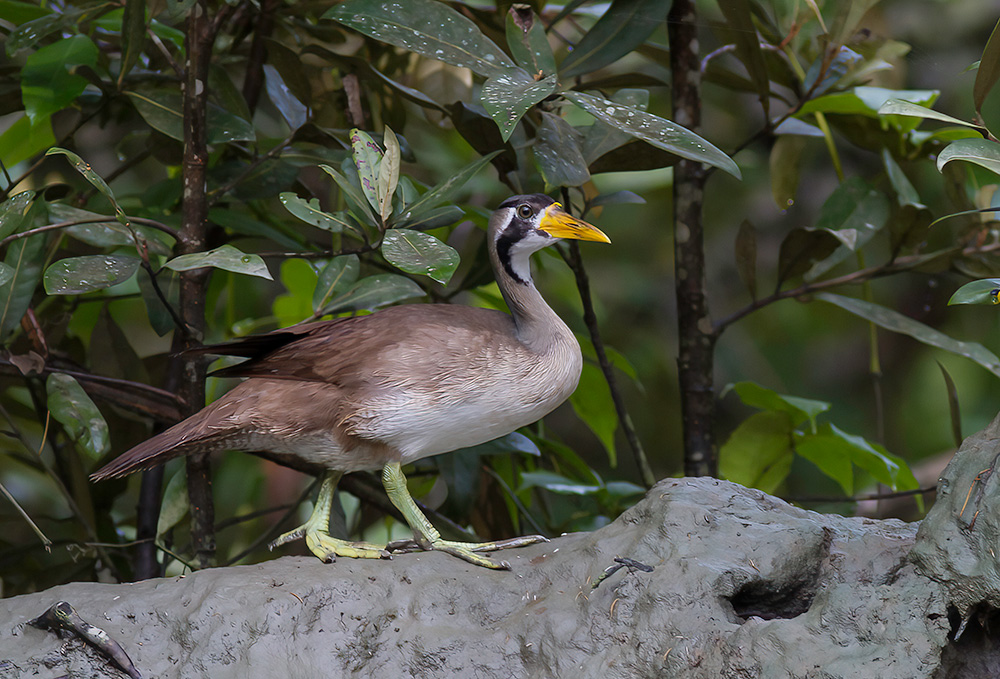
© Sayam U. Chowdhury
The Masked Finfoot (Heliopais personatus) is among Asia’s most poorly known waterbirds. The species is now listed as Critically Endangered due to an extremely small and rapidly declining population, driven by the ongoing loss and degradation of wetlands – particularly riverine lowland forest in tropical Asia. The species was uplisted to Critically Endangered in 2022 on the IUCN Red List. Finfoots represent a small, unique family of pantropical waterbirds (Heliornithidae), with H. personatus being the only representative in Asia.
Once widespread from the Sundarbans in Bangladesh eastward through mainland Southeast Asia to the Thai-Malay Peninsula, the Masked Finfoot is now mostly confined to just two areas: the Sundarbans in Bangladesh, where systematic surveys have been conducted, and the forested wetlands of northern Cambodia. By contrast, the species has become exceedingly rare in Myanmar, Thailand, and Peninsular Malaysia – countries where it was once more frequently observed, indicating a sharp and recent population collapse. In Vietnam and Indonesia, its status appears even more dire, with no confirmed records in over a decade, where targeted field surveys are required to confirm its presence or absence.
Few studies have addressed the ecological requirements of the species, but available evidence indicates that it typically inhabits little-disturbed, lowland forested waterways such as rivers, oxbow lakes, ponds, and mangrove-lined tidal creeks (del Hoyo et al. 1996, BirdLife International 2001, Chowdhury et al. 2017). Field data suggest seasonal dispersive movements; for example, records in Cambodia’s Tonle Sap region peak during the wet season and decline thereafter, pointing to possible wet-season breeding migrations.
As one of the region’s rarest waterbirds, the conservation needs of the Masked Finfoot are urgent. The species also serves as a charismatic flagship for Southeast Asia’s disappearing freshwater wetlands and a sensitive indicator of ecosystem degradation. If successfully conserved, efforts aimed at safeguarding the Masked Finfoot will also support the livelihoods of rural communities that depend on these same forested wetlands for fishing, water, and flood protection.
At the 11th Meeting of Partners of the East Asian–Australasian Flyway Partnership (EAAFP), the dire status of the Masked Finfoot was highlighted. Decision 12 of MOP11 called for immediate conservation and research actions and requested BirdLife International to develop a proposal for a Masked Finfoot Task Force and prioritised workplan, for consideration at MOP12.
Problem statement
As a species largely reliant on undisturbed, lowland freshwater systems including slow-flowing forest creeks and oxbow lakes – the Masked Finfoot is highly vulnerable to a suite of anthropogenic threats. Throughout tropical Asia, such habitats are increasingly fragmented or degraded by human activities including intensive fishing, sand mining, river transport, and pollution. In both Bangladesh and Southeast Asia, the indiscriminate use of fishing gear such as monofilament gillnets has led to accidental mortality.
Concurrently, deforestation along major river corridors for agriculture and settlement continues unabated. In several range states, river damming (e.g. Xe Pian River, Lao PDR) alters natural hydrology, possibly disrupting seasonal water levels critical for feeding and breeding. The use of poisons and nets in riparian fishing also threatens the species directly. Given its tight dependence on undisturbed riparian ecosystems, the Masked Finfoot serves as both a flagship and a bioindicator species for these rapidly collapsing riverine landscapes across Southeast Asia.
Current estimates suggest that no more than 300 mature individuals survive across the species' entire range and possibly fewer. Following its initial uplisting to Endangered in 2009, the species was uplisted again in 2022 to Critically Endangered, primarily due to a collapse of breeding populations, especially in Myanmar, Malaysia, and Thailand, and ongoing habitat degradation.
Despite these trends, the Masked Finfoot has received little targeted conservation investment. This contrasts starkly with other large waterbird species in Asia, such as the Sarus Crane (Antigone antigone), White-winged Duck (Asarcornis scutulata), and Giant and White-shouldered Ibises, which have benefitted from national action plans and international funding.
The EDGE of Existence Programme ranks the Masked Finfoot among its top 50 most evolutionarily distinct and globally endangered species. Despite this, conservation efforts remain minimal.
Goal
To restore the Masked Finfoot Heliopais personatus to a favourable conservation status and down-list it from the threatened categories on the IUCN Red List.
Objectives
Objective (1): Secure all known breeding populations of the Masked Finfoot to prevent further declines and support immediate site-based conservation
Objective (2): Undertake targeted field surveys across key habitats to clarify the current distribution and population status of the species
Objective (3): Reduce direct threats to the species and its nesting habitats at priority sites through local engagement and improved habitat management
Objective (4): Strengthen regional capacity for ecological research, threat assessment, and long-term monitoring to inform evidence-based conservation of the Masked Finfoot
Objective (5): Build public, political and institutional support for the conservation of the Masked Finfoot and the protection of its wetland ecosystems
Objective (6): Assess the feasibility and potential role of ex-situ conservation or captive breeding as a safeguard for the species
Task Force Documents
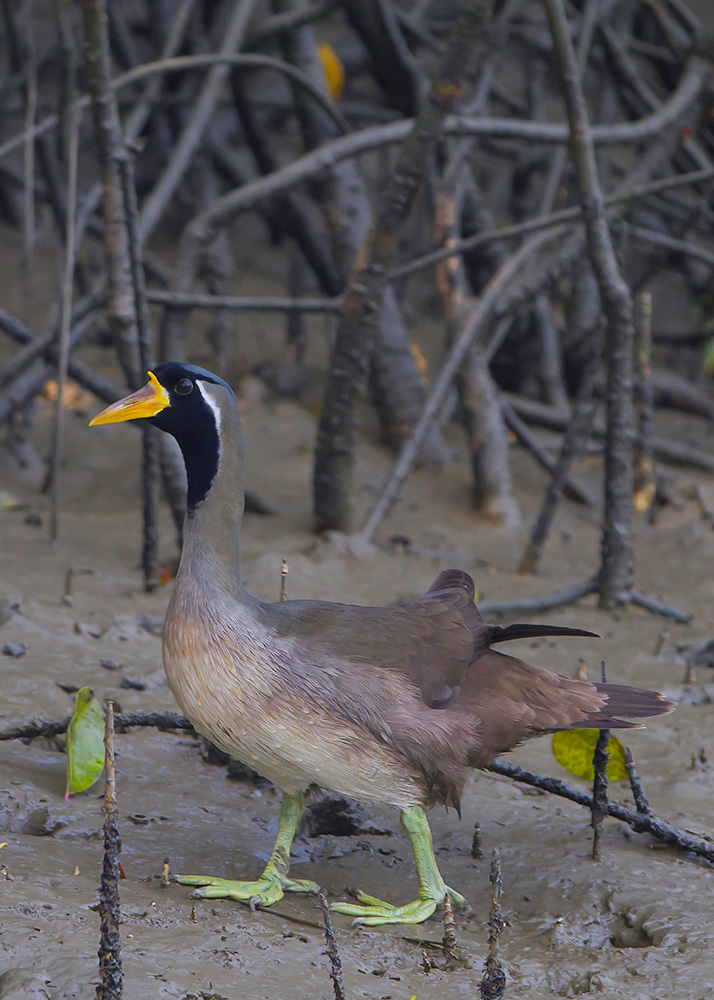
© Sayam U. Chowdhury
Executive committee
 Chairman: Sayam U. Chowdhury (sayam_uc@yahoo.com)
Coordinator: Yong Ding Li (dingli.yong@birdlife.org)
Assistant Coordinator: Paul Insua-Cao
Advisory committee
 Policy Advisor: Taej Mundkur
Scientific Advisor: Rhys Green
Fundraising Advisor: Duncan Lang
Communication Advisor: Vivian Fu
Ongoing Work
Bangladesh: Sundarbans Finfoot Research Project
Key Resources
- The status and distribution of the Masked Finfoot Heliopais personatus—Asia’s next avian extinction?
- Sayam U. Chowdhury, Ding Li Yong, Philip D. Round, Simon Mahood, Robert Tizard, Jonathan Eames
- Observations of the breeding of the Endangered Masked Finfoot Heliopais personatus in the Bangladesh Sundarbans
- Sayam U. Chowdhury, Md. Moniruzzaman, Gertrud Neumann-Denzau, Md. Jahidul Kabir
- Nesting Ecology and Habitat Preference of the Masked Finfoot (Heliopais personatus) in Sundarbans, Bangladesh
- Sayam U. Chowdhury, Gertrud Neumann-Denzau, Sabir Bin Muzaffar
- Status of the Masked Finfoot in Cambodia
- Berry Mulligan, Rours Vann, Sun Visal, Sam Han, Frédéric Goes
- Nests, eggs, hatchlings and behaviour of the Masked Finfoot Heliopais personatus from the Sundarbans in Bangladesh, with first nesting observations
- G. Neumann-Denzau, E. Fahrni Mansur, R. Mansur
- Some recent behavioural observations of Masked Finfoot Heliopais personata (Gray 1849) in Selangor Darul Ehsan, Peninsular Malaysia
- Chris R. Shepherd
- A finfoot from the Late Miocene of Toros Menalla (Chad, Africa): Palaeobiogeographical and palaeoecological implications
- Antoine Louchart, Cécile Mourer-Chauvire, Patrick Vignaud, H. Taisso MacKaye, Michel Brunet
