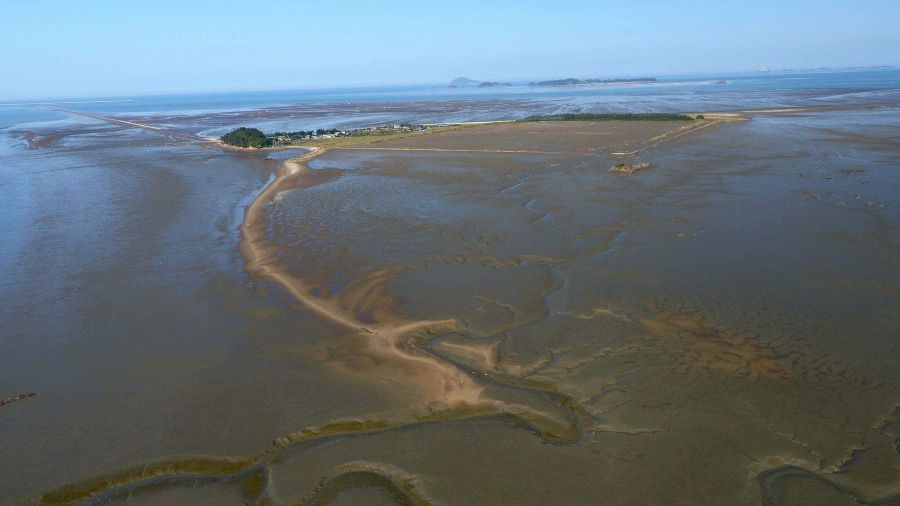
Yubudo-Island Getbol ⓒ Kyung-Nam Go
On 25 July 2026, during the 48th Session of the World Heritage Committee in Busan, Republic of Korea, the Committee approved the extension of the Republic of Korea’s Getbol, Korean Tidal Flats on the UNESCO World Heritage List, marking a significant milestone in safeguarding the Yellow Sea’s critical habitats for millions of migratory waterbirds that rely on the region as an essential stopover along their annual journeys between Australia and New Zealand and breeding grounds in the Arctic.
The inscription of Korea’s Getbol tidal flats strengthens EAAFP’s efforts to promote the conservation of the Yellow Sea as a critical stopover and migration hub for waterbirds along the East Asian–Australasian Flyway.
EAAFP plays an important role in strengthening international cooperation among Flyway countries, particularly by promoting transboundary collaboration between the Republic of Korea, People’s Republic of China and the DPR Korea. The inscription complements China’s Yellow Sea–Bohai Gulf World Heritage site and provides an important foundation for further cooperation to conserve the region’s interconnected coastal wetlands. Through regional dialogues and its Yellow Sea cooperation mechanisms, EAAFP works with governments, site managers, scientists and international organisations to raise awareness and profile of the Yellow Sea, importance of migratory waterbirds habitats, promote coordinated conservation action and management through regional cooperation. These efforts continue to build a stronger foundation for the long-term, coordinated conservation of the Yellow Sea as one interconnected ecosystem.
The inscription therefore represents not only recognition of Korea’s outstanding tidal-flat ecosystems, but also an important step towards long-term, coordinated conservation of the Yellow Sea and the wider East Asian–Australasian Flyway.
In July 2021, the 44th Session of the World Heritage Committee endorsed the inscription of the Republic of Korea’s tidal flats on the UNESCO World Natural Heritage List and recognised the Getbol’s significant biodiversity values to demonstrate Outstanding Universal Value (OUV). As a result, four Korean tidal flat sites, Seocheon Getbol, Gochang Getbol, Shinan Getbol, Boseong-Suncheon Getbol were inscribed on the UNESCO World Heritage Lists as part of the Getbol, Korean Tidal Flats serial property.
 Waders in Seocheon Getbol ⓒ Seocheon County
Following the initial inscription (Phase 1), IUCN encouraged the Republic of Korea to establish a clear, phased approach for future extensions, with the aim of incorporating additional critical habitats along the East Asian–Australasian Flyway (EAAF). It further called for strengthened cooperation with other States Parties, particularly China, to enhance the conservation of shared migratory bird habitats and support potential future transboundary and serial World Heritage nominations.
In July 2026, following the recommendations made in 2021, the Getbol, Korean Tidal Flats property has been expanded to include six serial components, incorporating adjacent tidal flat areas to create a more connected and representative conservation network.
The Boseong–Suncheon Tidal Flats have been expanded to include Yeosu and Goheung tidal flats, becoming the Boseong–Suncheon–Yeosu–Goheung Tidal Flats. The Shinan Tidal Flats have been extended to include Muan Tando Bay and are now known as the Shinan–Muan Tando Bay Tidal Flats. The Muan Hamhae Bay Tidal Flats and the Seosan Tidal Flats in Garolim Bay have been newly added as independent component parts. The newly added World Heritage areas cover approximately 27,975 hectares, with associated buffer zones covering 24,795 hectares.
The expanded property supports exceptional biodiversity, with 2,446 species recorded across the Getbol areas. Among the 216 bird species identified, 114 are waterbird species, including 24 globally threatened species, such as the Spoon-billed Sandpiper. In addition, 53 tidal flat fauna species are endemic to the Yellow Sea, further demonstrating the site’s global conservation importance.
At the plenary session, the World Heritage Committee recognised the expanded Getbol, Korean Tidal Flats for its outstanding contribution to conserving the Yellow Sea’s biodiversity and its role as a critical habitat for threatened and endemic species. The property was particularly recognised for its importance as a key site along the EAAF, supporting a wide range of migratory species.
Speaking at the session, Mr Min Huh, Administrator of the Korea Heritage Service, stated: “Getbol provides essential habitats for endangered migratory birds and sustains exceptional biodiversity. This inscription reflects the Republic of Korea’s unwavering commitment to conservation and our shared responsibility to protect this heritage. Getbol does not belong to Korea alone; it is a shared heritage of all humanity. We will continue our efforts to safeguard its Outstanding Universal Value, promote harmonious coexistence with local communities, and pass this precious heritage on to future generations.”
 Mr Su-Hyun Park, Governor of Chungcheongnam-do Province at the Plenary Session ⓒ EAAFP
Mr Su-Hyun Park, Governor of Chungcheongnam-do Province and representative for the management of Korean Tidal Flats, added: “This marks the beginning of our collective responsibility to conserve this outstanding heritage and ensure that it is passed on, intact, to future generations.”
 Ms Jennifer George, Chief Executive of the EAAFP Secretariat during the intervention at the Plenary Session ⓒ EAAFP
Ms Jennifer George, Chief Executive of the East Asia–Australasian Flyway Partnership (EAAFP), highlighted the global importance of the Yellow Sea during her intervention, stating: “At the heart of this Flyway lies the Yellow Sea, one of the world’s largest and most productive tidal flat ecosystems. The Korean Getbol provides irreplaceable feeding and resting habitats for millions of migratory waterbirds, including globally threatened species listed on the IUCN Red List. It also supports exceptional biodiversity, local livelihoods, and the enduring relationship between people and nature. Its conservation therefore reflects the fundamental values of the World Heritage Convention. As the People’s Republic of China, the Democratic People’s Republic of Korea, and the Republic of Korea are all EAAFP Partners, we invite all three countries to strengthen cooperation in safeguarding the Yellow Sea as a shared natural heritage—not only for people today, but also for future generations.”
 Mr Myung Ho of the Eco-Horizon Institute during the intervention at the Plenary Session ⓒ EAAFP
Mr Myung Ho of the Eco-Horizon Institute represented Korean environmental NGOs and highlighted ongoing pressures facing the World Heritage property, Getbol, Korean Tidal Flats. During his intervention, he stated: “In light of Decision 44 COM 8B.6, further extensions should include urgent areas such as Ganghwa, Incheon, Hwaseong, Saemangeum, the Nakdong River estuary area, and other marine protected areas. We kindly call for rigorous assessments of development projects around the Getbol, Korean Tidal Flats property. Current projects within and near the Phase I and Phase II sites, as well as their buffer zones, may negatively affect their Outstanding Universal Value (OUV). These include offshore wind farm developments, bridge construction within Phase I areas, and a new airport project near the inscribed sites.”
Mr Tim Badman, Director of World Heritage at IUCN, welcomed the progress made and encouraged continued efforts. He noted that IUCN strongly supports the implementation of World Heritage Committee Decision 44 COM 8.6 and further extensions where additional areas demonstrate complementary value and where local support has been secured. He expressed hope that this new phase would contribute towards creating a more complete and inclusive serial property through future additions.
 Local governments at the Planery Session ⓒ EAAFP
The EAAFP also participated in the seminar Flying Beyond Borders: Conserving the Yellow Sea Tidal Flats through Transboundary Cooperation, held on 25 July. Co-hosted by UNESCO, the World Heritage Promotion Team for Korean Tidal Flats, the World Coastal Forum Coordination Group (WCF), and the Yancheng Wetland and Natural World Heritage Conservation and Management Center (Yancheng Heritage Center), the seminar highlighted the importance of transboundary cooperation in conserving the Yellow Sea’s tidal flats and the migratory waterbirds that depend on them.
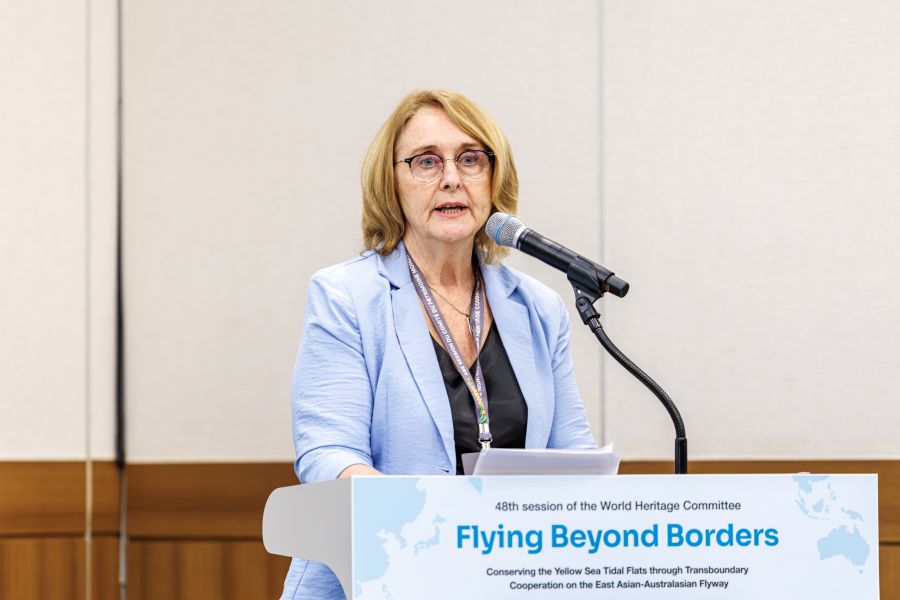
Ms Jennifer George at the seminar “Flying Beyond Borders: Conserving the Yellow Sea Tidal Flats through Transboundary Cooperation”
ⓒ World Heritage Promotion Team of Korean Tidal Flats
EAAFP Chief Executive Jennifer George delivered a presentation on The Yellow Sea Resolution: A Milestone for Flyway-Wide Tidal Flat Protection, highlighting World Heritage recognition as a shared responsibility and an opportunity to strengthen partnerships and conservation action across the East Asian–Australasian Flyway.
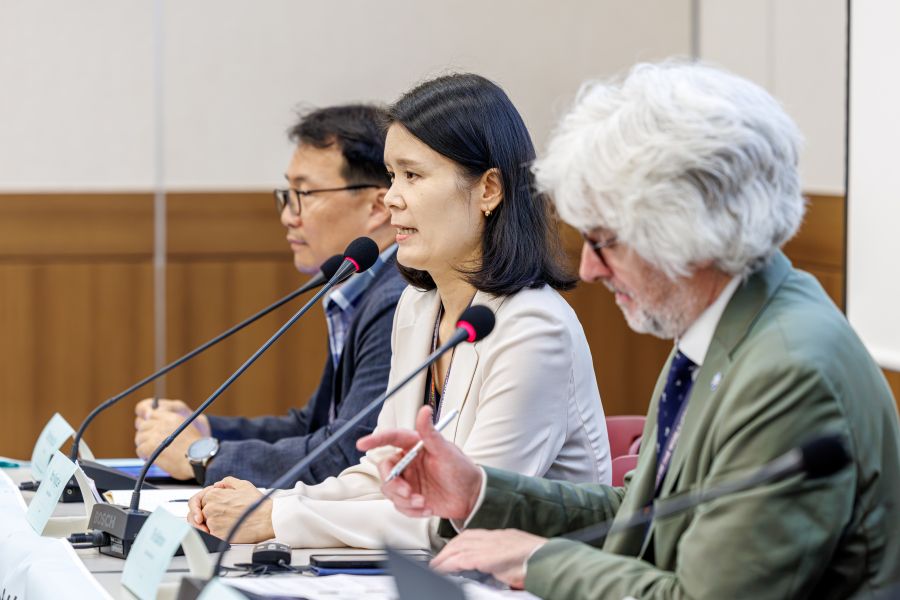 Ms Yoon Lee at the seminar “Flying Beyond Borders: Conserving the Yellow Sea Tidal Flats through Transboundary Cooperation”
ⓒ World Heritage Promotion Team of Korean Tidal Flats
The seminar brought together representatives and experts from across the region to exchange perspectives on the conservation of Yellow Sea coastal wetlands. The panel discussion, chaired by Tim Badman, Director of World Heritage at IUCN, highlighted the need for stronger cooperation among the Republic of Korea, China and the Democratic People’s Republic of Korea, alongside science-based research and greater synergies among UNESCO, EAAFP and the Convention on Wetlands.
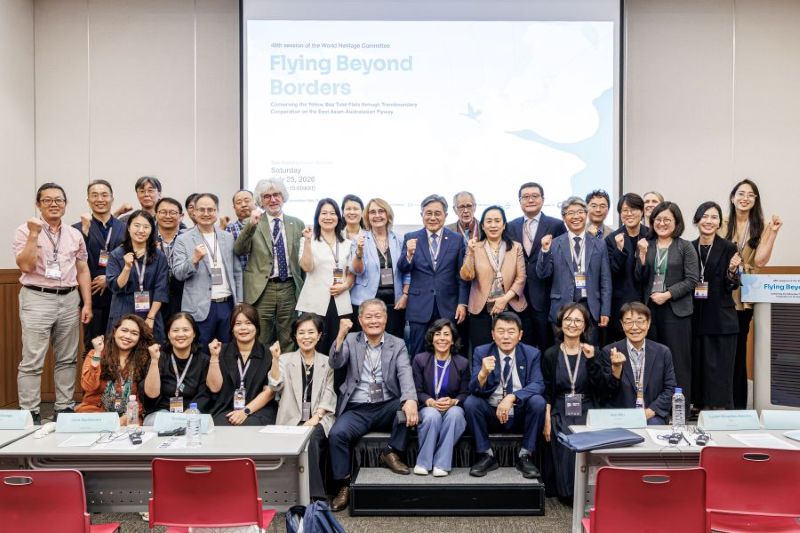 Group photo from the seminar “Flying Beyond Borders: Conserving the Yellow Sea Tidal Flats through Transboundary Cooperation”
ⓒ World Heritage Promotion Team of Korean Tidal Flats
The seminar concluded with the announcement of the Busan Statement on Cooperation for the Conservation of the Tidal Flats and Coastal Wetlands of the Yellow Sea, a voluntary, non-binding framework to promote knowledge exchange and collaboration in safeguarding the Yellow Sea’s tidal flats, coastal wetlands and migratory waterbirds.
On 27 July 2026, the seminar “Integrated Conservation and Management of the Getbol, Korean Tidal Flats World Heritage: Experiences and Future Directions” was hosted by Ministry of Ocean and Fisheries, and organised by Korea Marine Environment Corporation (KOEM).
The seminar brought together national and international experts to share experiences, achievements, and future directions for the conservation of this globally important World Heritage site.
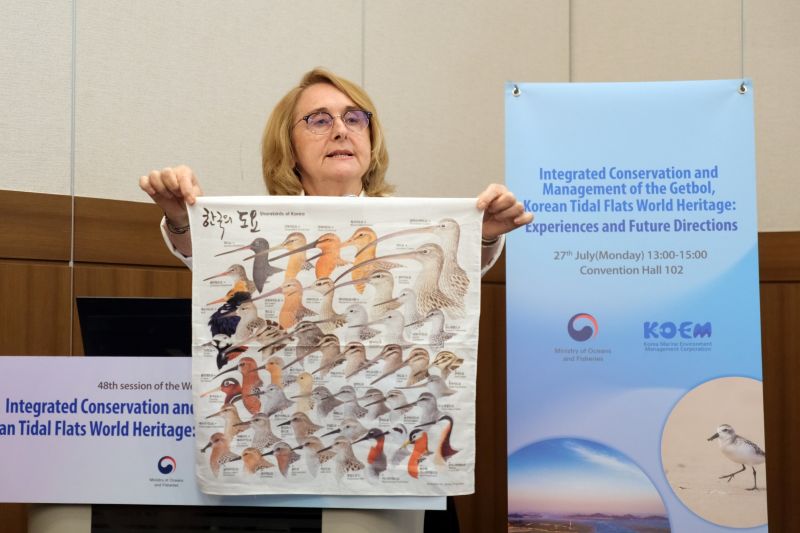
Ms Jennifer George at the seminar “Integrated Conservation and Management of the Getbol, Korean Tidal Flats World Heritage: Experiences and Future Directions”
ⓒ Young-Nam Kim
Opening remarks were delivered by Ms Jennifer George, Chief Executive of EAAFP, who emphasised the importance of collective action, stating “It takes us from recognition to responsibility. To sharing experience, strengthening dialogue and creating approaches to conservation and management that reflect the unique ecological and human character of this region.”
The programme featured presentations by Dr Young Nam Kim (KOEM) on the conservation and management system for Getbol, Korean Tidal Flats World Heritage, Professor Chang-Yong Choi (Seoul National University) on key results from Outstanding Universal Value (OUV) monitoring in the Republic of Korea and Mr Young-Jin Jeong (Gochang Ramsar Getbol Center) on sustainable World Heritage tourism and CEPA activities.
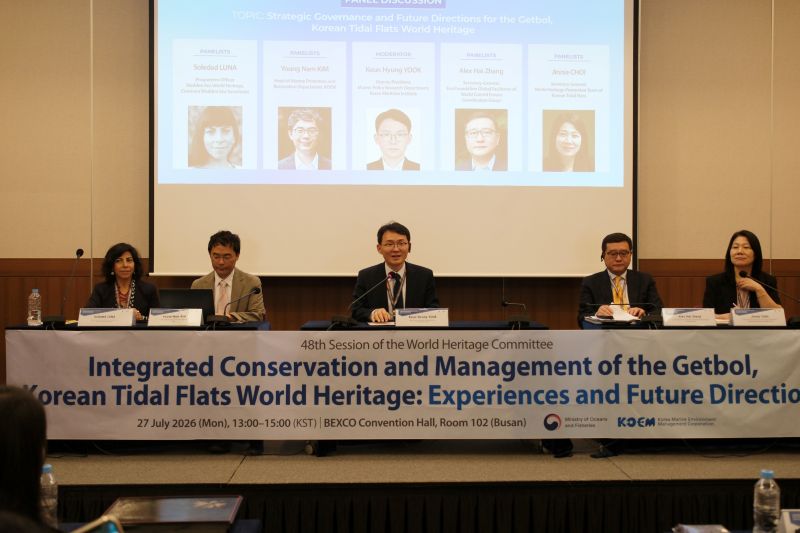 Panel discussion at the seminar “Integrated Conservation and Management of the Getbol, Korean Tidal Flats World Heritage: Experiences and Future Directions”
ⓒ Young-Nam Kim
A panel discussion on strategic governance and future directions for Getbol, Korean Tidal Flats World Heritage brought together experts from Korea and the international conservation community, including representatives from the Ministry of Oceans and Fisheries Korea, the Wadden Sea World Heritage, Eco Foundation Global, and the World Heritage Promotion Team of Korean Tidal Flats.
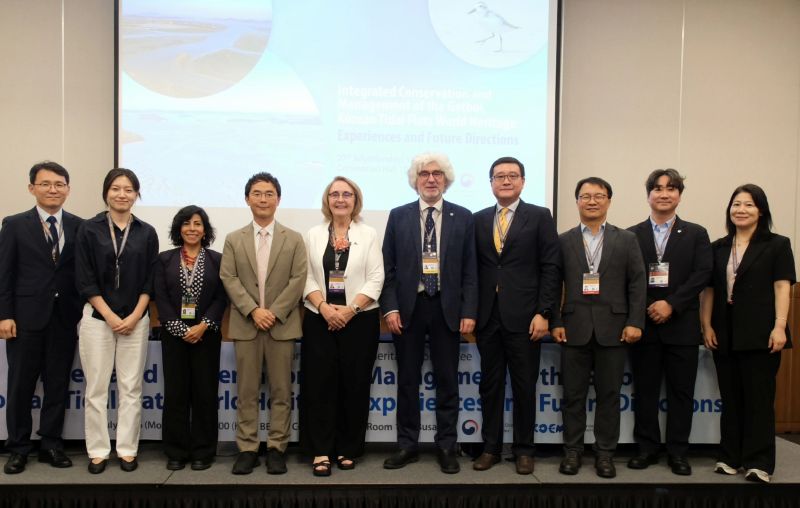
Group photo from the seminar “Integrated Conservation and Management of the Getbol, Korean Tidal Flats World Heritage: Experiences and Future Directions”
ⓒ Young-Nam Kim
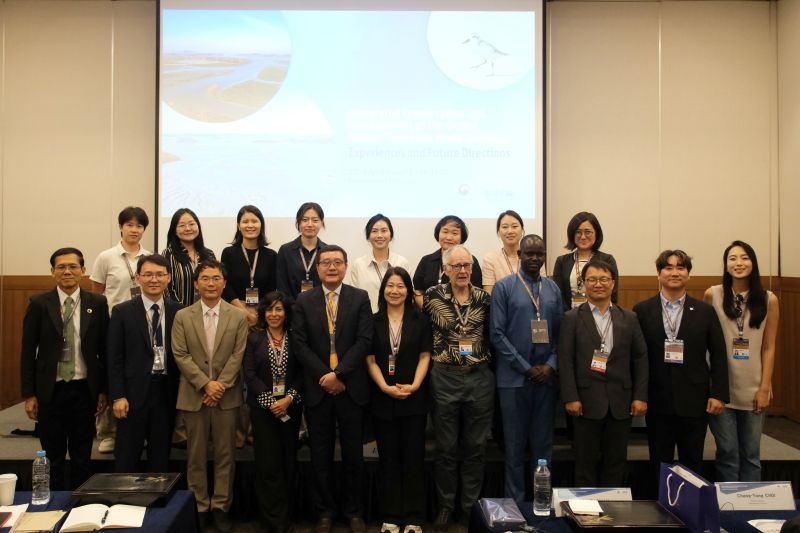 Group photo from the seminar “Integrated Conservation and Management of the Getbol, Korean Tidal Flats World Heritage: Experiences and Future Directions”
ⓒ Young-Nam Kim
The seminar concluded with a shared message that, through knowledge exchange and international cooperation, we can strengthen the long-term conservation and sustainable management of World Heritage tidal flat ecosystems.
The World Heritage Committee also encouraged the Republic of Korea to strengthen cooperation with other States Parties to enhance the conservation of the Yellow Sea ecosystem and the EAAF. Later that day, the Busan Statement on Cooperation for the Conservation of the Tidal Flats and Coastal Wetlands of the Yellow Sea was announced at a side event, reaffirming a shared commitment to transboundary cooperation for the protection of these internationally important ecosystems.
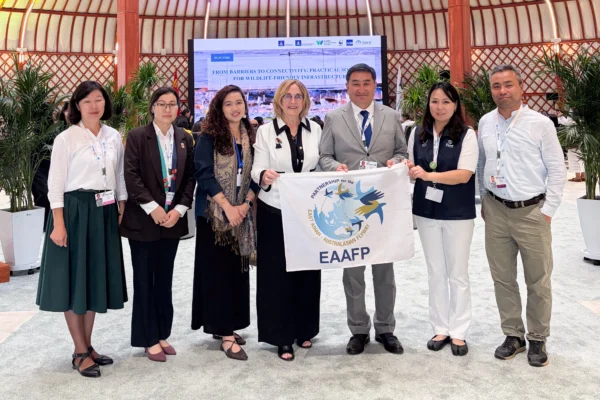
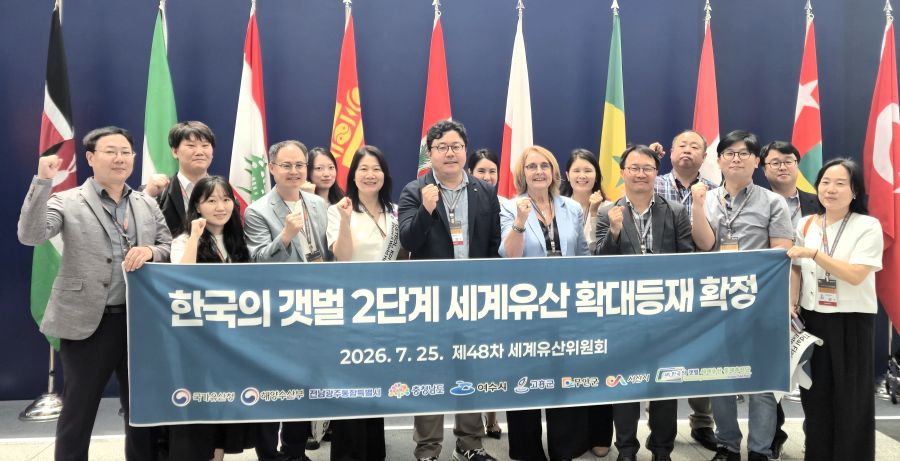 ⓒ EAAFP
Article on the first inscription: “Getbol, Korean Tidal Flats” inscribed on UNESCO World Heritage List”
2021, Advisory Body Evaluation (IUCN): https://whc.unesco.org/document/189222
UNESCO World Heritage Getbol, Korean Tidal Flats: https://whc.unesco.org/en/list/1591
Busan Statement: http://eaaflyway.org/wp-content/uploads/2026/07/Busan_Statement_Yellow-Sea-Side-Event_Final.pdf
Nominations to the World Heritage List (WHC/26/48.COM/8B): https://whc.unesco.org/document/226095
Local news reports: https://www.youtube.com/watch?v=oJkpwki11vw
Watch the plenary [2:05:34-2:18:28]: https://youtu.be/BZMMhHmRuII?si=UPR9pT2_WLEhSpMi