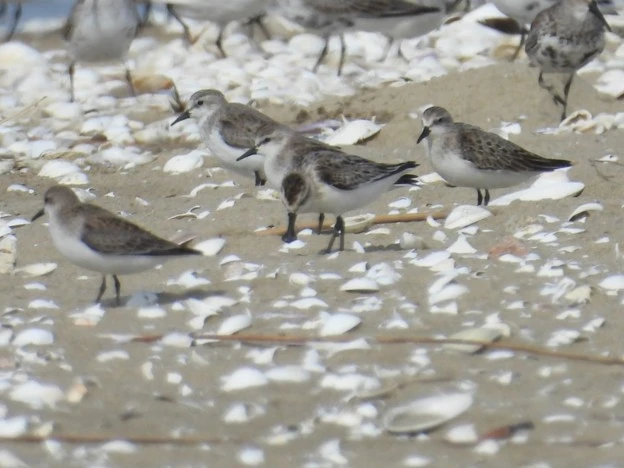
Ⓒ Hyun-Min Lee
From 27 September to 2 October 2026, the EAAFP Spoon-billed Sandpiper Task Force conducted a field survey on Yubu-do Island, Seocheon-gun, Republic of Korea, to monitor the Critically Endangered Spoon-billed Sandpiper and strengthen understanding of the island’s importance as a key stopover site for migratory waterbirds along the East Asian–Australasian Flyway (EAAF). The survey was supported by the Hanns Seidel Foundation, a partner of the East Asian–Australasian Flyway Partnership (EAAFP), and the Royal Society for the Protection of Birds (RSPB) and carried out in collaboration with Korean researchers and conservation specialists from Seoul National University, Kyunghee University, Incheon National University, and Meet Green Institute.
The survey site, Yubu-do and Seocheon Tidal Flats, located on Korea’s western coast, are important habitats for threatened migratory waterbirds, including Eurasian Oystercatchers. Designated as Wetland Protected Areas in 2007 and 2008, these tidal flats have experienced significant changes in sedimentation and geomorphology following the construction of the Geum River and Saemangeum barrages. Bird surveys recorded approximately 150,000 individuals of 98 species between 2000 and 2003, and around 500,000 individuals of 69 species between 2008 and 2009. The area’s ecological importance is further demonstrated by its rich biodiversity, including 95 species of large benthic animals and 125 species of fish and other marine life.
The survey aimed to assess the global population of the Critically Endangered Spoon-billed Sandpiper and to better understand the importance of Yubu Island as a key stopover site along the East Asian–Australasian Flyway for migratory waterbirds.
During the survey, researchers conducted scan-sampling surveys at both high and low tides, surveying the proportion of juvenile and adult Spoon-billed Sandpipers. They also observed colour-marked Far Eastern Curlews, Spoon-billed Sandpipers, Great Knot and Black-faced Spoonbill, providing valuable records to improve understanding of their migratory movements. Resighting records confirmed that two Far Eastern Curlew marked from wintering ground in Sarawak, Malaysia, a juvenile Great Knot marked in Kamchatka, Russia, and one Black-faced Spoon-bill marked in wintering ground in Taiwan. The team also observed Spoon-billed Sandpiper carrying legflag ‘ White 1H’, a head-started bird born in 2016 in Meinypil’gyno, Chukotka, Russia which had been regularly recorded stopping over at Yubu Island during autumn migration. This remarkable record highlights the site fidelity of individual shorebird and the importance of long-term monitoring in understanding the movements and survival of migratory birds.
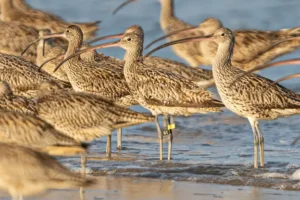
Ⓒ Ki-Chan Ryu
The survey on Yubu Island also strengthened cooperation between Korean and international experts, providing an opportunity to exchange field knowledge and technical expertise. Continued collaboration in research, monitoring and information sharing is essential for addressing the conservation challenges faced by the Critically Endangered Spoon-billed Sandpipers and other shorebirds across their migratory range, where the protection of important habitats requires coordinated efforts across national borders.
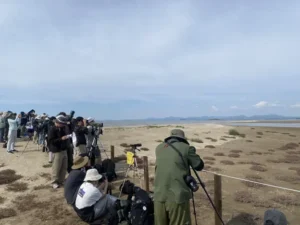
In addition to the survey, the team observed birdwatching etiquette signage and a newly installed fence at the northern observation point on Yubu Island.
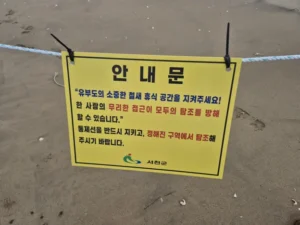
The recommendation for the signage and fence was originally made by the late Professor Hankyu Kim of Kyung Hee University, who supported and participated in the EAAFP Spoon-billed Sandpiper Task Force’s pilot survey on Yubu Island last year. During the pilot survey, researchers observed small shorebirds flying around for over an hour at high tide without landing due to presence of human at their limited roosting space. Such situation is not ideal for the birds during their critical stopover when they need to rest and conserve energy for their onward migration.
Following the recommendation from the late Professor Kim, EAAFP conveyed the proposal to Seocheon County, which responded proactively by installing the fence. The fence keeps visitors at a reasonable distance from the roosting shorebirds during high tide, so that there are room available for birds to land at the roost. Hence, visitors were able to observe the birds and photograph them at a reasonable distance, a win-win for both the birds and people..This collaborative effort represents a practical step towards protecting migratory shorebirds and providing them with a safer place to rest and refuel during the migration season.
Looking ahead, the EAAFP Spoon-billed Sandpiper Task Force will continue working with partners and researchers to advance conservation measures in line with the Spoon-billed Sandpiper Action Plan 2025–2035. Through sustained scientific research and international cooperation, the Task Force aims to improve understanding of the species’ needs and support the protection of the habitats on which it depends throughout its remarkable migratory journey.

Site Information Sheet – Yubu-do Tidal Flat [EAAF101]: https://eaaflyway.org/wp-content/uploads/2017/12/sis-rok-eaaf101.pdf