World Wetlands Day Event in Bago Region
Author: Thaw Phyoe Shwe, Program Manager (Education and Livelihood Development)
Biodiversity And Nature Conservation Association (BANCA)
The Gulf of Mottama is located in the southern part of Myanmar, bordering Mon State, Bago Region, and Yangon Region. It covers an area of over 400,000 acres and is an estuary of the Sittaung River. Due to the continuous deposition of sediment, it has become a place rich in alluvial soil.
The tiny creatures that live and breed in the silt deposits provide a complete food chain for birds and aquatic animals in the area. The Gulf of Mottama has received international recognition as Ramsar Site (ID 2299) under the Convention on Wetlands of International Importance and designated as Flyway Network Site (EAAF-117) by the East Asian-Australasian Flyway Partnership.
Even before it was recognized as Myanmar’s 4th Ramsar site, BANCA has been actively involved in conservation efforts. BANCA has been working to conserve the Spoon-billed Sandpiper and other migratory shore bird species since 2008. Along with annual bird surveys, it has worked to meet the needs of the local community and ensure successful conservation.
This area is home to abundant invertebrates, important nursery areas for marine fish, and up to 150,000 migratory waterbirds in the non-breeding season, including Critically Endangered Spoon-billed Sandpiper Calidris pygmaea, with fewer than 400 individuals remaining in the world. Approximately half of the global population migrates annually to the Gulf of Mottama. The site is also vital for other key species of East Asian-Australasian Flyway (EAAF), includes Great Knot Calidris tenuirostris (EN), and Spotted Greenshank Tringa guttifer (EN), Bar-tailed Godwit Limosa lapponica, Curlew Sandpiper Calidris ferruginea, Asian Dowitcher Limnodromus semipalmatus, Eurasian Curlew Numenius arquata, Black-tailed Godwit Limosa limosa. Additionally, the Gulf supports the livelihoods of thousands of people through fisheries, important at local, national and regional level.
Since 2013, local conservation groups have been formed to conserve, patrol, monitor, educate, and provide technical support to important species in the region.
During the period of providing high-performance training to local conservation groups and organizing awareness days, and awareness has been further enhanced among the public. With the participation of the public, conservation activities have been further improved.
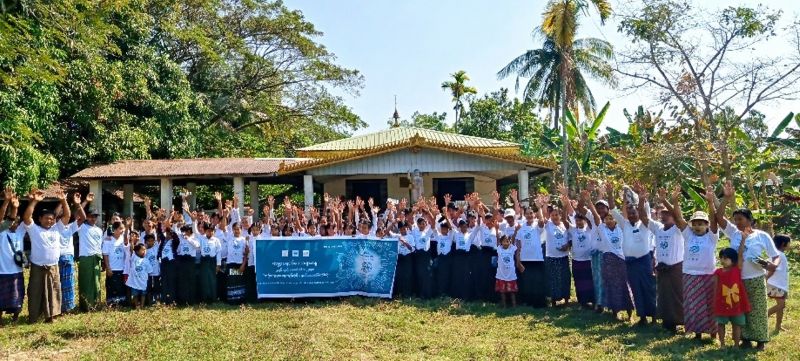
A total of 427 participants took part in the awareness events and capacity-building training activities organized under the project, reflecting strong community involvement across Mon State and Bago Region. Participants included village authorities, students, women, youth, and members of Local Conservation Groups, highlighting broad stakeholder engagement in wetland and migratory bird conservation efforts. Notably, women accounted for 62% of total participants, while youth participation reached an impressive 73%, demonstrating the project’s success in promoting inclusive community engagement and empowering key local groups to play active roles in long-term conservation initiatives.
By providing continuous training and organizing events for local people, we create a sense of unity in the conservation work. Now, with the help of East Asian-Australasian Flyway Partnership (EAAFP), we have been able to successfully conduct capacity building training courses and events.
 Capacity building of Biodiversity Conservation training in village
 Sharing the discussion with team in capacity building training
 World Wetlands Day event at school in Mon state
 Group photo with trainers and trainees
 Game Activity within training
We faced many challenges in conservation of the Gulf of Mottama. These are having not enough trainees because some peoples were moving to other places. Furthermore, political issues are also one of the big challenges in this area. Some locals are unable to attend the training because it coincides with their work schedule. Local Peoples were afraid due to inspections between the village and the training site. The rising of commodity prices and travel costs are also one of the challenges.
Promote the involvement of enthusiastic young people in conservation and provide updated training to support local conservation efforts that can contribute to the achievement of the sustainable conservation practices in the Gulf. Offer additional trainings, and provide necessary field equipment to established LCGs for effective long-term conservation efforts. Invite other wetland areas to learn from each other through exchange visit program.