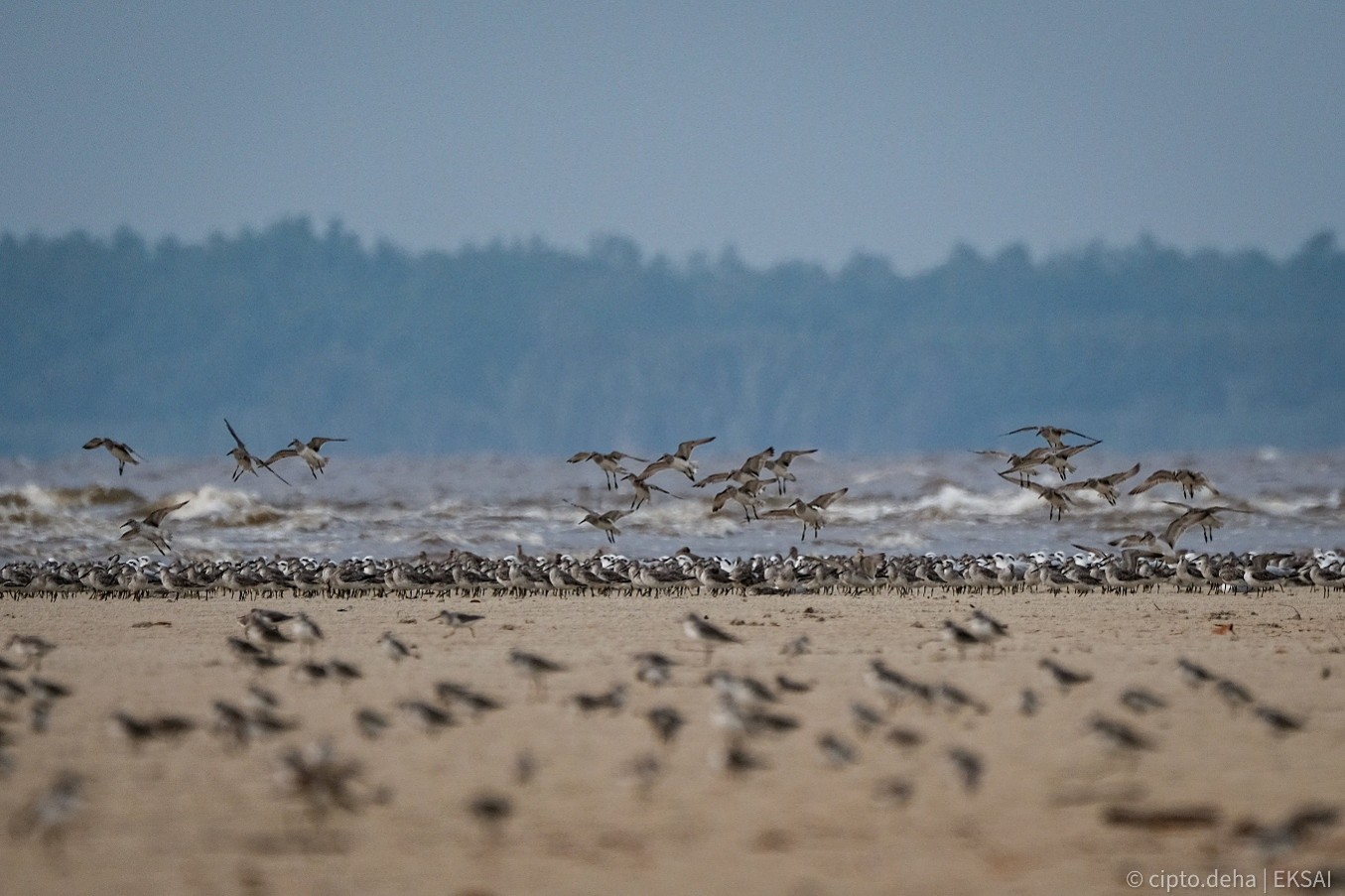
A flock of shorebirds roosting along the quiet mudflats of Cemeti Beach, Central Kalimantan — a newly documented haven for migratory birds along the East Asian–Australasian Flyway
ⓒ Ragil S. Rihadini
Author: Ragil S. Rihadini (EKSAI Foundation)
Report: Link
Tucked away on the quiet coast of Central Kalimantan, Cemeti Beach had long remained undocumented in bird migration records—until a recent project uncovered its surprising importance. From May to December 2024, the EKSAI Foundation, with support from the EAAFP Small Grant Fund, conducted a series of bird surveys and community outreach efforts that placed Cemeti on the map as a potential key site for migratory shorebirds along the East Asian–Australasian Flyway (EAAF).
Field surveys recorded 25 species of migratory shorebirds using the mudflats and coastal habitats of Cemeti Beach. Among them was the globally Endangered Far Eastern Curlew (Numenius madagascariensis), with up to 71 individuals counted during peak migration. Although this does not meet the 1% population threshold required for Flyway Network Site (FNS) designation, it remains one of the highest counts ever recorded for this species in Kalimantan. Other regionally important species included the Bar-tailed Godwit (Limosa lapponica) and Pacific Golden Plover (Pluvialis fulva).
Why does this matter? Because there is still very little known about migration sites in Borneo, and sites like Cemeti may be filling critical gaps in the flyway. Research shows that the loss of intertidal habitats in East Asia has driven major declines in migratory bird populations (Studds et al., 2017). Identifying lesser-known stopover sites—especially those used by threatened species—is now more important than ever.
Beyond the scientific surveys, the project focused heavily on working with local communities. Informal education sessions were held in Satiruk Village, where residents learned about the global journeys of shorebirds and the vital role Cemeti Beach plays in their survival. The discussions also addressed threats such as hunting and disturbance, building awareness and pride in local conservation efforts.
To support this, the team provided binoculars, a spotting scope, and bird guidebooks in Bahasa Indonesia. Illustrated posters, bird ID sheets, and a locally developed booklet were also distributed to community spaces. Community members were trained in basic birdwatching techniques, laying the foundation for future citizen science and stewardship.
This effort was made possible through strong local partnerships. PT Rimba Makmur Utama (RMU), a peatland restoration company active in the area, joined field activities and helped integrate bird conservation into their broader environmental programs. As more sites like Cemeti are discovered and protected, the Flyway gains stronger support—from both science and community.