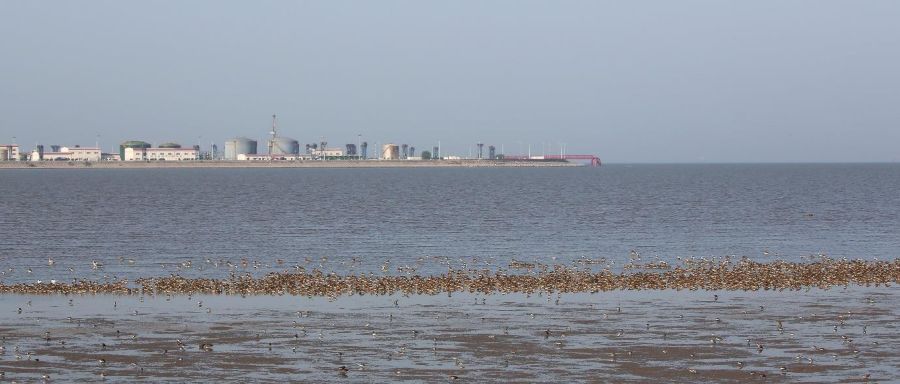
A typical morning view (and a typical image for an update!) 10-05-2026 ⓒ C. Hassell
Katherine Leung and Chris Hassell
15-05-2026
And so, here we are again. Global Flyway Network’s (GFN) 20th visit (2007–2026) to the bird-rich Luannan Coast. Where we concentrate our work on the ‘Nanpu mudflat’. And GFN’s 18th consecutive year (2009–2026).
We would like to start off by thanking three private donors and the UK-based shorebird conservation charity Wader Quest for their generous donations to our efforts for 2026. And, as ever, Professor Zhang and Dr Lei of Beijing Normal University for facilitating our trip.
We are lucky to have the services of Liu Yang and Mr. Liu as our local colleagues. They are a joy to have on the team and have been with us since 2016.
This year we have started scanning a little later than in recent years. This is to hopefully capture Red Knots that seem to come here in the ‘second peak’ around 21 May. It is a balancing act. Starting later means we might miss a few marked birds that pass through early but that will hopefully be offset by resightings some marked birds that are late migrants.
As ever, our efforts are concentrated on the birds on the Nanpu mudflat as we traverse the Nanpu seawall. And while the Red Knots from GFN’s marking study remain the focus of our attention not a single marked bird goes past our telescope without being recorded. And at the end of the season those records are sent to the banders along the EAAF (and CAF) to enhance their studies.
On May 11, we recorded Red Knot 1LLBL a bird now in its 21st year of life having been marked as a male in his second year of life on 12-08-2007. This is the 9th year we have recorded him here.
 A busy scanner 09-05-2026 ⓒ C. Hassell
The tides, and weather were good for us for the first 3 days, slow outgoing tides early in the morning give us good light and keep the birds close to the seawall for our scanning efforts. But as the tides have got smaller and alter in the morning life for a scanner isn’t as much fun. Distant birds and poor light. Plus, on one early morning thick fog, meaning sitting in the van and drinking coffee had to take precedence, plus watching a few nice passerines along the seawall.
Day 2 of our trip was the eBird Big Day and so a very long day commenced at 5 AM and concluded at 7 PM. The truth being that the older member of the team didn’t manage the last 2 hours! The day’s birding didn’t feel as ‘good’ as last year, but we finished only 4 species down on last year’s total ending the day on 104.
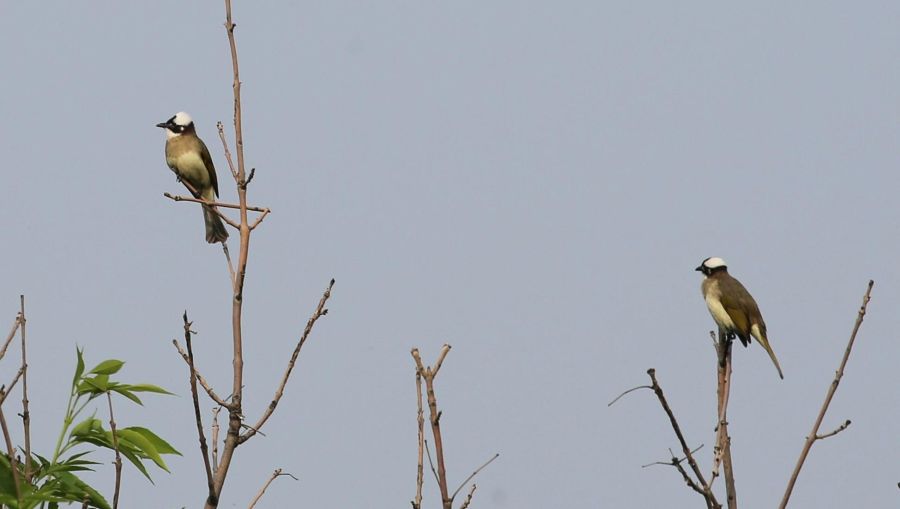 Chinese Bulbuls are a common resident and abundant migrant. Often, we see 200 or more migrating along the seawall per scanning session 13-05-2026 ⓒ C. Hassell
Passerine migration has been relatively quiet but of note have been Yellow-breasted Bunting, Purple-backed Starling. And, while not unusual, stunning birds like Chestnut Bunting and Rufous-bellied Woodpecker.
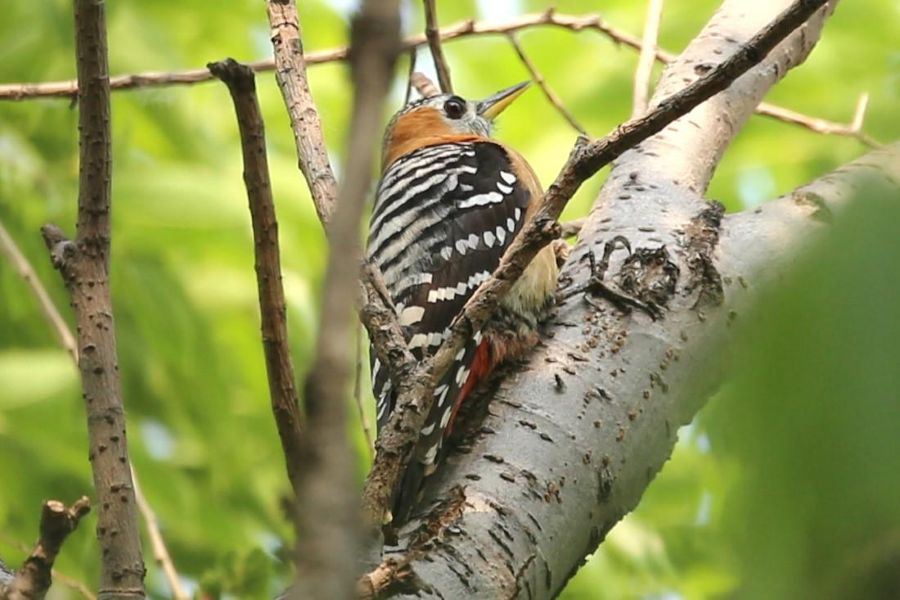 Rufous-bellied Woodpecker (female) 13-05-2026 ⓒ C. Hassell
 Hair-crested Drongo 13-05-2026 ⓒ C. Hassell
Here is a chatty update from GFN. A more formal report will be produced at the conclusion of the field work season.