Updates of Avian Influenza situation by FAO/EMPRES-AH (March 2025 – June 2025)
Disclaimer: The boundaries and names shown and the designations used on these map(s) do not imply the expression of any opinion whatsoever on the part of FAO concerning the legal status of any country, territory, city or area or of its authorities, or concerning the delimitation of its frontiers and boundaries. Dashed lines on maps represent approximate border lines for which there may not yet be full agreement. Dotted line represents approximately the Line of Control in Jammu and Kashmir agreed upon by India and Pakistan. The final status of Jammu and Kashmir has not yet been agreed upon by the parties.
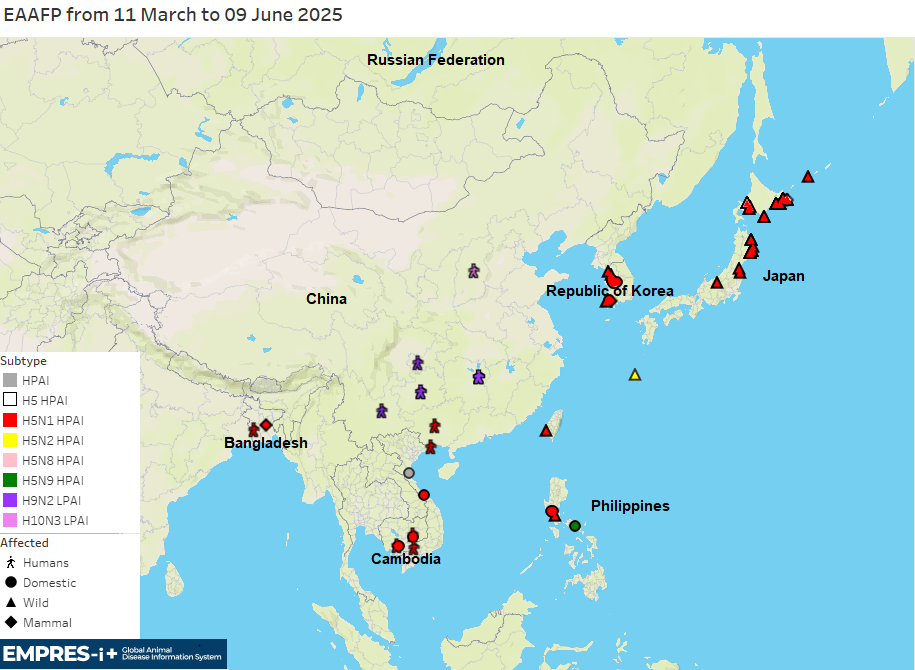
Source: United Nations Geospatial. 2020. Map of the World. [Cited May 2025]. Modified with Emergency Prevention System Global Animal Disease Information System (EMPRES-i), the World Organisation for Animal Health (WOAH) and National Authorities data, 2025.
FAO/EMPRES-AH is constantly monitoring the avian influenza situation worldwide and compiles information from multiple national and international sources as well as peer-reviewed scientific articles. Close collaboration with country and regional offices, the implementation of avian influenza field surveillance projects, and networks of expertise like WOAH/FAO’s OFFLU (www.offlu.org) provide access to timely information on outbreaks, surveillance findings, and genetic similarities of circulating viruses or their virologic features. This information is stored in the EMPRES Global Animal Disease Information System (EMPRES-i+), a database that can be accessed online at https://empres-i.apps.fao.org/.
During the period from 11 March to 9 June 2025, at least three high pathogenicity avian influenza (HPAI) virus subtypes (H5N1, H5N2, H5N9) and two low pathogenicity avian influenza (LPAI) virus subtypes (H9N2, H10N3) have been reported in East and Southeast Asia. H5Nx HPAI viruses continue to circulate in Asia and are well established in certain areas of the region.
During this period, Cambodia reported three H5N1 HPAI outbreaks in domestic birds in Kampong Speu(2) and Kratie (1) provinces.
China reported a single H5N1 HPAI virus detection in a wild Black-faced Spoonbill (Platalea Minor) in Tainan City, Taiwan Province.
In Japan, unlike the last reporting period, no HPAI outbreaks were reported in domestic birds, however, the virus was still circulating and being detected in wildlife, with a total of 96 HPAI events reported across 5 prefectures. Of these, 86 H5N1 HPAI and 7 H5 HPAI were reported in wild birds with 37 detections in Large-billed Crow (Corvus Macrorhynchos). During April through mid-May, H5N1 HPAI infection was reported for the first time in Ancient murrelet (Synthliboramphus antiquus), Arctic Loon (Gavia arctica), Crested auklet (Aethia cristatella), Rhinoceros auklet (Cerorhinca monocerata), Spectacled guillemot (Cepphus carbo) in eastern Hokkaido. Additionally, the H5N1 virus was detected in at least three marine mammals, including Harbor Seals (Phoca vitulina) and Sea otters (Enhydra lutris), marking the first recorded occurrence of the virus in these species in Japan. These viruses are closely related to the H5N1 HPAI virus strain isolated from Crested auklets in the Okhotsk Sea in Russian Federation in March 2025 [reference].
The Philippines reported at least three H5N1 HPAI outbreaks in domestic birds in Central Luzon Region along with H5N1 virus detections in two wild birds (unspecified) in National Capital Region. Furthermore, H5N9 HPAI was reported for the first time ever in a domestic duck farm in Bicol Region.
The Republic of Korea reported 11 outbreaks of H5N1 HPAI in poultry farms, including chicken and duck farms, across four provinces and municipalities. Additionally, six H5N1 HPAI cases occurred in wild birds involving Baikal Teal (Sibirionetta formosa), Black-headed Gull (Chroicocephalus ridibundus), Eurasian buzzard (Buteo buteo), Grey Heron (Ardea cinerea), and unspecified Anserinae and Phalacrocoracidae. Of note, H5N1 HPAI virus was also detected in a dead wild leopard cat in South Jeolla Province, which constitutes the first documented instance of H5 avian influenza in a wild mammal in South Korea.
AI viruses continue to circulate extensively in East and Southeast Asia, with occasional human cases. Cambodia reported two influenza A(H5N1) human infections with fatal outcomes in Kampong Speu and Kratie provinces. Additionally, Viet Nam reported one influenza A(H5N1) human infection in Tay Ninh Province. China reported a total of eleven influenza A(H9N2) human infections in Chongqing Municipality (1), Guangxi Autonomous Region (1), and Guizhou (3), Henan (1), Hunan (4), and Yunnan (1) provinces, as well as one influenza A(H10N3) human infection in Shaanxi Province and one influenza A(H5N1) human infection in Guangxi Autonomous Region.
Highly pathogenic H5N1, H5N2, H5N5, H5N6, and H5N8 viruses have demonstrated the ability to spread via migratory water birds. We consider avian influenza activity to be lower in the period from March to June, therefore reports of outbreaks in poultry or detections in wild birds and humans are expected to decrease over the coming months in the region.
The list of bird species affected by H5Nx HPAI globally is available HERE with the new species reported since 2021 highlighted in orange.