FAO/EMPRES-AH is constantly monitoring the avian influenza situation worldwide and compiles information from multiple national and international sources as well as peer-reviewed scientific articles. Close collaboration with country and regional offices, the implementation of avian influenza field surveillance projects, and networks of expertise like WOAH/FAO’s OFFLU (www.offlu.org) provide access to timely information on outbreaks, surveillance findings, and genetic similarities of circulating viruses or their virologic features. This information is stored in the EMPRES Global Animal Disease Information System (EMPRES-i+), a database that can be accessed online at https://empres-i.apps.fao.org.
Map. Distribution of avian influenza events reported in animals and humans from 10 December 2025 to 2 March 2026.
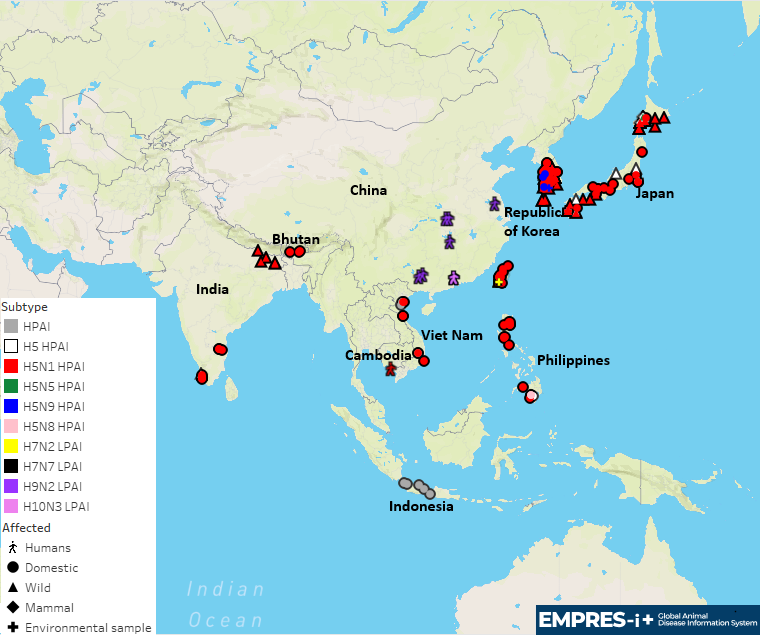
Note: The H5 HPAI virus detection of Heard Island, Australia is not included on the map. Disclaimer: The boundaries and names shown and the designations used on these map(s) do not imply the expression of any opinion whatsoever on the part of FAO concerning the legal status of any country, territory, city or area or of its authorities, or concerning the delimitation of its frontiers and boundaries. Dashed lines on maps represent approximate border lines for which there may not yet be full agreement. Dotted line represents approximately the Line of Control in Jammu and Kashmir agreed upon by India and Pakistan. The final status of Jammu and Kashmir has not yet been agreed upon by the parties. Source: United Nations Geospatial. 2020. Map of the World. [Cited March 2026]. Modified with Emergency Prevention System Global Animal Disease Information System (EMPRES-i), the World Organisation for Animal Health (WOAH) and National Authorities data, 2026.
During the period from 10 December 2025 to 2 March 2026, at least four high pathogenicity avian influenza (HPAI) virus subtypes (H5N1, H5N5, H5N8 and H5N9) and four low pathogenicity avian influenza (LPAI) virus subtypes (H7N2, H7N7, H9N2 and H10N3) have been reported in East, South, and Southeast Asia. H5Nx HPAI viruses continue to circulate in Asia and are well established in certain areas of the region.
Australia reported H5N1 HPAI virus detections in Gentoo penguins (Pygoscelis papua) on Heard Island (an Australian external territory). In the last reporting period, H5 HPAI virus detections were already reported in Southern elephant seals (Mirounga leonina).
Bangladesh reported H5 virus infection in domestic cats that occurred in January 2026.
Bhutan reported three H5N1 HPAI outbreaks in domestic birds affecting Chhukha (1) and Zhemgang (2) districts.
China reported 17 H5N1 HPAI outbreaks in domestic (15) and wild (2) birds in Taiwan Province. Wild bird species affected include Black-faced spoonbill (Platalea minor) and Eurasian wigeon (Anas penelope). In addition, Taiwan Province reported the detection of H7N7 (2) and H7N2 (1) LPAI viruses through environmental surveillance as well as one H7N7 LPAI virus detection in a Black-faced spoonbill (Platalea minor).
India reported 14 H5N1 HPAI outbreaks in domestic birds in Andhra Pradesh (3) and Kerala (11) states. In addition, five H5N1 HPAI virus detections were reported in House crows (Corvus splendens) in Bihar State, and one H5 HPAI virus detection in a Northern pintail (Anas acuta) in Kerala State.
Indonesia reported six HPAI outbreaks in domestic birds in Banten (2), Central Java (1), Riau (1) and West Java (1) provinces as well as the Special Region of Yogyakarta (1). The two most recent outbreaks were observed in February 2026.
In Japan, H5 HPAI continues to circulate actively, with a total of 63 events reported across 25 prefectures during this period. Of these, 47 events were attributed to H5N1 HPAI and one to H5N5 HPAI. H5N1 HPAI was reported in domestic (14) and wild birds (27), and in environmental samples (6). In January 2026, H5N5 HPAI virus was detected in a dead Carrion crow (Corvus corone) in Hokkaido. In addition, 15 H5 HPAI events were reported in wild birds (10), wild mammals (3) and in environmental samples (2), with the mammalian detections involving a Japanese marten (Martes melampus) and two Japanese raccoon dogs (Nyctereutes viverrinus). Wild birds affected during this reporting period span several families and species including Accipitridae – Eastern buzzard (Buteo japonicus), Anatidae – Mallard (Anas platyrhynchos), Mandarin Duck (Aix galericulata), Whooper swan (Cygnus cygnus), Corvidae – Carrion crow (Corvus corone), Large-billed Crow (Corvus macrorhynchos), Falconidae – Peregrine Falcon (Falco peregrinus), Gruidae – Hooded crane (Grus monacha), Strigidae – Ural owl (Strix uralensis), and Threskiornithidae – Black-faced spoonbill (Platalea minor). Notably, several environmental samples collected from the Izumi Wintering Habitat of Cranes (Ramsar site) tested positive since 3 November 2025, where a total of 11 Hooded cranes (Grus monacha) and one White-naped crane (Grus vipio) were found dead in the last reporting period (6 September – 9 December 2025); however, during this reporting period only one Hooded crane was lost, and there has been no HPAI outbreaks in poultry in the Kagoshima Prefecture during this winter.
The Philippines reported 12 H5N1 HPAI outbreaks in domestic birds across six different regions, affecting chicken, ducks, quails and turkeys. In addition, the Philippines reported one H5 HPAI outbreak from October 2025 and two H5N8 HPAI outbreaks that occurred in September 2025, all affecting domestic birds.
The Republic of Korea reported a total of 70 HPAI events involving H5N1 (65) and H5N9 (5) virus subtypes. H5N1 HPAI was reported across two cities and nine provinces, with 41 outbreaks in domestic birds (chicken, ducks, quails), and 28 detections in wild birds. Wild birds affected during this reporting period span several families and species including Accipitridae – Cinereous Vulture (Aegypius monachus), Anatidae – Mallard (Anas platyrhynchos), Indian Spot-billed Duck (Anas poecilorhyncha), Gadwall (Anas strepera/Mareca strepera), Greater White-fronted Goose (Anser albifrons), Greylag Goose (Anser anser), Whooper swan (Cygnus cygnus), Red-crested Pochard (Netta rufina), Ardeidae – Great White Egret (Ardea alba), Grey Heron (Ardea cinerea), Falconidae – Peregrine Falcon (Falco peregrinus), Strigidae – Eurasian Eagle-owl (Bubo bubo). In addition, four H5N9 HPAI outbreaks were reported in domestic birds in Chungcheongnam-do (3) and Jeollanam-do (1), and one H5N9 HPAI virus detection through environmental sampling also in Jeollanam-do.
Viet Nam reported 26 HPAI outbreaks in domestic birds, including chicken and duck farms, in Dak Lak (3), Dong Thap (1), Ha Tinh (7), Long An (2), Ninh Binh (3), Ninh Thuan (1), Phu Tho (1), Quang Ngai (1), Thanh Hoa (1) and Tien Giang (6) provinces. H5N1 HPAI virus subtype was confirmed in six of these outbreaks.
AI viruses continue to circulate extensively in some parts of Asia, resulting in occasional human cases. During the reporting period, Cambodia reported one influenza A(H5N1) human infections in Kampot Province. Additionally, China reported a total of eight influenza A(H9N2) human infections in Guangxi Autonomous Region (1), and in Guangdong (2), Guangxi (2), Hubei (2), Hunan (1), and Jiangsu (1) provinces. In addition, China reported one influenza A(H10N3) human infection in Guangdong Province.
Highly pathogenic H5N1, H5N2, H5N5, H5N6, and H5N8 viruses have demonstrated the ability to spread via migratory water birds. We consider avian influenza activity to have reached its peak in the Region during the period from December to March, driven partly by wild bird winter migration as well as increased poultry trade prior to and during major festivities such as Lunar New Year. Therefore, reports of outbreaks in poultry and detections in wild birds are expected to decrease over the coming months.
The list of bird species affected by H5Nx HPAI globally is available HERE with the new species reported since 2021 highlighted in orange.