David Lawrie, Pukorokoro Miranda Naturalist Trust (PMNT)
The Pukorokoro Miranda Naturalist Trust (PMNT) is a flyway partner because of its work on the international stage in China, South Korea and North Korea, and assisting in Australia. However, it has an unusual aspect in that it is also the manager of the Robert Findlay Wildlife Reserve (RFWR) which is the most important component of the high tide roost system for shorebirds in the Firth of Thames. The Firth is a Ramsar site, and also a Flyway Network site. The PMNT is not only an INGO but also a site manager.
The Robert Findlay Wildlife Reserve is situated on the western side of the Firth of Thames and is a dynamic coastal site. The Firth of Thames has a strong southerly current which flows down the western side of the coastline. The intertidal zone is rich in marine life with numerous beds of bivalves, and feeding habitat for birds and fish. As the shellfish mature and die the shells are eventually washed to the shoreline. Longshore drift moves the shells in the southerly direction, and high tides and storm events create long mobile shell ridges which provide ideal roosting sites for shorebirds. Sediment deposited on the landward side of each ridge, gradually builds up so the ridge becomes stationery. A succession of such ridges, known as cheniers, have aggregated over c.4000 years to form the Pukorokoro Miranda chenier plain.

This means that management of the RFWR requires constant attention as the bird hides require regular relocation as the shell banks extend and are modified by the currents. In recent times a further issue has been the pond that has formed behind the current shell bank. Open to the tide, this shallow area is a critically important high tide roost for shorebirds. The tidal outlet runs through a culvert discharging eventually into the Pukorokoro Stream. This outlet across the mudflats has gradually silted up so that more water is retained in the pond. Over time water depth in the pond gradually increased and stabilised to a stage where it was no longer suitable as a shorebird roost. The pond that was created, however, was suitable for ducks, swans and grebes, which did provide a level of interest but was not the primary purpose.
Before After

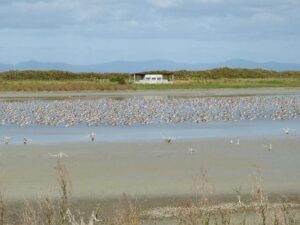
During 2022 the pond stabilised and the level of water was static throughout the year with only minor inflow of fresh water. The PMNT Council decided that some management action would need to be taken to enable control of water levels in the ponds to restore a shallow water regime preferred by shorebirds. This was further given urgency because during the warm summer months of October an outbreak of botulism occurred in the pond as water temperatures increased and the bacterium causing this disease was introduced by waterfowl from other affected areas. The rangers from the Trust had the distressing job of collecting dead and dying birds every morning before visitors arrived at the hides. Most of the affected birds were waterfowl which were affected by their feeding action of dabbling in the substrate. Also affected were some Red Knot which were also feeding around the margins of the pond.
The necessary management actions, however, were not easy to achieve because the work involved excavation within the marine tidal area and the removal of a small area of mangroves. Both of these activities required consent from the Waikato Regional Council. I was instructed by the PMNT Council to prepare an application for the necessary consents, and this was lodged with the Regional Council on the 23rd November 2022. It was necessary to apply some pressure to the approving agency to give some urgency to issuing the consent, but it still did not approve the application until the 26th April 2023.
The work was then scheduled to be undertaken in the July/August period to ensure that it was completed before the migratory shorebirds returned from the northern hemisphere. The work was
undertaken by an excavator using swamp pads operating on the soft marine mud to dig a new channel from the pond outlet to the deep water during the neap tide period.
Once completed the pond was drained over several days and the pond bed allowed to partially dry.
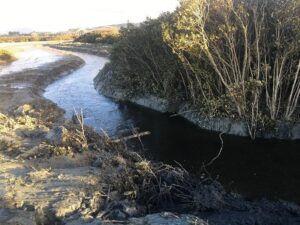
Once the birds started returning in September, they quickly settled into a routine of roosting either in the partially dried pond bed or the shell banks behind, and the bird hides were then able to be fully utilised. Since that time the water level in the pond has been carefully controlled to allow salt water to enter on the very high tides to partially control all the weed growth but is then drained to maintain the very shallow water that the birds preferred to roost in.
This has, however, shown that coastal environments need to be carefully managed to ensure that they are fulfilling the purpose of the sensitive environment that they are protecting. It is also necessary that terrestrial local authorities write rules that allow suitable activities that do not hinder appropriate management actions to enhance habitat creation or restoration.
The success of the restoration of the Robert Findlay Reserve is a prime example of how sensible application of the rules can be applied to achieve an outcome that is internationally renowned.