In this issue of Flyway Story, we invited our donor Dr. Hyun-ah Choi from the Hans Seidel Foundation’s Korea office.
“Let’s do it together!” — Dr. Hyun-ah Choi
EAAFP: Hello, Dr. Hyun-ah Choi. Thank you for kindly accepting the interview. Could you please introduce yourself?
Dr. Hyun-ah Choi: Hello, I am Hyun-ah Choi from the Hans Seidel Foundation’s Korea office, where I am responsible for environmental work. Since 2015, I have been involved in ecological (bird) surveys around the DMZ and border areas, and I am also engaged in research in the fields of environment and ecology.
EAAFP: Was there an experience that influenced your decision to support the EAAFP Foundation in its efforts for the conservation of migratory waterbirds, their habitats, and biodiversity? If there is any activity related to this that stands out in your memory, please feel free to share your thoughts and experiences at the time.
Dr. Hyun-ah Choi: While working on various collaborative projects with the EAAFP Secretariat, I had considered making a donation, but at that time, the Secretariat was not accepting donations. I thought it wasn’t possible to donate. However, in 2020, I had the opportunity to participate as a speaker in a webinar organized by the EAAFP Secretariat on the cranes in the DMZ. During this time, I was considering what to do with the speaker’s fee I received, and I learned that the EAAFP had established a foundation (EAAFP Foundation). Though it was a small amount, I decided to donate the speaker’s fee and made the decision to support the foundation.
*The EAAFP Foundation was established in 2019 to expand support for the EAAFP (East Asia-Australasia Flyway Partnership) program.
EAAFP: The Hans Seidel Foundation is a key partner of the EAAFP, contributing through continuous cooperation. We are truly grateful for this. As a senior researcher at the Hans Seidel Foundation, why do you think the collaboration with EAAFP is important, and what outcomes would you like to see achieved through this partnership?
Dr. Hyun-ah Choi: Through collaboration with organizations like EAAFP, my interest in ecology, the environment, and migratory birds has grown much more than in the past. I was personally raised in an environmentally friendly setting, but during that time, I didn’t have a strong interest in birds. For example, my parents are farmers, and during rice farming seasons, I didn’t particularly like the sparrows that were often seen. Similarly, the swallows that lived under our roof and disturbed my morning sleep during my childhood weren’t something I was fond of. 😅 However, through my involvement in collaboration projects with EAAFP, I learned how important sparrows and swallows are, and now I actively observe and take an interest in them. Today, I am continuing my research and activities on various bird species, focusing on their migration routes, habitats, breeding sites, resting sites, and the conservation of forest and wetland ecosystems.
While one can naturally develop an interest in the environment and migratory birds on their own and choose to engage in related activities, for me, it was through cooperation with EAAFP and its partners that I became aware of these issues. I hope that EAAFP, along with its partners, can create opportunities for people to engage in conservation activities in the fields of environment, ecology, and migratory birds. It would be great if there were platforms for people who are interested in the East Asia-Australasia Flyway (EAAF) to exchange and collaborate with each other.

Research with Dr. Seliger at Baengnyeong Island, a border area of the Yellow Sea ©Hyun-ah Choi
EAAFP: The Hans Seidel Foundation has been actively collaborating with EAAFP for the conservation of migratory birds in South Korea’s border areas. Why do you think conservation of migratory birds in the border areas is particularly important?
Dr. Hyun-ah Choi: We are aware of the boundary between North and South Korea, but the migratory birds traveling between the two Koreas are unaware of this boundary. I believe that through these birds, we can promote environmental cooperation between the North and South. For example, in 2019, there was a Swan Goose (Gaeri) festival at the Mundok Wetlands in North Korea, which is an EAAF site [EAAF045]. The same species of Swan Goose observed at Mundok Wetlands has also been observed at the Han River Estuary Wetlands, another EAAF site [EAAF028], which is located in the border region. This leads me to imagine that, during the spring and autumn migration periods, the Swan Goose festival could potentially be held simultaneously or around the same time at both Mundok Wetlands and Han River Estuary Wetlands, which serve as important stopover sites for the birds.
EAAFP: After reading your article “There Are No Borders in Nature” in Gyeonggi Ilbo, I was able to reconsider the importance of habitat protection for migratory wildlife through ecological connectivity and the significance of collaboration through partnerships. Regarding this, what do you think should be prioritized in order to effectively secure “connectivity”?
I believe the priority should be exchange and collaboration. It is necessary to understand the similar characteristics of ecosystems and ecological spaces, and to recognize that they are interconnected. In order to jointly respond to issues such as ecosystem destruction caused by development activities and the impacts of climate change, cooperation should be considered.
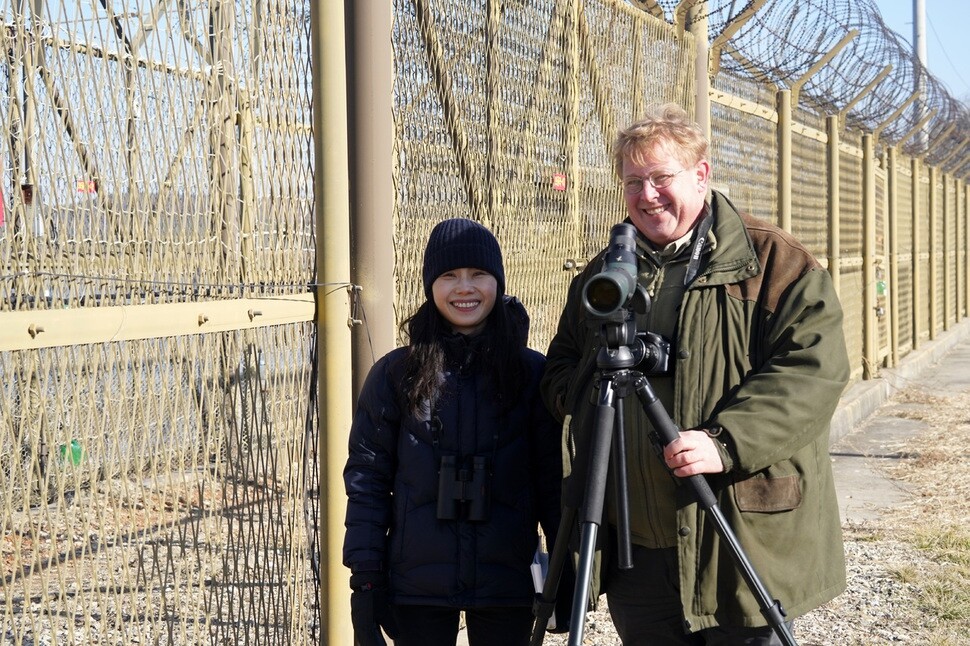
Research with Dr. habil Bernhard Seliger, Resident representative of the Hanns Seidel Foundation Korea Office, at the Han River Estuary Wetlands, a North-South border area \[EAAF 028] ©Kyung-man Park
EAAFP: We understand that you have been actively involved in research and activities related to the conservation of forest and wetland ecosystems. Recently, Korea’s tidal flats have been gaining attention as a new blue carbon (marine ecosystem carbon sink), but the urbanization of tidal flats has become a serious issue. In this context, we would like to hear your thoughts on possible solutions to achieve both conservation and development simultaneously.
Dr. Hyun-ah Choi: I, too, would love to know if there is a way to achieve both conservation and development. 😅
I believe it is necessary to strike a balance rather than leaning too much toward one side. Instead of focusing solely on the benefits of development, it is important to also consider the benefits of conservation. This requires raising awareness among various stakeholders and approaching tidal flat development with consideration for the surrounding ecosystems and environment. Interaction and collaboration with various stakeholders are essential, and once again, I would like to emphasize the importance of exchange and cooperation.
EAAFP: Do you have a message you would like to convey to the interview readers regarding the protection of migratory waterbirds and the conservation of their habitats along the East Asian-Australasian Flyway?
Dr. Hyun-ah Choi: A phrase I often say when doing something is… “Let’s do it together!”
I also recommend visiting the Flyway Network Sites (FNS) along the migratory bird routes. As of 2024, there are a total of 154 network sites. I’m curious how many of these sites the readers have visited and which ones they would like to visit. For reference, I visited the Moreton Bay Boondall Wetlands [EAAF013] in Queensland, Australia, last March. 😊
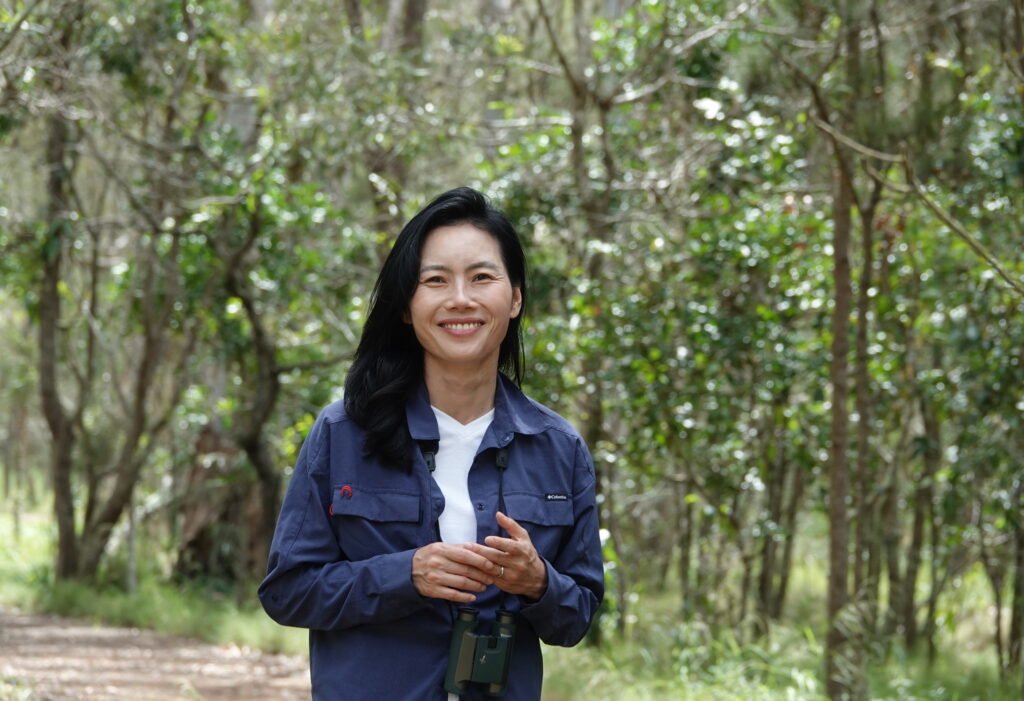
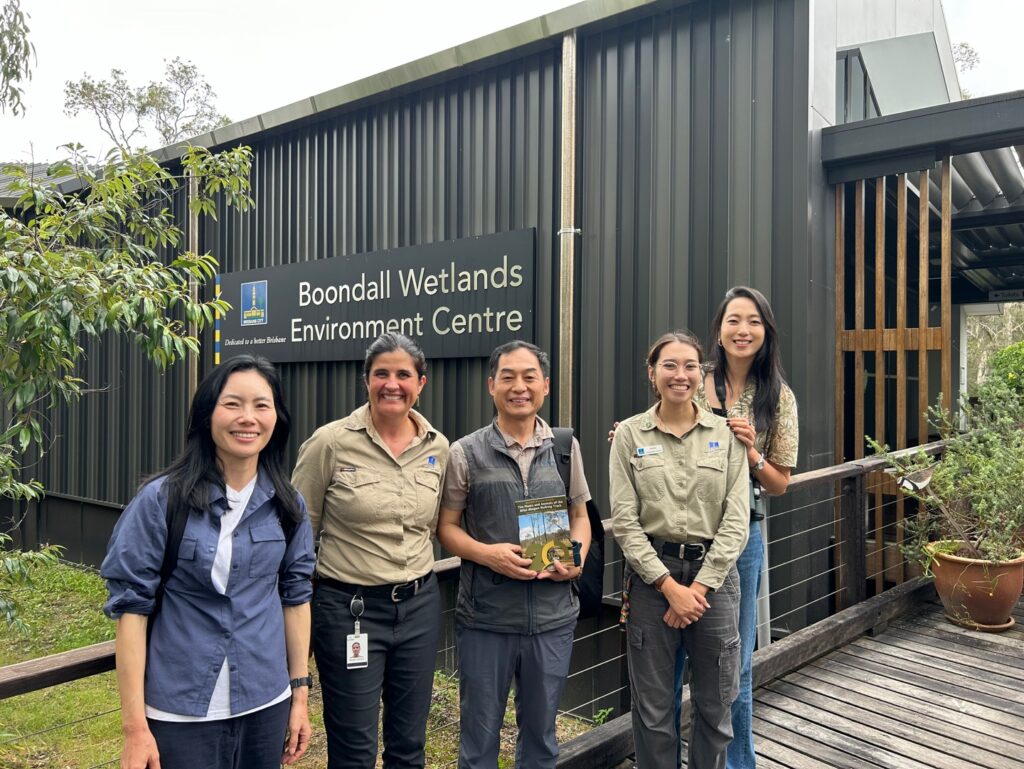 Visit to Moreton Bay, Boondall Wetlands, Queensland, Australia [EAAF013] ©Hyun-ah Choi
Hanns Seidel Foundation Korea Office