World Migratory Bird Day 2026 to Highlight Important Role of Community Science in Bird Conservation
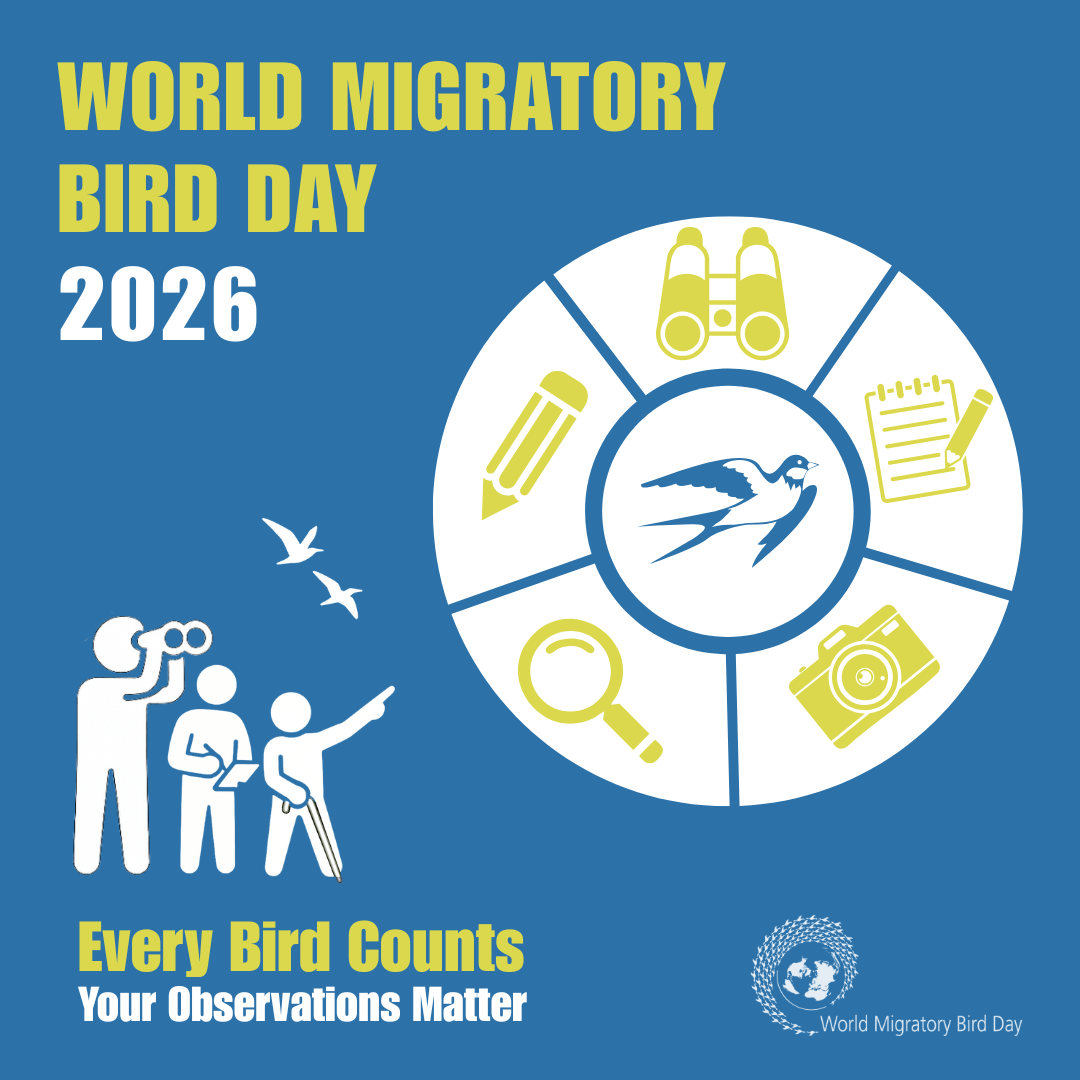
Bonn/Boulder/Incheon, 18 December 2025 – The global Partners behind World Migratory Bird Day (WMBD) are excited to announce the theme for 2026: “Every Bird Counts – Your Observations Matter!” highlighting the important role of community science (also referred to as citizen science) for the conservation of migratory birds.
The 2026 campaign shines a spotlight on people-driven efforts that are essential for bird conservation and science, celebrating how individuals, communities, and organizations around the world are helping to build the knowledge base to better conserve migratory birds across borders.
By focusing on the contribution of individuals, participatory science and public bird monitoring efforts, the campaign will celebrate the millions of bird enthusiasts around the world that are contributing to the data and knowledge that inform policy decisions and are essential for bird conservation – through each recorded observation.
The Power of Community Science
From backyard observations to coordinated global surveys, millions of people around the world contribute vital information about migratory birds, their habitats, and the challenges they face each year. Through these recorded observations, people are engaging in community / citizen science that helps track migration patterns, population trends, and changes in habitats across flyways.
The campaign will showcase how every observation contributes essential data and supports evidence-based conservation at local, national, and international scales.
Connecting with Nature to Support Conservation
When people take part in bird counting activities that help gather this important data, they also strengthen their connection to nature, deepen their understanding of the pressures facing birds, and often become stewards of nature protection, strengthening society’s engagement with nature.
A Global Effort Across All Flyways
This year’s theme is particularly meaningful as it recognizes the many community science projects along all of the world’s major flyways. We will be focusing on the monitoring initiatives and platforms that already exist to record bird observations in ways that support both science and policy. World Migratory Bird Day 2026 also coincides with the 60th Anniversary of the International Waterbird Census, an opportunity to celebrate this global effort to monitor and protect migratory waterbirds as well as promote other community and citizen science initiatives across all flyways of the world. By encouraging people to gather observations from across migratory routes, we can build a clearer picture of the “story of the flyways,” emphasizing connectivity, international collaboration, and our collective responsibility.
How You Can Contribute
You can get involved in conservation-focused projects that contribute to long-term monitoring and research, such as community science programs, coordinated bird counts, or public events that build awareness of how sustained data collection supports migratory birds. Even small, regular observations can add value when they are part of a larger, ongoing effort to track populations over time. However you choose to participate, thoughtful and consistent engagement helps strengthen the science that informs conservation policy across the world’s flyways.
World Migratory Bird Day 2026 will take place on 9 May and 10 October, recognizing that migration occurs at different times in the northern and southern hemispheres and is part of a repeating annual cycle.
The partners behind World Migratory Bird Day look forward to working closely with all interested stakeholders, external partners, governments, organizations, and communities across all flyways to amplify this message and continue using World Migratory Bird Day as a way to raise awareness and conservation action for migratory birds across borders.
Every bird counts! Join us and make a difference by counting birds for conservation!
For more information please visit: www.worldmigratorybirdday.org
About World Migratory Bird Day
World Migratory Bird Day is a global campaign that serves as a beacon for conservation efforts aimed at conserving migratory birds and their journeys across borders. Celebrated twice a year—in May and October—WMBD reflects the cyclical nature of bird migration and the varying peak bird migration periods in the northern and southern hemispheres. This worldwide initiative triggers countless educational events, uniting people in a common goal to conserve and protect migratory birds and their habitats.
Each year, WMBD focuses on a central theme to inspire action and concentrate global efforts towards preserving the habitats and wellbeing of migratory birds.
The WMBD campaign is organized by the Convention on the Conservation of Migratory Species of Wild Animals (CMS), the African-Eurasian Migratory Waterbird Agreement (AEWA), Environment for the Americas (EFTA), and the East Asian–Australasian Flyway Partnership (EAAFP).
Join us in celebrating World Migratory Bird Day and take part in this global movement to create a more sustainable future for migratory birds and our shared natural world.
For more information about World Migratory Bird Day and ways to get involved, please visit www.worldmigratorybirdday.org
About the Convention on Migratory Species (CMS)
An environmental treaty of the United Nations, the Convention on the Conservation of Migratory Species of Wild Animals (CMS) provides a global platform for the conservation and sustainable use of migratory animals and their habitats. This unique treaty brings governments and wildlife experts together to address the conservation needs of terrestrial, aquatic, and avian migratory species and their habitats around the world. Since the Convention’s signing in 1979, its membership has grown to include 133 Parties (132 countries plus the European Union). Discover more at www.cms.int
Learn more at www.cms.int
About the Agreement on the Conservation of African-Eurasian Migratory Waterbirds (AEWA)
The Agreement on the Conservation of African-Eurasian Migratory Waterbirds (AEWA) is an inter-governmental treaty dedicated to the conservation of migratory waterbirds that migrate along the African-Eurasian Flyway. The Agreement covers 255 species of birds ecologically dependent on wetlands for at least part of their annual cycle. A total of 84 countries and the European Union have signed the environmental treaty, which has a geographic range covering 119 countries across Africa, Europe, the Middle East, Central Asia, Greenland, and the Canadian Archipelago.
Learn more at www.unep-aewa.org
About Environment for the Americas (EFTA)
Environment for the Americas connects people to nature and birds through research, education, and outreach. At the heart of our efforts lies the coordination of World Migratory Bird Day across the Americas, an initiative that engages people of all ages in the protection of our shared migratory birds. Working with over 800 organizations from Canada to Argentina and the Caribbean, we motivate migratory bird-focused activities on public lands, at zoos, in school, botanic gardens, museums, and many other locations. Through these programs, we empower people to make a tangible difference for the environment. EFTA’s efforts have also spurred international collaborations for bird conservation and facilitated changes across borders that ensure a future where migratory birds are protected and celebrated.
Learn more at www.environmentamericas.org
About the East Asian–Australasian Flyway Partnership (EAAFP)
The EAAFP is an international Partnership established in 2006 to provide a framework that promotes dialogue, cooperation, and collaboration to conserve migratory waterbirds, their habitats, and the livelihoods of people who depend on them across the East Asian–Australasian Flyway. It is also a Ramsar Regional Initiative. A unique element of the Partnership is its mission to build and strengthen a connected chain of internationally important sites for these birds as they migrate across 22 countries. This connectivity is not only ecological — linking habitats across vast distances — but also social, bringing together the communities who steward these Flyway Network Sites and share responsibility for the birds that rely on them. These 22 countries have the greatest species density on earth yet face the highest number of vulnerable migratory bird species. Our 42 Partners work together across borders, across sites, and across communities to make a meaningful difference for them.
Learn more at www.eaaflyway.net
For more information please contact:
Florian Keil, Coordinator of the World Migratory Bird Day Campaign. Information Officer at the CMS and AEWA Secretariats, Tel: +49 (0) 228 8152451, contact@worldmigratorybirdday.org
Susan Bonfield, Executive Director at Environment for the Americas, Tel: +001 970-393-1183, sbonfield@environmentamericas.org
Minjae Baek, Communications Officer at the East Asian–Australasian Flyway Partnership, Tel: +82 32 458 6504, communication@eaaflyway.org