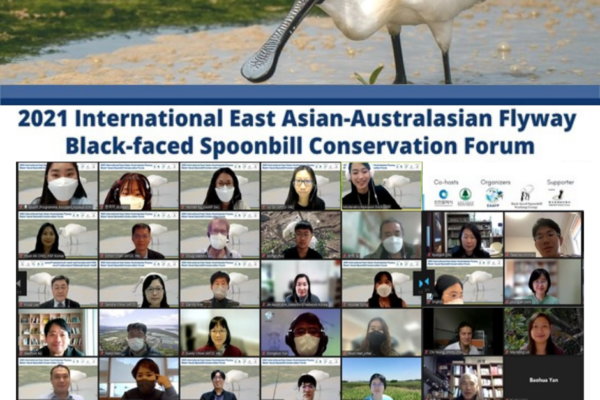
EAAFP Corporate Champion Hyundai Motor Company donated 10,000 USD to EAAFP Foundation
EAAFP Foundation is happy to announce that Hyundai Motor Company, a leading South Korean multinational automotive manufacturer donated 10 million KRW (equivalent to 10,000 USD) to EAAFP Foundation to…
Continue reading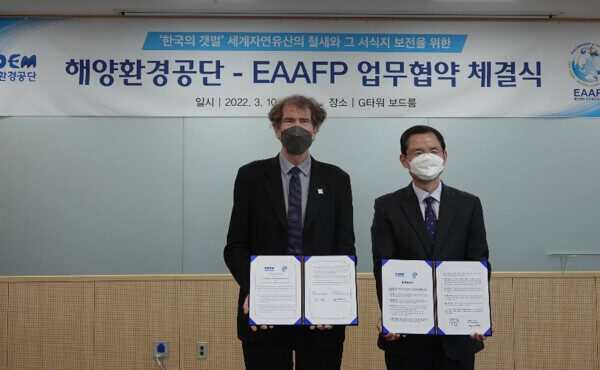
The EAAFP Secretariat signed MOU with Korea Marine Environment Management Corporation (KOEM)
Korea Marine Environment Management Corporation (KOEM) signed a Memorandum of Understanding (MoU) with the EAAFP Secretariat at…
Continue reading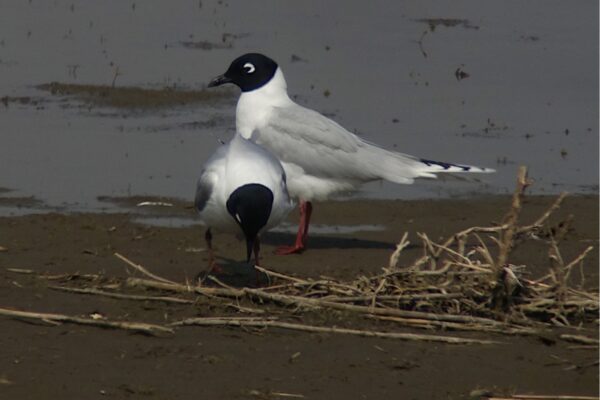
Local government, NGOs and citizens collaborate to strengthen the conservation of Hwaseong Wetlands, Ro Korea
Written by Dr. Nial Moores, Birds Korea Biodiversity is…
Continue reading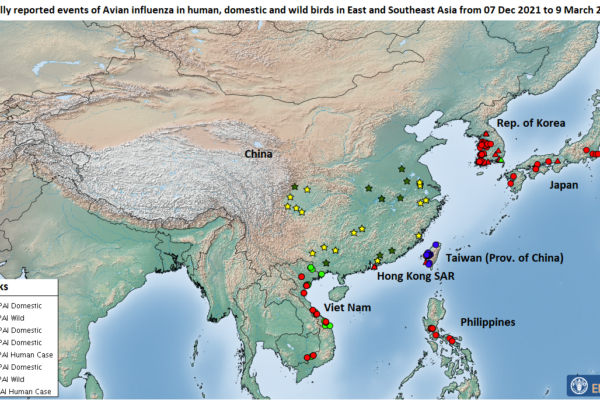
Updates of worldwide avian influenza situation by FAO/EMPRES-AH (Dec 2021 – Mar 2022)
FAO/EMPRES-AH is constantly monitoring the avian influenza situation worldwide and compiles information from multiple national and international sources as well as peer-reviewed scientific articles. Close collaboration with country and…
Continue reading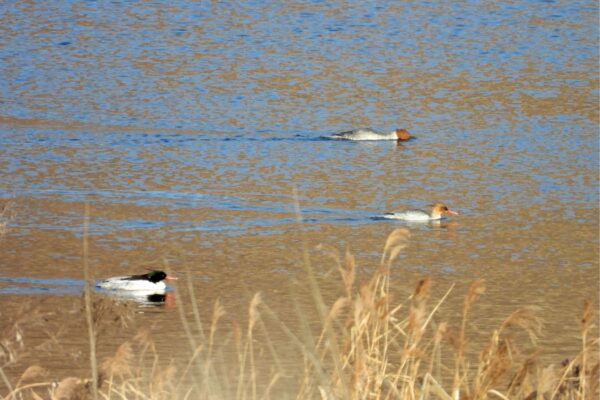
Confirmation of important sites for Scaly-sided Merganser in Ro Korea
On 11th February 2022, colleagues from the EAAFP Secretariat Programme Team (Ms. Hyeseon Do, Ms. Yeonah Ku and Mr. Yong June Kim) visited Yeoncheon County, Republic of Korea,…
Continue reading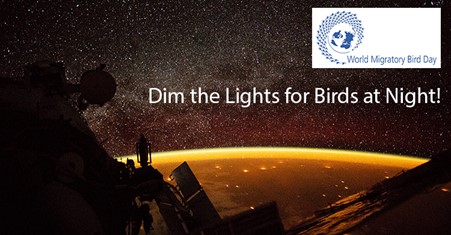
“Dim the Lights for Birds at Night!” – The World Migratory Bird Day 2022 Slogan Announced!
©NASA Space Observatory “Dim the Lights for Birds at Night!” has been selected as the official slogan of the 2022 edition of the UN-backed global World Migratory Bird Day campaign and was officially announced on 25th February 2022. This year, the campaign’s focus is on the impacts of light pollution on migratory birds. “World Migratory Bird Day 2022 is not only about raising awareness on the negative effects of light pollution on migratory birds. We also hope the campaign will trigger concrete commitments and pledges from Parties, cities, and other key stakeholders across the world,” said Amy Fraenkel, Executive Secretary of Convention on Migratory Species (CMS). With the two peak days of the campaign, the aim is to raise awareness around the issue in May and initiate concrete actions to tackle light pollution in October. Best practice guidelines are currently being developed under the Convention on Migratory Species to address this growing issue and ensure that action is taken globally to help birds migrate safely. Artificial light is increasing globally by at least 2 per cent per year and it is known to adversely affect many bird species. Light pollution is a significant threat to migratory birds, causing disorientation when they fly at night, leading to collisions with buildings, interfering with their internal clocks, or interfering with their ability to undertake long-distance migrations. “This year’s campaign highlights the impacts of the increasing but underestimated threat of light pollution on migratory birds. “Dim the Lights for Birds at Night” sends a simple but strong message that we need to act collectively to curb the use of unnecessary light at night so that we can reduce the negative impact it has on migratory birds,” said Jacques Trouvilliez, Executive Secretary of AEWA. Solutions to light pollution are readily available. For instance, more and more cities in the world are taking measures to dim building lights during migration phases in spring and autumn. Further information about the impacts of light pollution on migratory birds and steps one can take to address this issue will be made available on the WMBD website throughout the year. We encourage event organizers to start thinking of ways to incorporate the theme of light pollution and the slogan into their planned World Migratory Bird Day 2022 events and activities. For more information and to register WMBD events please visit: www.worldmigratorybirdday.org Related content: CMS COP13 Resolutions and Decisions on Addressing Light PollutionResolution 13.5 - Light Pollution Guidelines for Wildlife Annex of Resolution 13.5 - National Light Pollution Guidelines for Wildlife including Marine Turtles, Seabirds and Migratory Shorebirds Decisions 13.138 to 13.139 - Light Pollution Guidelines for WildlifeOfficial announcement: https://www.cms.int/en/news/dim-lights-birds-night-%E2%80%93-world-migratory-bird-day-2022-slogan-announced
Continue reading
The story of ‘messenger’ A49, connecting Incheon and Hong Kong
Migratory waterbirds flying between breeding and non-breeding…
Continue reading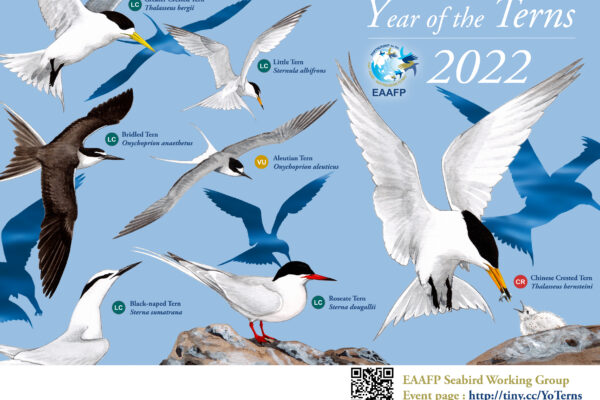
EAAFP Secretariat and Seabird Working Group launches “Year of the Terns” in 2022
On 22nd February, 2022, the EAAFP Secretariat and EAAFP Seabird Working Group announced 2022 as the “Year of the Terns” for the EAA Flyway. The announcement is a preface to the focus that EAAFP will put on raising awareness and promoting collaboration for the conservation of seabirds in the East Asian-Australasian Flyway (EAA Flyway). The campaign was officially launched during the 49th Annual Meeting of Pacific Seabird Group (PSG) Northeast Asia Seabird Conservation Committee Meeting.There are over 150 seabird species in the EAA Flyway. Many seabird species have long trans-equatorial migration routes and spend most of the year at sea, only returning to land to breed. Since much of their annual lifecycle is spent offshore, they are especially difficult to study and most aspects of their life histories remain poorly understood in the EAA Flyway. While many populations are doing well, others are experiencing population declines that are difficult to detect given the months they remain away from global eyes. To increasing awareness of these Ocean Sentinels, the Secretariat and the EAAFP Seabird Working Group are excited to designate 2022 as the “Year of the Terns”. The Secretariat and the EAAFP Seabird Working Group hope to accomplish the following three objectives with this campaign: 1. To raise awareness of seabirds, especially terns, within EAA Flyway 2. To encourage dialogues and collaboration on seabirds research and conservation within EAA Flyway 3. To promote and strengthen working relationships within EAAFP Seabird Working Group, also with site managers of Flyway Network Sites for seabirds, and beyond To do so, seven, out of the 16 EAA Flyway tern species, were selected for the campaign, including the Chinese Crested Tern (CR), Aleutian Tern (VU), Greater Crested Tern, Bridled Tern, Little Tern, Black-naped Tern and Roseate Tern. The Secretariat and Seabird WG will also be developing activities for the campaign accordingly. Robb Kaler, Chair of EAAFP Seabird Working Group, expressed “According to a global assessment, seabirds are generally more threatened than other comparable groups of birds. Many populations have declined rapidly in recent decades due to various threats, including incidental bycatch, overfishing, pollution, invasive species, warming oceans and more. We hope that the “Year of the Terns” campaign, will raise awareness about seabirds, both for the health of their populations, and as an indicator of the health of oceans on which seabirds and all of us depend. We are excited for this opportunity for more joint actions to conserve seabirds in the EAA Flyway and expand the Seabird Working Group’s network of partners.” Doug Watkins, Chief Executive of EAAFP Secretariat said. “Seabirds received relatively less attention and conservation effort in the EAA Flyway compared to other taxa, probably due to the vast distribution range of many species and the challenges to study them. Therefore, we need to strengthen our network in seabird studies and conservation and promote more collaboration in the region, and the actions cannot be delayed.” Stay tuned for more upcoming activities such as a photo competition and a talk series. The EAAFP Secretariat and Seabird Working Group invite everyone to support and celebrate the “Year of the Terns with them! Check the “Year of the Terns” webpage: https://eaaflyway.org/year-of-the-terns-2022/ For inquiries and interest to support the Year of the Terns, please contact: Ms. Vivian Fu Communication Officer, EAAFP Secretariat Email: communication@eaaflyway.org
Continue reading