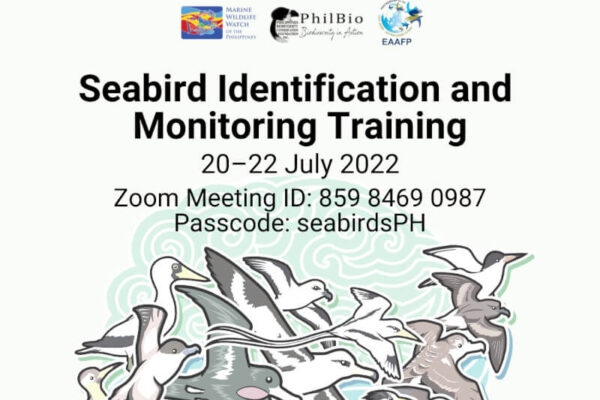
The Philippines conducts its 1st National Training on Seabird Identification and Monitoring
In the effort to increase our knowledge and capacities in conserving seabirds in the Philippines, the Biodiversity Management Bureau of the Department of…
Continue reading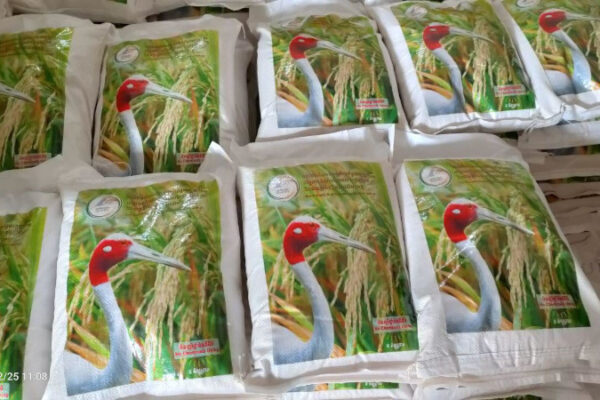
“Crane Rice” – an initiative to improve local livelihoods and conserve the threatened Sarus Crane in Cambodia
‘Sarus Crane Rice’ ©Ministry of Environment of Cambodia & NatureLife Cambodia The Ministry of Environment of Cambodia, in collaboration with NatureLife Cambodia and BirdLife International, has now established a new ‘Crane Rice’ initiative, aimed at improving local livelihoods and better conserving the stately Sarus Crane. ‘Crane Rice’ will involve wildlife-friendly rice farming practices which will benefit the cranes and other waterbirds in Anlung Pring Protected landscape, the first Flyway Network Site in Cambodia (EAAF144) located in Boeung Salang Kang Tbaung and Prek Kruss communes, Kampong Trach district, Kampot Province, Cambodia. Under this initiative, participating farmers need to grow native and crane-preferred rice varieties. They also need to adhere to the guidelines for crane rice. This means that the farmers cannot hunt and snare wildlife on their plots, and apply poisons. Farmers are also expected to avoid encroaching on protected lands and encouraged to adopt organic rice farming (i.e. no application of chemicals fertilizers and herbicides). Half of the rice grown on leased land, will be harvested and packaged for sale while the remainder will be left in the fields to benefit Sarus Cranes and other biodiversity. For crane conservation and protection to be successful, it needs to consider local livelihoods and engagement with stakeholders. The Ministry of Environment will continue to collaborate with our NGO partners to find markets for Crane Rice to ensure the success of the pilot programmes, while encouraging farmers to participate in this initiative and working to ensure that the rice can be sold at a premium. ©Ministry of Environment of Cambodia & NatureLife Cambodia Since its pilot inception which supported by IUCN-Netherland, the project team have collaborated with 16 farmers and over 10 years, leased 17 hectares of rice fields to pilot work to grow crane-friendly rice, thereby benefiting local livelihoods. The number of farmers who have participated in this Crane Rice initiative increased this year, which is very encouraging. Local farmers planting the seeds ©Ministry of Environment of Cambodia & NatureLife Cambodia The permanently based rangers are collaborating with the local authorities and partner NGO to educate local people about the legislation that protects wildlife and the value of rare bird species, especially the Sarus Crane. The Crane Rice Initiative has provided supplementary feeding for the cranes that annually visit our site during their non-breeding season. Mr. Teup Khay, a farmer from Kok Chamkar, was appreciated for joining the Sarus Crane rice pilot project as it provided him with additional income. At the same time, his family are growing rice without the use of chemical fertilizers and pesticides that can help to provide safer food, which they are very proud of. Moreover, If the cranes are better conserved, they will also help to attract more tourists, who would also enjoy the local culture, and hospitality of their communities. About Sarus Crane: Sarus Crane is one of the crane species in EAAFlyway. There is mainly only one species of cranes in Southeast Asia. It is a short-distant migrant between Vietnam and Cambodia, including a re-introduction programme in Thailand. Based on the findings of the 2020 Sarus Crane census in Cambodia, only 194 birds have been recorded, an all-time low. In the last few years, the number of cranes has declined steadily due to the high mortality rate and low nesting success in its breeding grounds. Additional threats faced by the cranes include deteriorating habitat conditions, poisoning caused by pesticide use, lack of food, change in water regimes at key wetlands, diseases, and in the long-term, climate change. Sarus Crane © Ayuwat Jearwattanakanok Article prepared by The Ministry of Environment of Cambodia.
Continue reading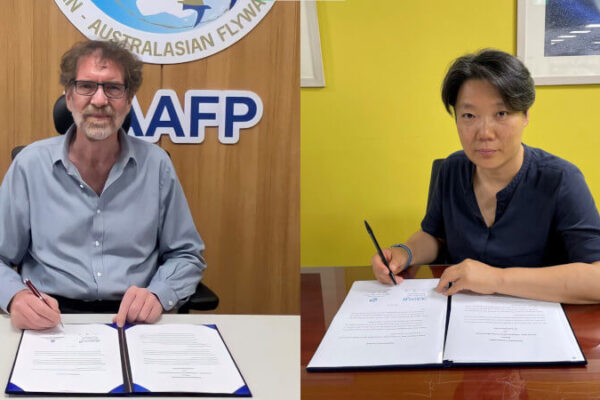
EAAFP Secretariat signs MOU with Seoul Science Center, Ro Korea
Dr. Jung-Kyu Lee, Head of the Seoul Science Center (SSC) and Mr. Doug Watkins, Chief Executive of the…
Continue reading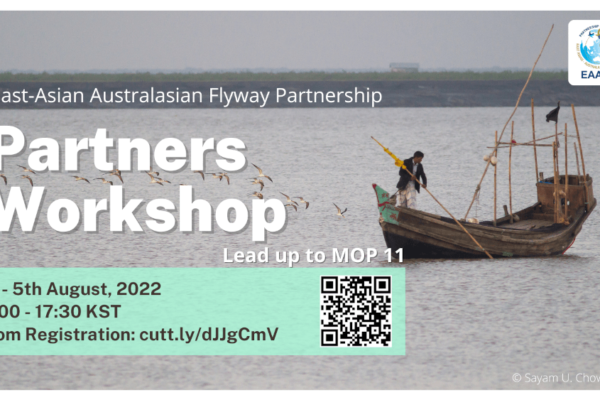
Announcement of EAAFP Partners Workshop leading up to MOP 11
In preparation of and to increase dialogue with and between Partners in the months leading up to MOP11, which will be held in Brisbane Australia, from 12th – 17th March 2023, the Secretariat is organizing a series of webinars endorsed by the EAAFP Management Committee with the following schedule and program. The webinar series will give Partners the opportunity to be briefed on important ongoing activities of the Secretariat and follow-up on Decisions made at MOP10. The EAAFP Secretariat is inviting all Partners to mark these dates and participate in the webinars.Title: EAAFP Partners Workshop lead up to MOP 11 Date/Time: 1 – 5 August 2022; 15:00 – 17:30 KST Organizers: EAAFP Secretariat and Management Committee Participants: EAAFP Partners, EAAFP Working Groups and Task Forces, Flyway Network Site Managers Language: English Meeting Platform: Zoom Register: https://cutt.ly/dJJgCmV *We invite everyone to join as many sessions as possibleEAAFP Provisional ProgrammeDay Programme Presenter/ModeratorDay 1 Opening Remarks Robb Kaler, MC ChairBriefing on MOP11 Doug Watkins, Secretariat Chief Executive/Nick Davidson, TsC ChairActivities of the Management Committee Robb Kaler, MC ChairReport on the Secretariat’s workplan and budget Doug Watkins, Secretariat Chief ExecutiveDay 2 Presentation on the Partner New Reporting Template for MOP11 Doug Watkins, Secretariat Chief ExecutiveInteractive Session 1: How to increase the effectiveness of Working Group/Task Forces for EAAFP, following up on the Discussion Paper presented at MoP10 (link). (TBC)Day 3 MOP10 DD08: EAAFP Guidelines for National and Site Partnerships (link) Jennifer George, ConsultantMOP10 DD 09: EAAFP Guidelines for the Sister Site Program (link)Day 4 Presentation on the revised CEPA Action Plan 2023 – 2028 Casey Burns, CEPA Working Group ChairUpdate on the ADB Regional Flyway Initiative Duncan Lang, Asian Development Bank /Doug Watkins, Secretariat Chief Executive /Ding Li, BirdLife InternationalDay 5 Conservation Status Review of Migratory Waterbird Populations for the EAAFP [MOP10 DD 12] / Q&A Taej Mundkur, Consultant to Wetlands InternationalInteractive Session 2: How to expand, strengthen and engage the Flyway Site Network, including adopting a more simplified and focused nomination form (SIS) Nick Davidson, TsC Chair/Qing Zeng, Science OfficerClosing Remarks Robb Kaler, MC ChairFor inquiries, please email to secretariat@eaaflyway.org.
Continue reading
Literature list (Jan-June 2022)
1) Biology & ecologyLiu, D., Y. Zhou, Y. Fei, C. Xie, and S. Hou. 2021. Mitochondrial genome of the critically endangered Baer’s Pochard, Aythya baeri, and its…
Continue reading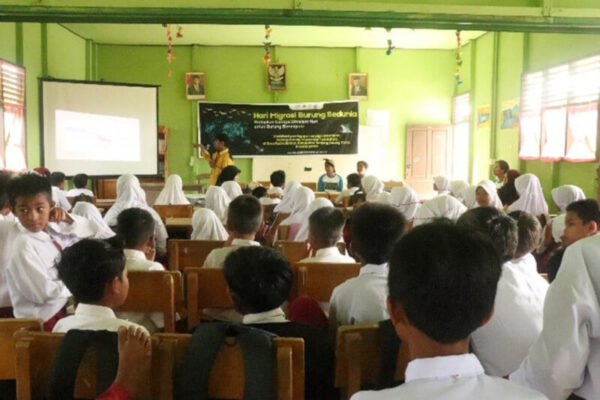
Celebrating 2022 World Migratory Bird Day in Kuala Simbur Village, Jambi Province, Indonesia
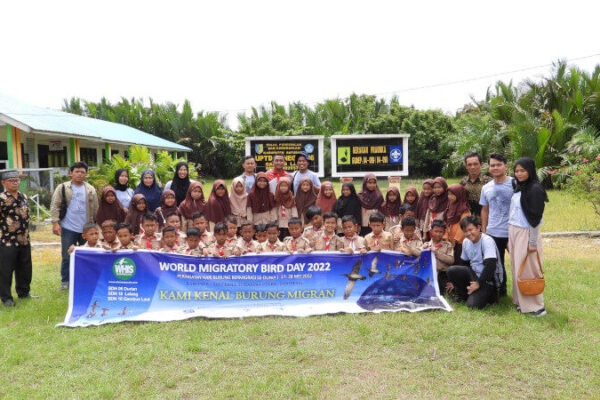
Wildlife Observer Community (WOC) based in Indonesia was founded in 2017. Since then, WOC has been working on data collection, observation, research and conservation. In order to motivate and raise awareness amongst people and local community, WOC has been organizing awareness campaigns in Sumatra. Celebrating World Migratory Bird Day (WMBD) was one of the campaigns. Promotion of WMBD to local students ©️ WOC Under WOC regular conservation activity programme this year, the organization successfully organized two WMBD events in Kuala Simbur Village, Muara Sabak Timur, Tanjung Jabung Timur Regency, Jambi Province, Indonesia between 16 and 18 May 2022: field visit and birdwatching, and public awareness. Bird watching activity ©️ WOC A Field visit and Birdwatching was carried out in the Kuala Simbur Village, Muara Sabak Timur, Tanjung Jabung Timur Regency, Jambi Province, Indonesia as a place to observe migratory waterbirds for the first time. During the activity, the team did not find any large flocks of migratory waterbirds but found permanent migratory birds and some resident waterbirds. This can still be used as education for participants who took part in this activity by seeing the real conditions of migratory bird habitat in Kuala Simbur Village, Muara Sabak Timur, Tanjung Jabung Timur Regency, Jambi Province, Indonesia. The participants were very enthusiastic in participating in this activity. ©️ WOC WOC also organized an awareness-raising campaign among the local people and students close to the habitat of migratory birds. On 17 – 18 May, the project team conducted an awareness-raising campaign in SD Negeri 22/X Kuala Simbur, Madrasah Aliyah Bustanul Ulum, for local people. The goal of this activity was to provide knowledge on migratory birds and their migration to local people and children near the site. Village kids doing bird watching ©️ WOC The project team also met the Head of Kuala Simbur Village and he was very enthusiastic about this event because they provide knowledge to the surrounding community about migratory birds where the presence of migratory birds must be maintained by maintaining their habitat and dimming the lights.
Continue reading
2022 World Migratory Bird Day Celebration in West, South and Eastern Mongolia
The celebration of World Migratory Bird Day (WMBD) 2022 in Mongolia by Wildlife Science and Conservation Center (WSCC) in West, South and Eastern Mongolia was a success. WSCC, Mongolia has been celebrated WMBD since 2010s by small grants or organization’s own funds every year with various public awareness activities following each year’s WMBD theme and slogan. Demo talk how to use opticals, Southern Mongolia ©️ Wildlife Science and Conservation Center - Mongolia The celebration was organized between 12 – 20 May in Western, Eastern and Southern Mongolia, supported by EAAFP WMBD small grant and cooperation with WWF Mongolia, Oyu Tolgoi LLC, and high schools of every soum (area of pastureland) in the vicinity. All three sites were very special places for migratory birds and thus, it is very important to involve local kids and teachers to explain the bird species around the home.Students bird watching, Western Mongolia ©️ Wildlife Science and Conservation Center - Mongolia Demonstration talk of how, why we ring birds, Western Mongolia ©️ Wildlife Science and Conservation Center - MongoliaOver 910 participants have been reached out through this event to share about bird research and migratory birds’ conservation, especially how to deal with light pollution to protect migratory birds and other animals. Many of the school students joined this kind of activities for the first time to learn about WMBD, and they would keep this memory of the event in their hearts. Releasing Siberian Rubythroat, Eastern Mongolia ©️ Wildlife Science and Conservation Center - Mongolia Two competitions, birdwatching competition and bird drawing competition, were very attractive to all kids, and they enjoyed learning about birds and bird migration through these two competitions. Most importantly, the two ringing stations also tremendously aided in the learning - on bird study and conservation - for all attendees and their knowledge have greatly strengthened for their future, proven by the fact that several students have been started volunteering as an assistant ringer position when they have free time afterschool.Children heading out for the bird ringing activity, Eastern Mongolia ©️ Wildlife Science and Conservation Center - Mongolia Drawing competition in progress at the Khurkh BRS, Eastern Mongolia ©️ Wildlife Science and Conservation Center - MongoliaInformation leaflets were distributed among all participants in E and Western Mongolia. A total 12 winners of two competitions were rewarded with education materials such bird guidebook and wildlife conservation related books and painting materials. Presentations in Western Mongolia ©️ Wildlife Science and Conservation Center - Mongolia In the Western Mongolian activities were supported by WWF Mongolia, and they helped us with arranging education materials and rewards for the contest winners. Mongolian Bird Watching club members celebrated Global Big Day on 14 May as well, Team Mongolia observed 254 species in 24 hours, and was one of the biggest successes among the team members. They are very proud of their bird’s species diversity and were encouraged by our results which was 4th place in the Asia and 16th place in the world team rank. Many young members of the Team Mongolia were motivated for bird watching and delighted by our team efforts for Global Big Day.Students birdwatching, Southern Mongolia ©️ Wildlife Science and Conservation Center - Mongolia Team recording what they saw, Southern Mongolia ©️ Wildlife Science and Conservation Center - MongoliaArticle prepared by Mongolia by Wildlife Science and Conservation Center (WSCC).
Continue reading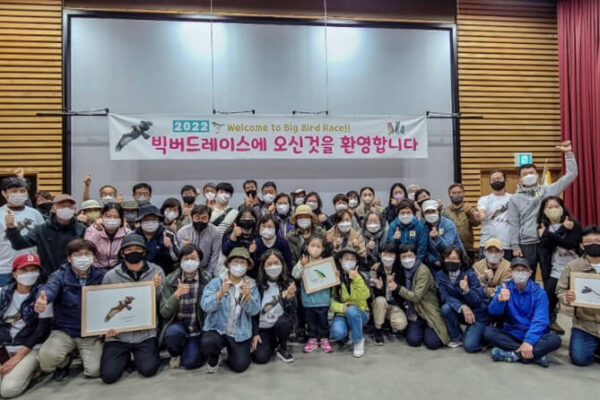
Ganghwa Big Bird Race for 2022 World Migratory Bird Day
From 30 April to 1 May 2022, the <Ganghwa Big Bird Race> was organized by Moolsaeal, a local NGO, on Ganghwa Island, Republic of Korea. A total of 26 teams, 110 birdwatchers from across the country (14 competitive, 12 non-competitive) spent 24 hours searching for birds in Ganghwa Island. Unlike normal birding competitions, all birds observed must be photographed and uploaded to a monitoring App called 'Getbol keepers'. With the records listed on this monitoring App, the judges score and rank them. The competition, which began with a congratulatory greeting from EAAFP Chief Executive Mr. Doug Watkins, followed by the lectures introducing Ganghwa birding places and instructions of the race. The BBR then kick-started in the heated atmosphere. Group Photo of Participants and Organization Committee ©️ 2022 Ganghwa Big Bird Race Organization Committee Families and EAAFP secretariat staff, who participated in the non-competition section, then attended a lecture by the organizer to learn about common bird species. Then they visited rice paddies and mudflats with professional birding guides for bird watching. At the end of the first day, there was a music performance to celebrate the event, followed by a sharing section in which all the teams were introduced and expressed their feeling for joining the Ganghwa BBR.Families participating in the non-competitive Birdwatching section ©️ 2022 Ganghwa Big Bird Race Organization Committee EAAFP Secretariat Staff at Ganghwa BBR ©️ 2022 Ganghwa Big Bird Race Organization CommitteeDuring the BBR, teams observed a total of 581 photo records and 102 bird species for two days. The first-place team scored 75 points (69 records + 6 additional points for protected species), the second-place team scored 56 points (51 records + 5 additional points for protected species), and the third-place team scored 55 points (51 records + 4 additional points for protected species).Participants for the competitive section ©️ 2022 Ganghwa Big Bird Race Organization Committee Families participating in the non-competitive section ©️ 2022 Ganghwa Big Bird Race Organization CommitteeSome sharing from the participants:Mr. Rahul Teku Vaswani and his family, from India, saw a black-faced spoonbill biting a giant frog and said, “It’s so amazing. The colors and patterns made by nature are really beautiful.” Another participant said, "There were not many birds this year. Continuous monitoring is needed, whether it is due to climate change or other environmental factors. We expect more people to participate next year.” For more on Ganghwa BBR (in Korean) https://ghbbr.modoo.at/?link=cgfdi6ow Article prepared by Moolsaeal.
Continue reading