14 November 2025
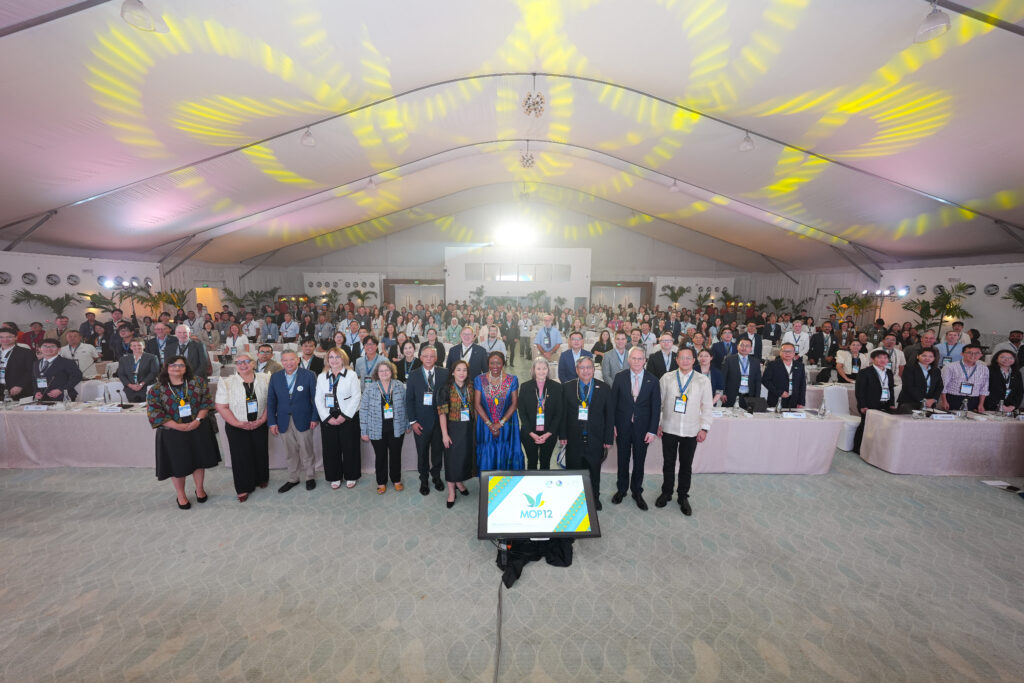
The 12th Meeting of Partners (MOP12) of the East Asian–Australasian Flyway Partnership (EAAFP) concluded in Cebu on Friday after a week of high-level discussions, new conservation commitments, and strengthened international cooperation for the protection of migratory waterbirds and wetlands across the Flyway. Hosted by the Philippine Government through the Department of Environment and Natural Resources (DENR) in collaboration with the EAAFP Secretariat, the event gathered delegates from more than 20 countries, including government officials, scientists, conservation organisations, youth groups, and development partners.
The meeting opened with a cultural performance by the University of Cebu featuring the Siloy, the endangered Cebu endemic Black Shama. Highlighting both the species’ fragility and the resilience of local communities striving to protect it, the presentation set the tone for a gathering firmly rooted in science and culture. DENR Region VII OIC-Regional Executive Director Laudemir Salac welcomed the international delegation, stressing the urgent need to protect wetlands increasingly threatened by development pressures and climate change.
EAAFP Chair Narelle Montgomery thanked the Philippines for hosting the meeting and underscored the shared responsibility of conserving migratory birds and their habitats along one of the world’s most important flyways. Wetlands Convention Secretary General Musonda Mumba, CMS (Convention on the Conservation of Migratory Species of Wild Animals) Executive Secretary Amy Frankel, and ASEAN Centre for Biodiversity Executive Director Jerome Montemayor each emphasised the irreplaceable ecological role of wetlands and the necessity of coordinated regional action. Asian Development Bank (ADB) Vice-President Scott Morris highlighted that investing in wetlands ultimately means investing in people’s livelihoods and climate resilience.
In his keynote address, DENR Undersecretary Ernesto D. Adobo, Jr. called for stronger integration of wetland conservation into national development planning and alignment with global environmental treaties. The opening day also saw the launch of the MOP12 Special Exhibit, showcasing conservation initiatives and Flyway Network Sites, followed by a press briefing that addressed issues ranging from habitat loss to pollution and climate risks. A memorial tribute was held for two distinguished conservationists, Prof. Chong Jong-ryol of the DPRK and Mr Richard Hearn of the Baer’s Pochard Task Force, who made significant contributions to flyway conservation.
During the first plenary session, delegates elected Assistant Director Mariglo Rosaida I. Laririt of DENR-BMB (DENR-Biodiversity Management Bureau) as Chair of MOP12 and Bruce McKinlay of New Zealand’s Pukorokoro Miranda Naturalists’ Trust as Vice-Chair.
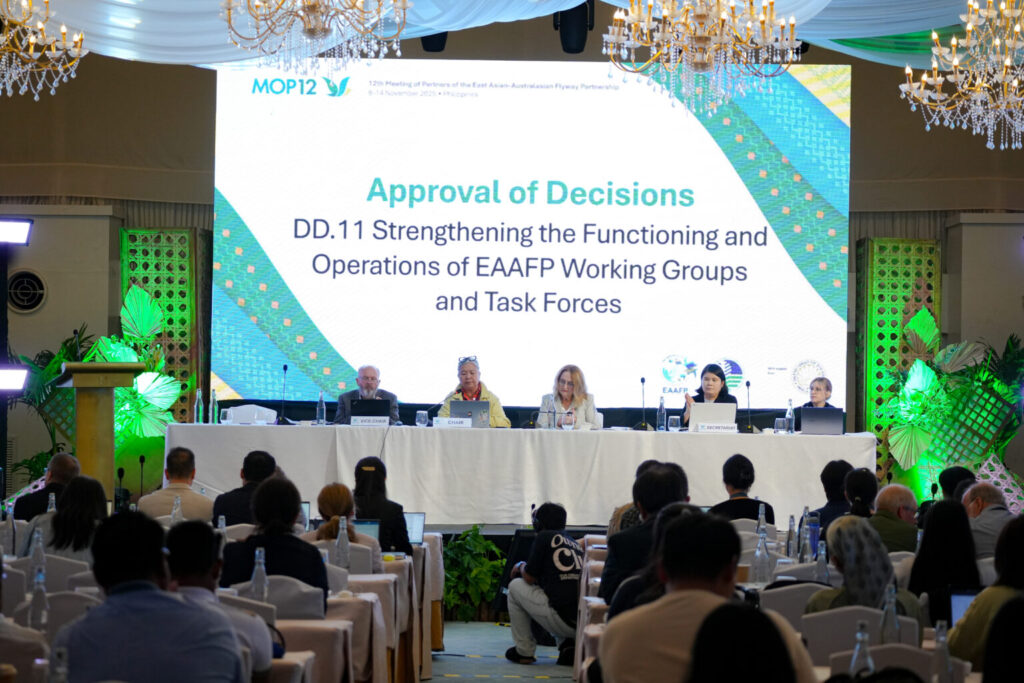
Subsequent sessions focused on strengthening science, governance, and conservation across the Flyway. Partners reviewed the implementation of the EAAFP Strategic Plan 2019–2028 and discussed ways to improve Flyway Site Network management and harmonise governance structures. A major outcome of the meeting was the development of the EAAFP Science Strategy, a framework to accelerate collaborative monitoring and research throughout the Flyway.
Species and habitat conservation were central to discussions. Delegates endorsed the Spoon-billed Sandpiper Action Plan 2025–2035 and reviewed the Far Eastern Curlew Action Plan, restructuring its task force to support more targeted interventions. The creation of a new Tidal Flats Initiative reflected growing concerns over widespread tidal flat loss in key countries. The adoption of international guidelines to mitigate light pollution marked another milestone, recognising the threat artificial lighting poses to migratory species.
Youth engagement and community participation emerged as major themes. Partners adopted the Youth Task Force’s new Terms of Reference and Work Plan through 2028, and presentations showcased innovative Communication, Education, Participation, and Awareness (CEPA) initiatives aimed at Gen Z audiences, including citizen science, digital storytelling, and cross-sector partnerships. Regional and national partners shared new research and conservation successes, from Indonesia’s national migratory bird framework to Korea’s improved breeding outcomes for Black-faced Spoonbills. China, Mongolia, and Russia presented updates on crane and waterbird conservation, while the Flyway University Alliance reported significant growth in its educational programmes. The Philippines highlighted its Phil Flyway Project, supported by the Global Environment Facility (GEF) and ADB, demonstrating integrated conservation efforts in three critical wetlands: Candaba, Sibugay, and Lake Mainit.
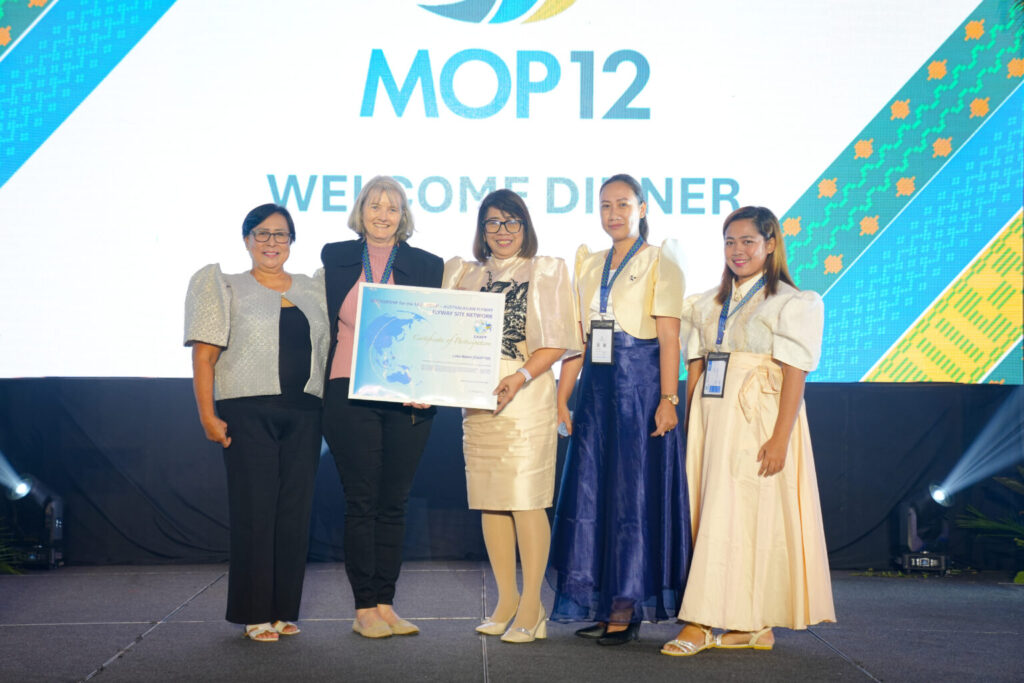
During the Welcome Dinner, new Flyway Network Sites were formally recognised, including Paleik Lake and Pyu Lake in Myanmar, the Yeoncheon Imjin River in the Republic of Korea, Bangpu Nature Education Center in Thailand, and Lake Mainit, Agusan Marsh Wildlife Sanctuary, and Sibugay Wetland Nature Reserve in the Philippines. Two Philippine sites—Sibugay Wetland Nature Reserve and Del Carmen Mangrove Reserve in Siargao—were celebrated for achieving Ramsar designation. New EAAFP Partners were also welcomed, including the Ramsar Regional Center–East Asia, Eco Foundation Global, and ICLEI Cities Biodiversity Center.
Field excursions on 13 November took delegates to the Olango Island Wildlife Sanctuary, one of the Flyway’s most important staging areas for migratory shorebirds. Participants also visited historic and cultural sites around Cebu, gaining insights into how local heritage and natural ecosystems intersect.
The final day of MOP12 on 14 November included elections and appointments for the Chair and Vice-Chair of the Partnership, an appreciation ceremony for outgoing Governance Chairs of the Management Committee, Finance Sub-Committee, and Technical Sub-Committee, and a special message from the host city, Incheon Metropolitan City. The day also featured pledges from partners, celebrations of the 20th Anniversary of EAAFP, and an invitation to host the 2nd Science Symposium, highlighting global partnership and cooperation on World Migratory Bird Day. The meeting concluded with closing remarks from the Chief Executive, Chair of the Partnership Narelle Montgomery, and the Philippine Government represented by Ms Mariglo Rosaida I. Laririt, reaffirming the region’s commitment to conserving migratory birds, wetlands, and the communities that depend on them.
The EAAFP extends its sincere thanks to the Government of the Philippines, all partners, collaborating organisations, participants, and sponsors, including POSCO INTERNATIONAL, Faunatech, Hunan Global Messenger Technology Co., Ltd., ADB, ASEAN Centre for Biodiversity, San Miguel Aerocity, Inc., and KOEN Yeongheung Power Division, for their invaluable support in making MOP12 a resounding success.
The East Asian–Australasian Flyway spans 22 countries from the Arctic to Australia, supporting more than 50 million migratory waterbirds annually. The EAAFP remains the region’s primary platform for international cooperation, ensuring these species and their habitats receive the focused protection they urgently require.