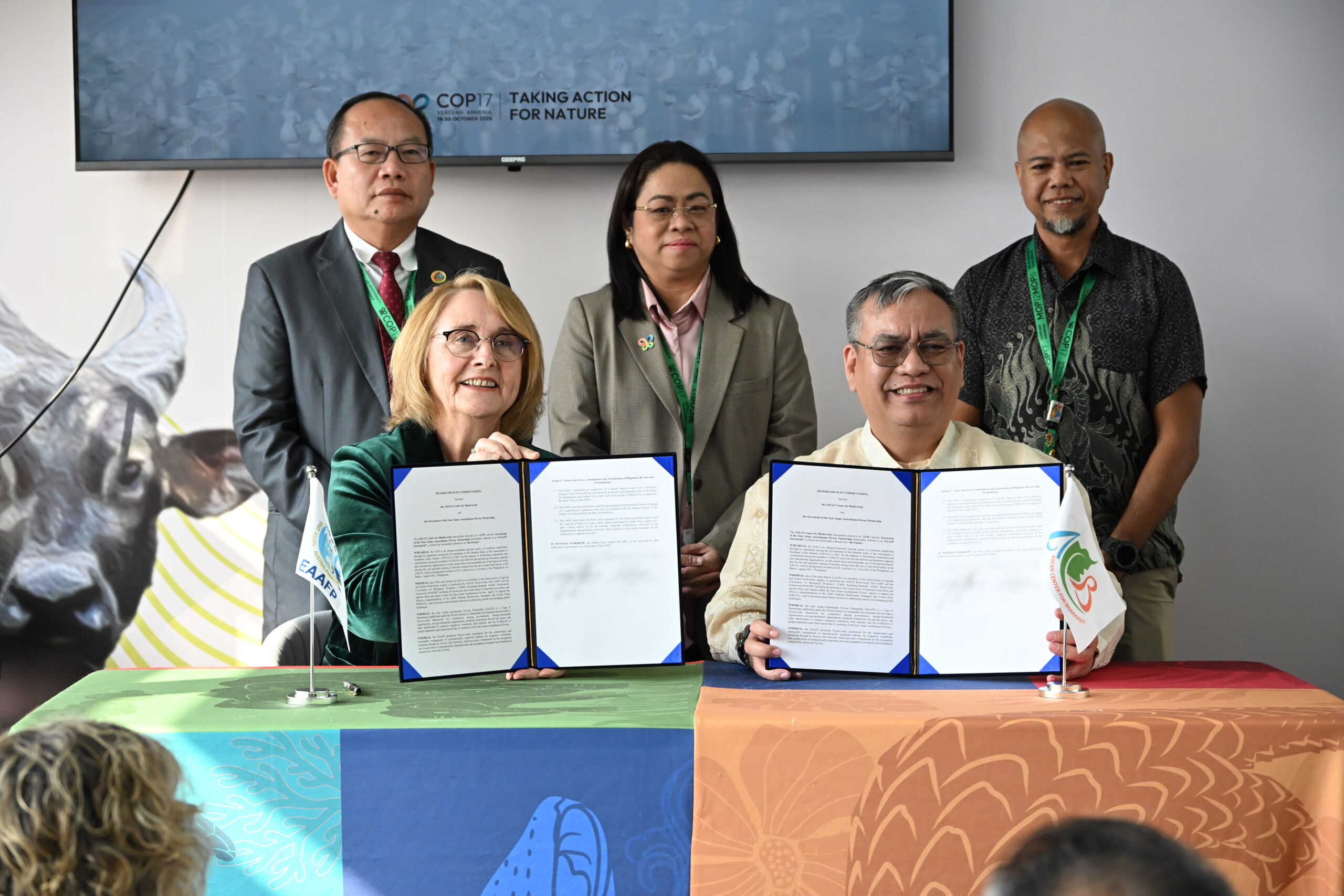
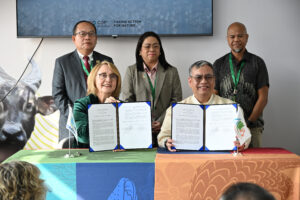
Marking a significant milestone for migratory waterbirds and wetland conservation, the ACB,represented by Dr Jerome Montemayor, and the EAAFP Secretariat, represented by Ms Jennifer George,signed a memorandum of understanding at the sidelines of the 17th UN Biodiversity Conference in Yerevan, Armenia.© ASEAN Centre for Biodiversity.
YEREVAN, Armenia – As international delegates convene in Yerevan for the 17th UN Biodiversity Conference, the ASEAN Centre for Biodiversity (ACB) and the East Asian–Australasian Flyway Partnership (EAAFP) Secretariat signed a memorandum of understanding on 27 October to formalise and strengthen joint efforts in conserving migratory waterbirds and their habitats.
Both the ACB and EAAFP Secretariat recognise the significance of regional and flyway-wide cooperation for the conservation of vulnerable species and the ecosystems on which they depend. Since 2014, the ACB and the EAAFP have been working together on knowledge sharing, capacity building, site assessments, and awareness raising. Most notably, through the ASEAN Flyway Network, their joint efforts have contributed to the designation of Flyway Network Sites within the region, enhancing ecological connectivity across Southeast Asia and the wider East Asian–Australasian Flyway.
In his remarks, Dr Jerome Montemayor, Executive Director of the ACB, reiterated the need to scale up ongoing efforts for the conservation of migratory waterbirds and wetlands. “Strengthening our partnership with the EAAFP Secretariat would give way to greater momentum and widen the scope of our efforts to address challenges in the Flyway. By joining forces, we are bringing more experts and diverse perspectives that will reinforce local and global actions to safeguard ecological connectivity for migratory species,” said Dr Montemayor.
This partnership was forged to support ASEAN Member States in realising the EAAFP Strategic Plan 2019–2028, the ASEAN Biodiversity Plan, and the Kunming-Montreal Global Biodiversity Framework (KMGBF). Beyond ongoing technical exchanges, the collaboration expands into new priority areas including joint policy development, resource mobilisation, site-to-site cooperation, regional and flyway-wide networks, and cross-cutting commitments to gender equality and inclusivity.
The ASEAN region lies along the East Asian–Australasian Flyway, which spans Alaska, North and East Asia, and extends to Oceania. Wetlands along the flyway serve as stopover sites for over 50 million migratory waterbirds. In the ASEAN region, Critically Endangered species such as the Spoon-billed Sandpiper, Masked Finfoot, and Chinese Crested Tern have been recorded along coasts, mudflats, lakes, and other wetland areas. Transboundary cooperation is one of the lifelines that can save these species from extinction and help them build resilient populations.
“Our migratory waterbirds need a network of wetlands, and wetlands need a network of people and institutions,” said Jennifer George, Chief Executive of the EAAFP Secretariat. “Our closer partnership with the ACB will build those networks and amplify the connectivity provided through the EAAFP Flyway Site Network. One country can protect a wetland. Only a network can conserve a journey.”
The MOU was signed by Dr Montemayor and Ms George, with EAAFP Chair Dr. Srey Sunleang, ACB Finance and Administration Director Atty Genalyn Bagon-Soriano, and Biodiversity Conservation Division Director Nheden Amiel Sarne serving as witnesses.
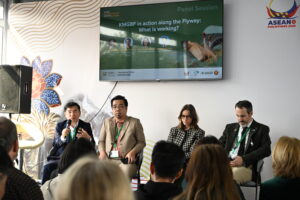
Before the signing ceremony, specialists from Cambodia, the Philippines, the ICLEI Cities Biodiversity Center, and the Asian Development Bank discussed lessons learned and different ways forward on the implementation of the Kunming-Montreal Global Biodiversity Framework in the context of flyways and migratory waterbirds and wetland conservation.© ASEAN Centre for Biodiversity.
The signing was held during the ACB and EAAFP-led side event at the ASEAN Pavilion. Titled “Where Connection Becomes Action: Delivering KMGBF Targets Across a Flyway”, the event explored the role of connectivity in ensuring that global biodiversity targets are met. Panelists Dr Ly Sophanna (Ministry of Environment of Cambodia), Anson Tagtag (Department of Environment and Natural Resources of the Philippines), Eleanor Dewar (ICLEI Cities Biodiversity Center), and Duncan Lang (Asian Development Bank) shared their unique perspectives on what works on the ground and opportunities to bridge gaps for long-distance migratory species.
During the side event, Mongolia, through Director General Uranchimeg Tserendorj of Mongolia’s Department of Protected Areas Policy, Ministry of Environment and Climate Change, likewise announced its hosting of the 13th Meeting of Partners of the EAAFP in 2028.