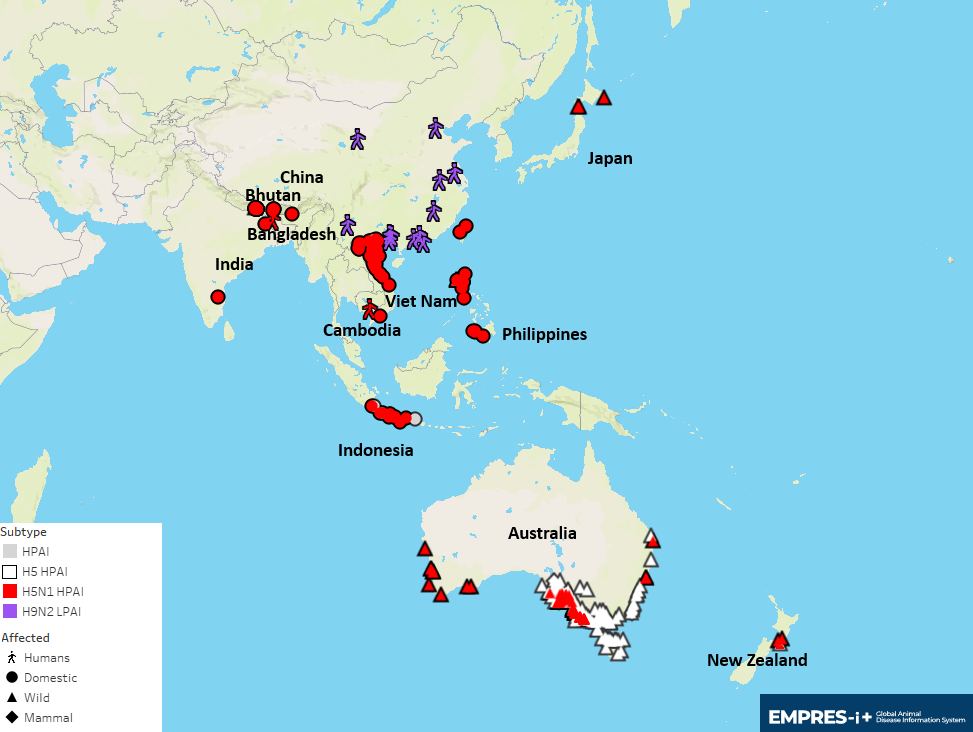
Map. Distribution of avian influenza events reported in animals and humans from 9 June to 15 September 2026.
Note: The H5 HPAI virus detection of Heard Island, Australia is not included on the map.
Disclaimer: The boundaries and names shown and the designations used on these map(s) do not imply the expression of any opinion whatsoever on the part of FAO concerning the legal status of any country, territory, city or area or of its authorities, or concerning the delimitation of its frontiers and boundaries. Dashed lines on maps represent approximate border lines for which there may not yet be full agreement. Dotted line represents approximately the Line of Control in Jammu and Kashmir agreed upon by India and Pakistan. The final status of Jammu and Kashmir has not yet been agreed upon by the parties.
Source: United Nations Geospatial. 2020. Map of the World. [Cited September 2026]. Modified with Emergency Prevention System Global Animal Disease Information System (EMPRES-i), the World Organisation for Animal Health (WOAH) and National Authorities data, 2026.
FAO/EMPRES-AH is constantly monitoring the avian influenza situation worldwide and compiles information from multiple national and international sources as well as peer-reviewed scientific articles. Close collaboration with country and regional offices, the implementation of avian influenza field surveillance projects, and networks of expertise like WOAH/FAO’s OFFLU (www.offlu.org) provide access to timely information on outbreaks, surveillance findings, and genetic similarities of circulating viruses or their virologic features. This information is stored in the EMPRES Global Animal Disease Information System (EMPRES-i+), a database that can be accessed online at https://empres-i.apps.fao.org/.
During the period from 9 June to 15 September 2026, one high pathogenicity avian influenza (HPAI) virus subtype (H5N1) and one low pathogenicity avian influenza (LPAI) virus subtype (H9N2) have been reported in Oceania and in East, South, and Southeast Asia. H5Nx HPAI viruses continue to circulate in Asia and are well established in certain areas of the region.
Australia reported its first ever introduction of H5 HPAI on 19 June 2026. Phylogenetic analyses of available virus sequences suggest multiple independent introductions of clade 2.3.4.4b H5N1 HPAI virus into mainland Australia from the sub-Antarctic region, most likely from or through locations epidemiologically connected to Heard Island via the Southern Ocean Flyway. As of 15 September 2026, more than 500 H5 HPAI events were reported in wild birds as well as 12 events in wild mammals. A wide
array of wild birds have been affected, spanning multiple families and species belonging to: Accipitridae, Artamidae, Corvidae, Diomedeidae, Falconidae, Haematopodidae, Laridae, Oceanitidae, Pelecanidae, Phalacrocoracidae, Procellariidae, Spheniscidae, Stercorariidae, Strigidae, Sturnidae, and Sulidae families; of these, 24 bird species were reported for the first time. Wild bird species of the Laridae family accounted for the majority of reported HPAI detections since June 2026. As for the wild mammals, H5 HPAI virus was detected in dolphins, sea lions, seals and foxes, including three species reported for the first time. For more details on the species affected by H5 HPAI in Australia, see Annex 1.
New Zealand reported its first ever introduction of H5 HPAI on 15 July 2026, shortly after Australia. During the reported period, three H5 HPAI events were detected in wild birds affecting a Brown Skua (Stercorarius antarcticus), Swamp Harrier (Circus approximans) and Southern Giant Petrel (Macronectes giganteus), with the latest detection confirmed on 21 August.
Bhutan reported one H5N1 HPAI outbreak in domestic birds in Mongar District.
China reported two H5N1 HPAI outbreaks in domestic birds in Taiwan Province in Changhua (1) county and Taipei (1) city, affecting quails and chickens respectively.
India reported six H5N1 HPAI outbreaks in domestic birds in Andhra Pradesh, Bihar and Sikkim states.
Indonesia reported six HPAI outbreaks in domestic birds in July (5) and August (1), in Lampung Province (1) on Sumatra Island, and West Java (1), Central Java (1), East Java (2) provinces on Java Island, affecting chickens and ducks.
Japan reported H5N1 confirmation in three samples collected from two Eastern Spot-billed Duck (Anas zonorhyncha) and one Northern Pintail (Anas acuta) in October 2025 in Hokkaido Prefecture.
Nepal reported 42 H5N1 HPAI events, marking a sustained HPAI activity since the last reporting period. Of these, 41 H5N1 HPAI outbreaks were reported in domestic birds, mostly in Bagmati Province. Additionally, one H5N1 HPAI event was reported in wild birds affecting a Common Pheasant (Phasianus colchicus) and a Grey Heron (Ardea cinerea), also in Bagmati Province.
The Philippines reported H5N1 HPAI in three wild bird species through the regular and enhanced surveillance conducted in June in the Municipality of Bolinao in Pangasinan Province involving species such as Eurasian Tree Sparrow (Passer montanus), Pied triller (Lalage nigra), Zebra Dove (Geopelia striata); and also reported H5 HPAI in Lowland White Eye (Zosterops meyeni), and Yellow Vented Bulbul (Pycnonotus goiavier). All these species, with the exception of the Eurasian Tree Sparrow, were reported with H5 HPAI infection for the first time. In domestic birds, four H5N1 HPAI outbreaks have been reported in chickens and ducks in Kalinga Province (Cordillera Administrative Region), Pangasinan Province (Region I), Pampanga Province (Region III) on Luzon Island, and Maguindanao del Sur Province (Bangsamoro Autonomous Region) on Mindanao Island. In particular, the prolonged outbreak in Pangasinan Province is affecting Municipalities of Bolinao and San Quintin for over three months.
The Republic of Korea has not reported any HPAI events during this reporting period.
Viet Nam reported at least 65 H5N1 HPAI outbreaks in domestic birds across 15 provinces and Ha Noi City.
Avian influenza viruses continue to circulate extensively in some parts of Asia, resulting in sporadic human infections. While the H5N1 virus recently detected in Oceania differs from those circulating in Asia, it nevertheless has zoonotic potential. During the reporting period, Bangladesh and Cambodia reported one influenza A(H5N1) human case in Rangpur Division and Phnom Penh, respectively. China reported a total of 13 influenza A(H9N2) human infections in Beijing Municipality (1), Guangxi Zhuang Autonomous Region (2), Hong Kong Special Administrative Region (1), and in Anhui (1), Gansu (1), Guangdong (2), Jiangxi (1), Jiangsu (2) and Yunnan (2) provinces.
Highly pathogenic H5N1, H5N2, H5N5, H5N6, and H5N8 viruses have demonstrated the ability to spread via migratory water birds. Avian influenza activity in Asia appears to have reached its seasonal low during the June to September period, although endemicity persists in poultry production systems in parts of the region. An increase in HPAI activity in poultry and wild birds is anticipated in the coming months as migratory bird movements intensify across the region. In Oceania, the broad range of wild bird species affected by H5 HPAI suggests that further detections in wild bird populations are likely, with occasional spillover events into susceptible mammalian species also expected. The list of bird species affected by H5Nx HPAI globally is available HERE with the new species reported since 2021 highlighted in orange.
Annex 1. Species H5 infection confirmed in Australian Government, as of 16 September 2026. The first-time H5 detection in the species is shown in red.
Accipitriformes: Accipitridae – Brown Goshawk (Accipiter fasciatus), Whistling Kite (Haliastur sphenurus), White-bellied Sea-eagle (Haliaeetus leucogaster), Black Kite (Milvus migrans), Swamp Harrier (Circus approximans);
Charadriiformes: Haematopodidae – Sooty Oystercatcher (Haematopus fuliginosus); Laridae – Pacific Gull (Larus pacificus), White-fronted Tern (Sterna striata), Greater Crested Tern (Thalasseus bergii); Stercorariidae – Brown Skua (Stercorarius antarcticus);
Falconiformes: Falconidae – Brown Falcon (Falco berigora), Peregrine Falcon (Falco peregrinus);
Passeriformes: Artamidae – Australian Magpie (Gymnorhina tibicen); Corvidae – Australian Raven (Corvus coronoides), Forest Raven (Corvus tasmanicus), Little Raven (Corvus mellori); Sturnidae – Common Myna (Acridotheres tristis);
Pelecaniformes: Pelecanidae – Australian Pelican (Pelecanus conspicillatus);
Procellariiformes: Diomedeidae – Shy Albatross (Thalassarche cauta); Oceanitidae – White-faced Storm-petrel (Pelagodroma marina); Procellariidae – Fluttering Shearwater (Puffinus gavia), Hutton’s Shearwater (Puffinus huttoni), Wedge-tailed Shearwater (Ardenna pacifica), White-headed Petrel (Pterodroma lessonii), Northern Giant Petrel (Macronectes halli), Southern Giant Petrel (Macronectes giganteus);
Sphenisciformes: Spheniscidae – Little Penguin (Eudyptula minor);
Strigiformes: Strigidae – Southern Boobook (Ninox boobook);
Suliformes: Phalacrocoracidae – Black-faced Cormorant (Phalacrocorax fuscescens), Great Pied Cormorant (Phalacrocorax varius), Little Black Cormorant (Phalacrocorax sulcirostris); Sulidae – Australasian Gannet (Morus serrator).
Carnivora: Otariidae – Long-nosed Fur Seal (Arctocephalus forsteri), Australian Fur Seal (Arctocephalus pusillus ssp. doriferus), Australian Sea Lion (Neophoca cinerea); Canidae – Red Fox (Vulpes vulpes);
Cetartiodactyla: Delphinidae – Common Dolphin (Delphinus delphis), Common bottlenose dolphin (Tursiops truncatus)