


What is World Migratory Bird Day?
World Migratory Bird Day (WMBD) is an annual global awareness-raising campaign aimed at celebrating the amazing journeys of migratory birds and inspiring worldwide conservation of migratory birds and their habitats. Traditionally observed on the second Saturday of May and October, the two days of World Migratory Bird Day serve as a means to reflect the cyclical nature of bird migration, as well as the varying peak migration periods in the northern and southern hemispheres. In 2026, WMBD will be celebrated on 9th May and 10th October.
Today, the campaign shines as a beacon of cooperation, with the Convention on the Conservation of Migratory Species of Wild Animals (CMS), the African-Eurasian Migratory Waterbird Agreement (AEWA), Environment for the Americas (EFTA), and the East Asian–Australasian Flyway Partnership (EAAFP) standing shoulder to shoulder. But fun fact, this collaborative tale first began in October 2017 with the trio CMS, AEWA, and EFTA. In a move reminiscent of the Three Musketeers, they combined strengths, integrating International Migratory Bird Day with World Migratory Bird Day (WMBD) to champion the cause of our avian companions. Then, just five years later, on March 17th, the ensemble welcomed a new member as the EAAFP officially entered the fold during the 11th Meeting of Partners (MoP11) in Brisbane, Australia. This fresh partnership heralds an exciting phase in the ongoing quest to raise awareness and safeguard the remarkable voyages of migratory birds around the world.
Official website of World Migratory Bird Day: https://www.worldmigratorybirdday.org/
The Theme of World Migratory Bird Day 2026
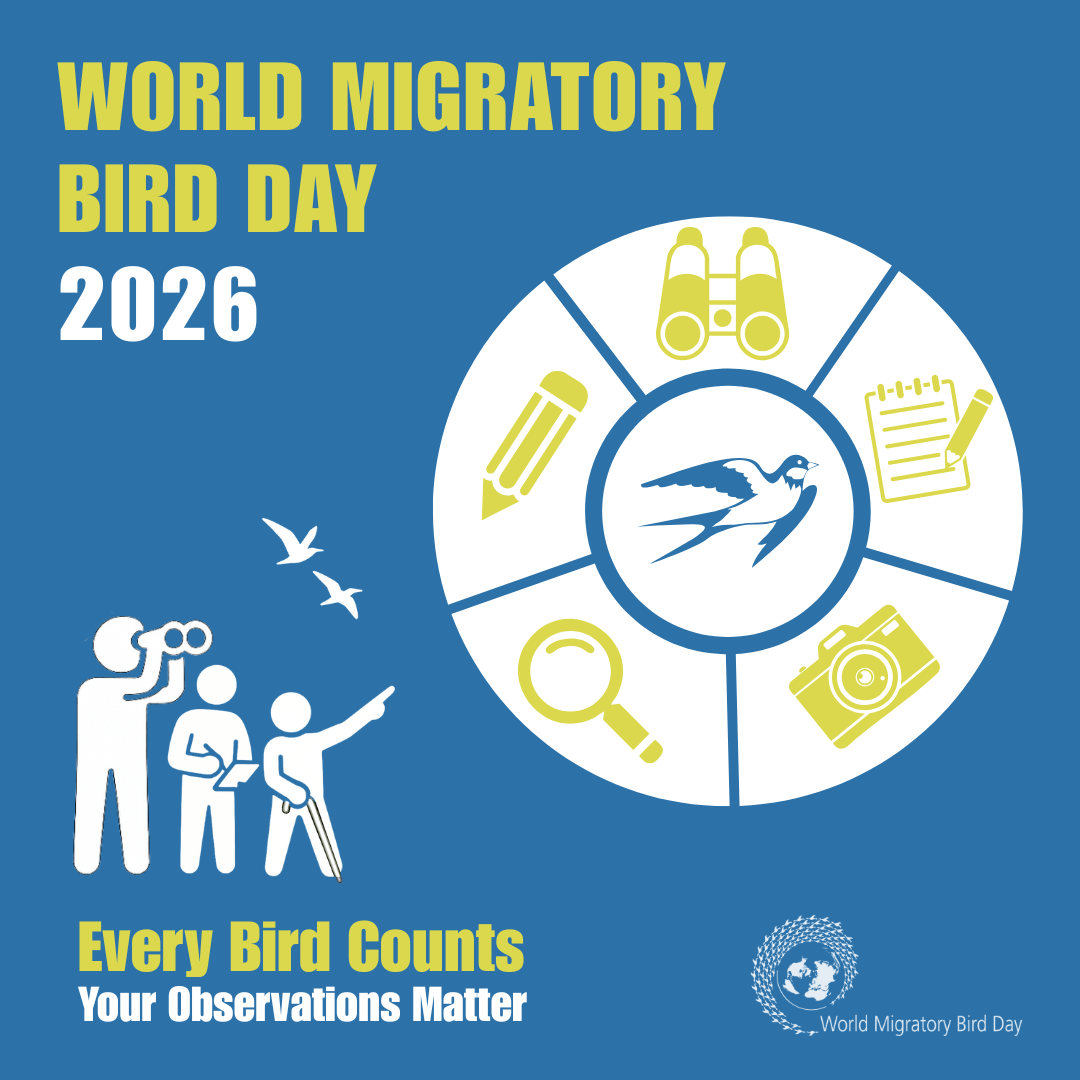
The partners behind World Migratory Bird Day are happy to announce that the theme for the 2026 campaign will be dedicated to Community science (also referred to as citizen science).
“Every Bird Counts – Your Observations Matter!” is the slogan for World Migratory Bird Day 2026, highlighting the important role of community science/citizen science for the conservation of migratory birds.
The 2026 campaign shines a spotlight on people-driven efforts that are essential for bird conservation and science, celebrating how individuals, communities, and organizations around the world are helping to build the knowledge base to better conserve migratory birds across borders.
By focusing on the contribution of individuals, participatory science and public bird monitoring efforts, the campaign will celebrate the millions of bird enthusiasts around the world that are contributing to the data and knowledge that inform policy decisions and are essential for bird conservation – through each recorded observation.
For the World Migratory Bird Day 2025 Campaign Toolkit, click [here].
Discover 2026’s EAA Flyway Species on the WMBD Poster
| American/Pied/Eurasian Oystercatcher (Haematopus palliatus/longirostris /ostralegus)The Oystercatcher is a striking black-and-white shorebird with a bright orange bill, found along coastal beaches, mudflats, and salt marshes of the Americas. Its populations are low, and it is listed as a Species of High Conservation Concern in the United States, Asia, and Oceania.Key threats include habitat loss, disturbance from people, dogs, and vehicles on beaches, predation of eggs and chicks, and plastic pollution. When adults are flushed from nests, eggs and chicks are left vulnerable to predators, weather, and trampling.Community science is critical for protecting this species. If you see a banded oystercatcher, record the band number and report it to the American Oystercatcher Working Group to support population tracking. Participate in beach-based shorebird surveys, such as the annual counts hosted by BirdsCaribbean. You can also help reduce plastic threats by organizing or joining beach cleanups and sharing data with programs like The Ocean Cleanup. |  | |
| Spoon-billed Sandpiper (Calidris pygmaea) The Spoon-billed Sandpiper is a tiny, critically endangered shorebird with a distinctive spoon-shaped bill. It breeds in the Arctic tundra of northeastern Russia and migrates to coastal South and Southeast Asia, relying on shallow wetlands to feed on small invertebrates.Severe population declines are driven by habitat loss from reclamation, coastal development, especially in the Yellow Sea, and traditional hunting. Protecting wetlands along its migration route is vital for survival.Community science supports conservation efforts. Observers can report sightings of individually marked birds through the EAAFP Leg Flag Database or participate in the International Waterbird Census, a global midwinter survey coordinated by Wetlands International. Even if Spoon-billed Sandpipers are not local, counting waterbirds in rivers, lakes, mudflats, and other wetlands contributes critical data to track populations and identify priority habitats, directly aiding conservation of this rare species. |  | |
Merlin (Falco columbarius) The Merlin is a small, powerful falcon known for its speed and agility. Once called the “pigeon hawk,” it hunts by flying low and fast to surprise small birds. Adult males are dark blue-gray, while females and juveniles are larger and brown, providing camouflage. Merlins is a holarctic species breed from Iceland to East Siberia in Eurasia, Mongolia, and Amur River drainage in Asia, also breed in northern forests of North America and Eurasia and migrate south in winter to the southern United States, Mexico, and northern South America. Populations declined sharply in the mid-20th century due to DDT, which caused eggshell thinning. Numbers rebounded after the pesticide was banned, but Merlins still face habitat loss, fragmentation, and increasing collisions with vehicles and windows as they adapt to urban areas. Raptor surveys, such as hawk migration counts coordinated by organizations like Hawk Mountain, allow people of all experience levels to contribute observations. Visiting migration watchsites, joining surveys, or supporting local efforts helps researchers monitor populations and protect raptors. |  | |
| Barn Swallow (Hirundo rustica) Barn Swallows are declining across much of their global range due to pesticide use, loss of nesting sites, and climate change. Protecting insects and breeding habitat is essential to their survival.Community science plays a major role in Barn Swallow conservation. These birds build visible mud nests on buildings, bridges, and homes, making them easy to monitor. By reporting nests and sightings, you help scientists track population trends and identify priority areas for protection.Submit nest data through NestWatch, log sightings year-round with eBird, or join swallow-focused projects on NatureCounts in Canada. In Europe and Africa, the EURING Swallow Project uses banding data to guide conservation—volunteers are always needed at banding stations. In Asia, monitoring and observation reports, along with the dissemination of educational materials such as “Barn Swallows Observation Guide” by WBSJ are supporting data collection and the assessment of the Barn Swallow population status. |  |
Be Part of the WMBD Celebration!
01. Join Us Online
Don’t forget to register your event on the Global Portal at https://www.migratorybirdday.org/events/
02. Other World Migratory Bird Day 2026 Activities
 | You are invited to join the EAAFP Team on May 9 for the Global Big Day by eBird! Be part of our team and help record migratory waterbirds in the #EAAFlyway! Here’s what you need to do:
You can find the “EAAFPTeam” profile here: https://ebird.org/profile/MzgyMzk1NA |
Resources for World Migratory Bird Day 2026
01. EAAFP World Migratory Bird Day 2026 Small Grant
The Small Grant Fund for the 2026 World Migratory Bird Day has been established to provide financial support for EAAFP Partners and collaborators from EAAFP Task Forces and Working Groups who plan to organize public events and/or conservation action-oriented workshops at national or local levels for World Migratory Bird Day. We strongly encourage EAAFP Partners and collaborators to apply for any suitable event or development of WMBD materials in local languages that aim to raise awareness of the need to conserve migratory waterbirds and the value of their habitats in the East Asian–Australasian Flyway.
For details, visit [here].
02. World Migratory Bird Day 2026 Trello Board
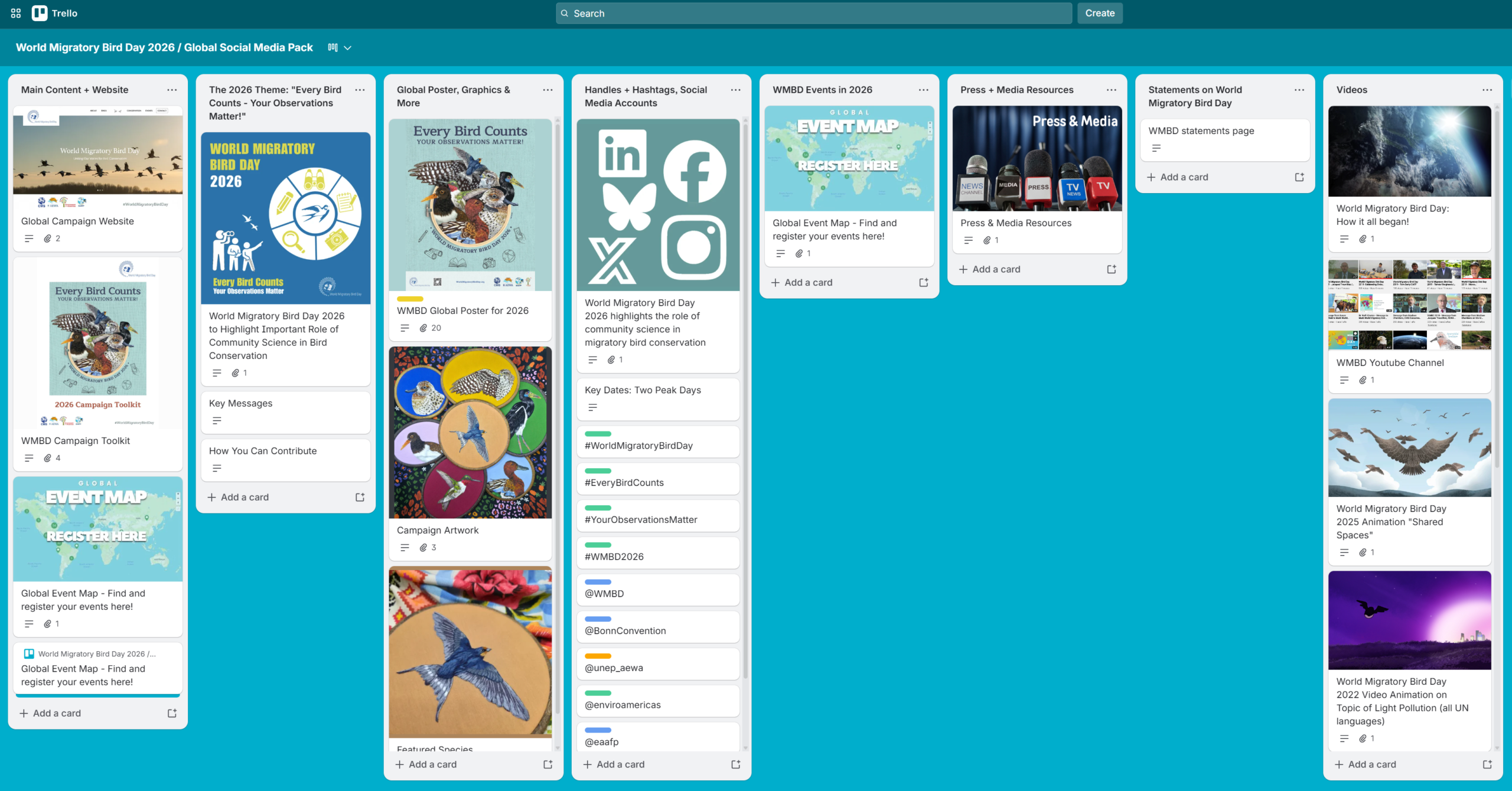
The WMBD 2026 Global Social Media Pack is a collection of ready-to-use campaign materials to help you share this year’s message. Access posters, graphics, statements, hashtags, key campaign information and more [here].
03. World Migratory Bird Day 2026 Poster in EAAF Languages
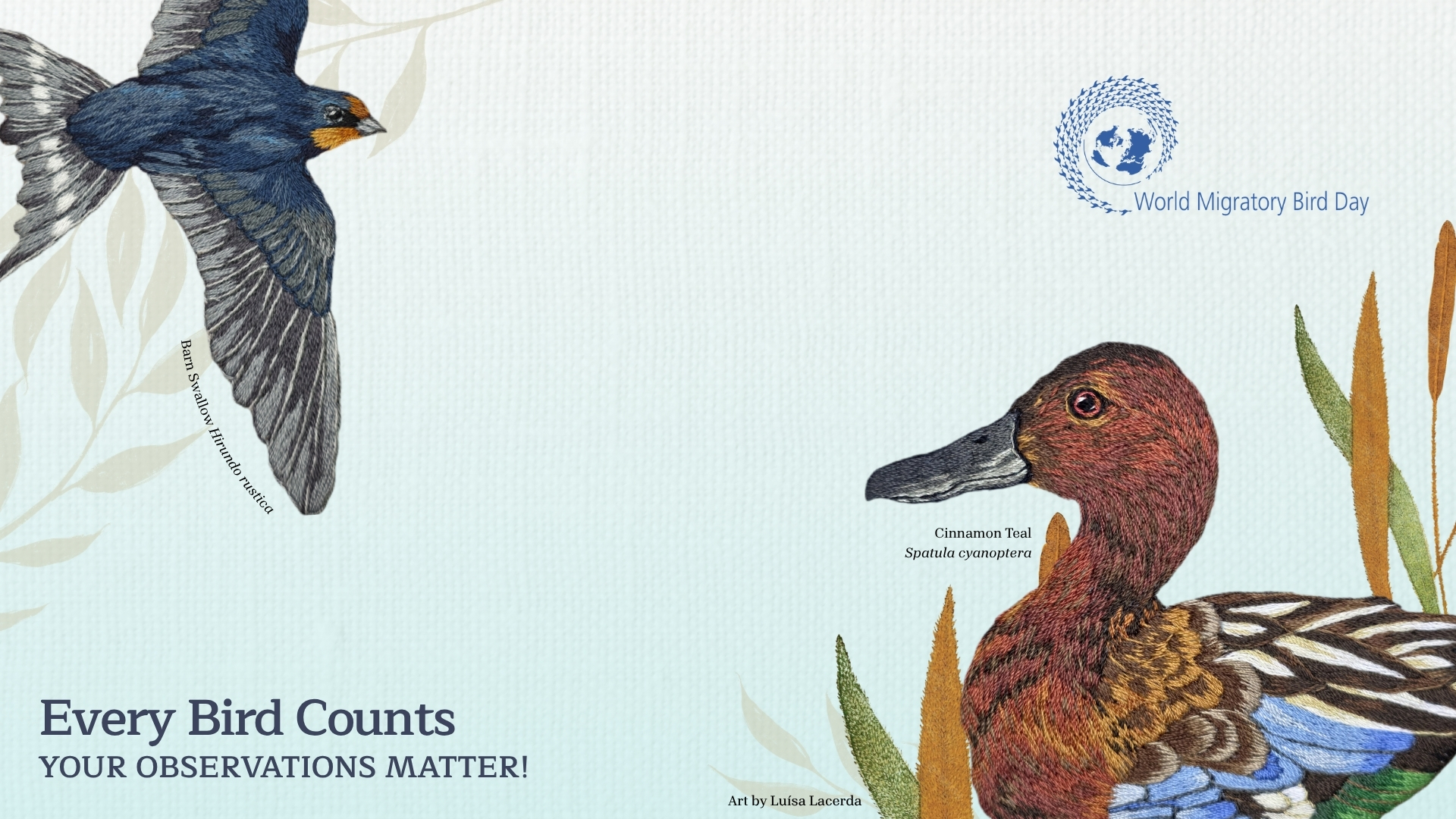
The mini collection of downloadable virtual backgrounds features the World Migratory Burd Day 2026 Ambassador Birds and theme “Every Bird Counts – Your Observation Matter!’, beautifully brought to life by Luísa Lacerda through her colourful embroidery. Download the full set here.
 |  |
 |  |
WMBD 2026 Around the World
Check out the global map of events below. Visit this link to register your event.
