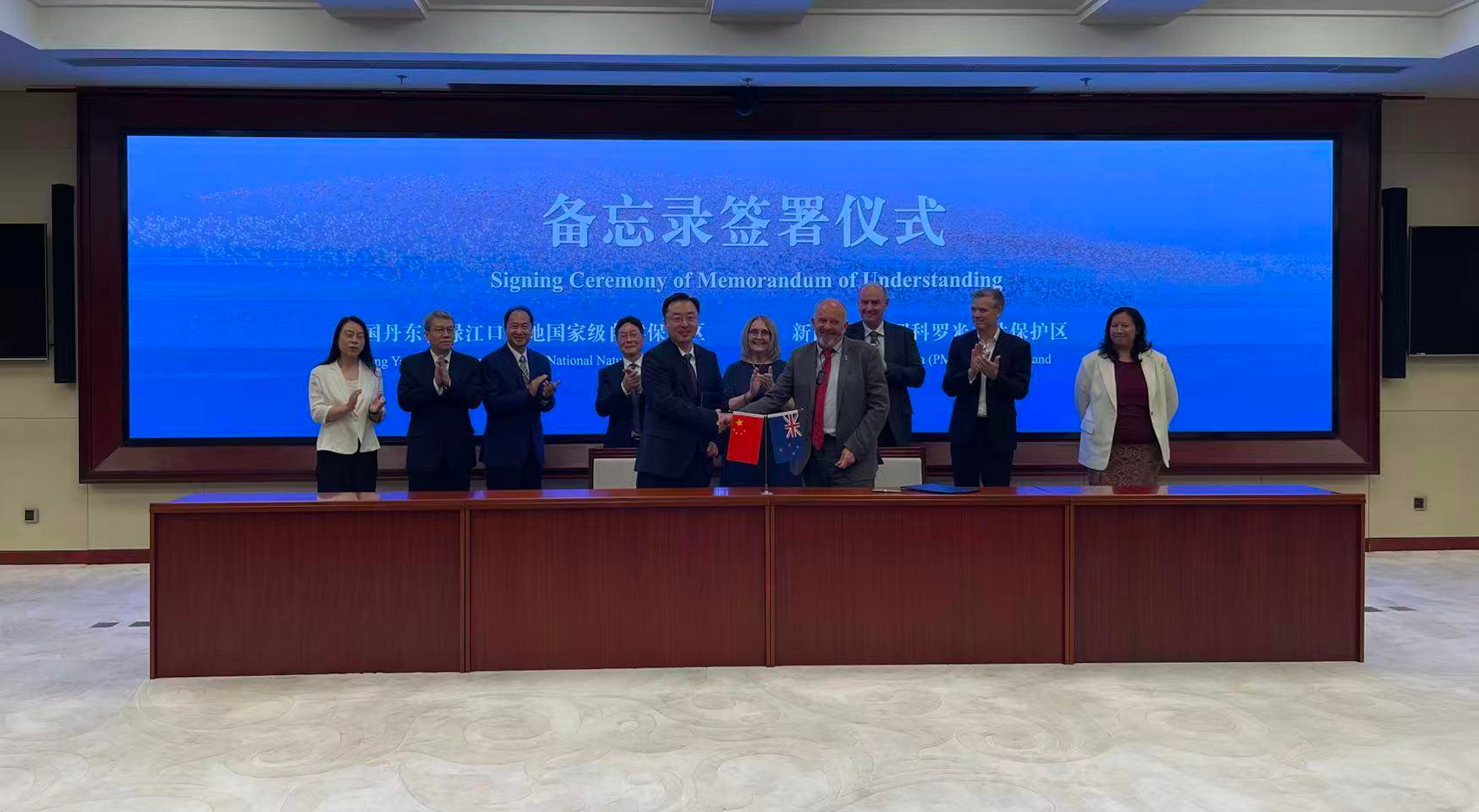
29 September 2025 — The People’s Republic of China’s Yalujiang National Nature Reserve [EAAF043] and New Zealand’s Firth of Thames [EAAF019] renewed their long-standing partnership by signing a Memorandum of Understanding (MoU) in China, reaffirming their status as Sister Sites under the East Asian–Australasian Flyway Partnership (EAAFP).
The signing ceremony was attended by Li Yunqing, Vice Administrator of the National Forest and Grassland Administration, and Jonathan Austin, New Zealand Ambassador to China. During the event, the two officials discussed ongoing cooperation between their countries and witnessed the formal signing of the MoU.
The renewed agreement continues the strong cooperation between the two Flyway Network Sites (FNS), particularly in research, capacity building, and awareness-raising for the conservation of migratory shorebirds. The Sister Site relationship focuses on several key species. One of them, the Bar-tailed Godwit (Limosa lapponica), breeds in the Arctic, migrates to the Firth of Thames during the non-breeding season, and relies on Yalujiang National Nature Reserve as a critical refueling stop during its long-distance migration. This remarkable journey underscores the importance of coordinated conservation efforts between China and New Zealand to ensure safe and connected habitats along the Flyway.
First formalised in 2004, the Sister Site partnership has delivered notable conservation outcomes. Long-term monitoring has confirmed Yalujiang as a vital staging site, with over 115,000 Bar-tailed Godwits recorded in a single migration season, reinforcing the site’s global importance and contributing to its recognition as a UNESCO World Heritage Site.
The partnership between Yalujiang National Nature Reserve, managed by Dandong City, and the Firth of Thames, managed by the Pukorokoro Miranda Naturalists Trust, demonstrates effective multi-sector collaboration. Government agencies, non-government organisations, researchers, and local communities work together to address shared conservation challenges across the East Asian–Australasian Flyway.
Beyond site-level impacts, this Sister Site cooperation has also served as a model for international collaboration in migratory waterbird conservation. Outcomes of the cooperation helped inform the 2016 bilateral agreement between the governments of China and New Zealand, in which both countries committed to protecting migratory species shared across their territories.
Knowledge exchange and joint learning between the two Flyway Network Sites have been instrumental in guiding effective local and transboundary conservation strategies. This collaboration is expected to continue and deepen following the renewal of the MoU.
The Sister Site Agreement is a programme under the Flyway Site Network of the EAAFP that connects Flyway Network Sites from different countries to promote coordinated conservation of migratory waterbirds and their habitats throughout the East Asian–Australasian Flyway.
Sources:
EAAFP Secretariat. (2023). EAAFP Flyway Site Network brochure. East Asian–Australasian Flyway Partnership. https://eaaflyway.org/wp-content/uploads/2023/12/EAAFP-2023-Brochure-10th_linked_font-linked_final_WEB-ver..pdf Eaaflyway
East Asian–Australasian Flyway Partnership Secretariat. (2016, April 1). Welcome notes on DOC and China’s SFA signing MoA to protect migratory birds. https://eaaflyway.org/welcome-notes-on-doc-and-chinas-sfa-sign-moa-to-protect-migratory-birds/
Pūkorokoro Miranda Shorebird Centre. (n.d.). Yalu Jiang 2009. https://shorebirds.org.nz/archives/97
Townshend, T. (2025, September 30). China and New Zealand sign cooperation agreement on migratory birds. Wild Beijing 北京自然. https://wildbeijing.org/2025/09/30/china-and-new-zealand-sign-cooperation-agreement-on-migratory-birds/ Wild Beijing 北京自然