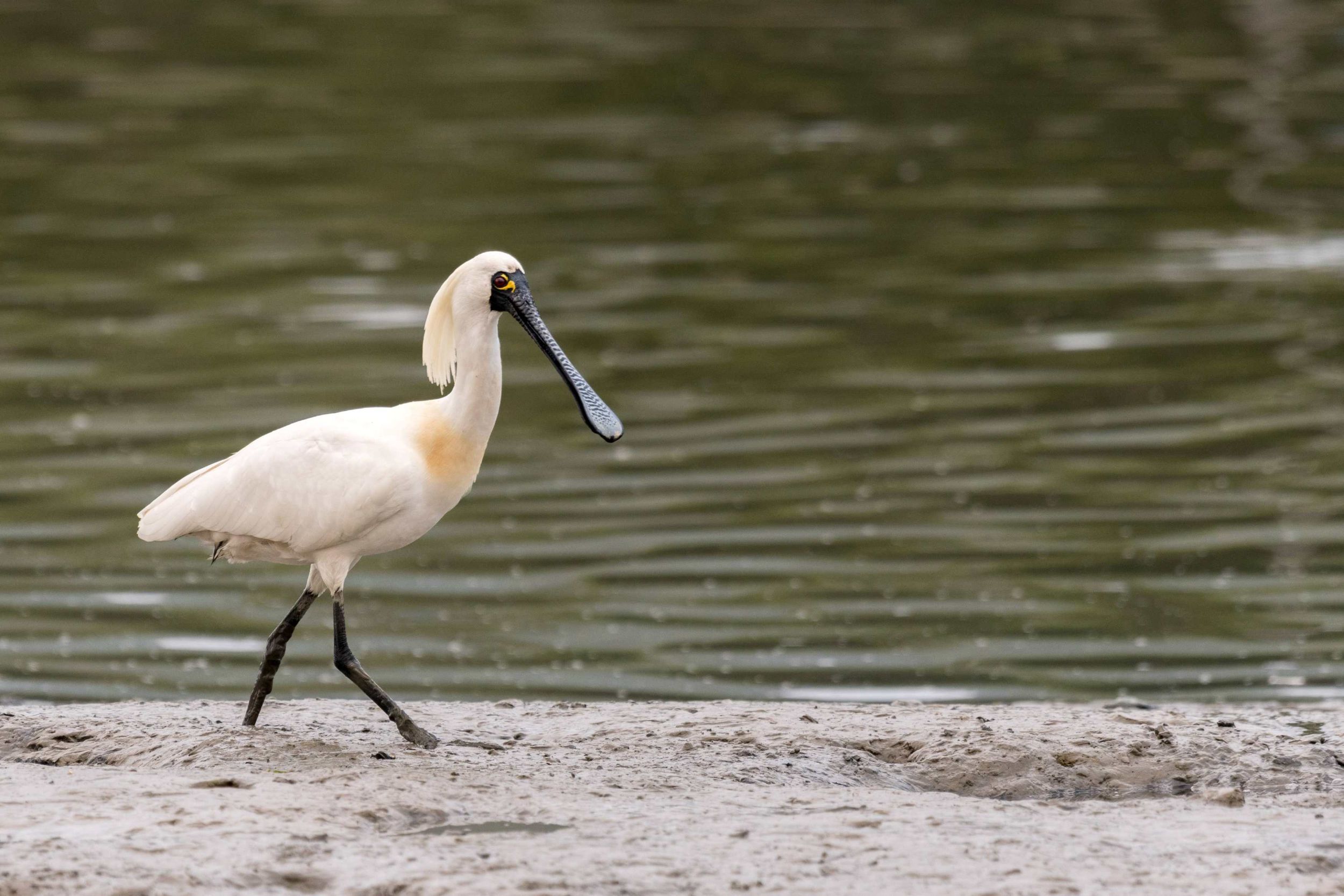
ⓒ Anson Tse, HKBWS
Over the past 40 years, international collaboration has helped save the species from the brink of extinction, but habitat threats and slowing growth demand renewed focus.
Hong Kong/Incheon, 17 October 2025
The East Asia–Australasian Flyway Partnership (EAAFP) Black-faced Spoonbill Working Group celebrates a rare conservation success of the Black-faced Spoonbill Platalea minor: The International Union for Conservation of Nature (IUCN) has proposed downlisting the species from globally Endangered to Vulnerable on its Red List. The global population of the Black-faced Spoonbill has surpassed 7,000 individuals for the first time, reaching 7,081 in 2025. This marks a dramatic recovery from fewer than 300 individuals in the late 1980s, thanks to decades of coordinated international efforts involving governments, NGOs, researchers, and local communities.
However, experts caution that the species’ future remains uncertain. This status change reflects a progress but not security. “The Black-faced Spoonbill has been saved—for now,” said Dr. Kisup Lee, Chair of the EAAFP Black-faced Spoonbill Working Group. “But its future depends on how we respond to the growing threats that continue to erode its habitat.”
The Black-faced Spoonbill is a medium-sized waterbird with white plumage and a distinctive spoon-shaped black bill. It breeds on islets in the Korean Peninsula, the northeastern coast of China, and Russia, and winters in the Southern coast of China, Taiwan, Hong Kong, Japan, Vietnam, and Southeast Asia. Despite an increase in population, this species still faces serious threats, including coastal wetland destruction from urbanization and land reclamation, pollution and human disturbance in estuarine zones, encroachment by renewable energy infrastructure such as wind farms and solar panels, and avian diseases outbreaks in their wintering congregation sites. The last two threats are now looming to have severe impacts on Black-faced Spoonbill populations. These threats could be intensified by climate change. Successful breeding habitat management practices, including the construction of artificial islands with predator control and vegetation management, have resulted in high breeding success for the Black-faced Spoonbills in these sites. However, there is a sign of slower population increases in recent years.
The population trend and improvement in the threatened status of the Black-faced Spoonbill are reflected in the volunteer-based annual International Black-faced Spoonbill Census. This has become one of the largest and most engaging citizen science surveys, resulting in positive conservation gains. NGOs, scientists, site managers, and citizens participated from their respective sites, contributing valuable data to jointly assess the global population of the Black-faced Spoonbill. The species’ recovery has fostered deeper engagement from local fisheries and communities, creating opportunities to share their conservation story. This recovery has also added value to local livelihoods through events, festivals, and other community-driven initiatives, such as local festivals in Hong Kong, educational programmes in Japan, and birthday and farewell parties in Incheon.
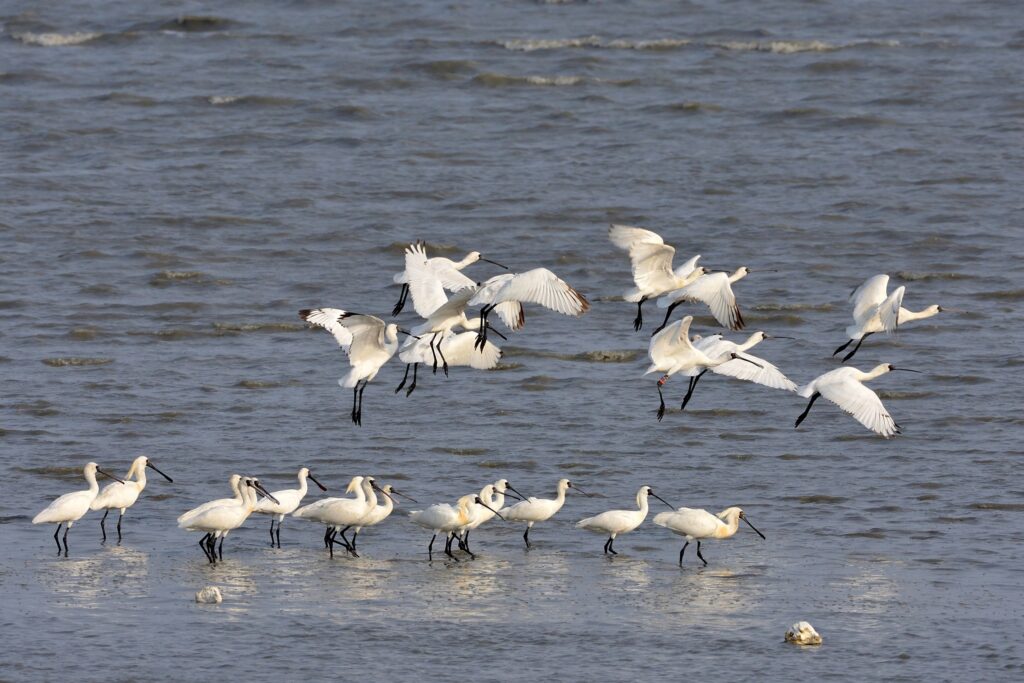
ⓒ DaeHwan Kim
“The story of the Black-faced Spoonbill is a testament to what global collaboration can achieve,” said Yat-tung Yu, Coordinator of the EAAFP Black-faced Spoonbill Working Group. “Now, we must ensure that this success becomes a foundation for long-term resilience—not just for spoonbills, but for the entire wetland ecosystem they depend on.”
Although the recovery of the Black-faced Spoonbill marks a celebratory milestone in our long-term joint conservation effort, it is crucial to maintain our commitment to conservation, as the species’ survival remains highly reliant on conservation interventions. To secure the species’ future, the Working Group is developing a new International Single Species Action Plan for 2026–2036, which will continue to address emerging threats and guide conservation efforts across the Flyway. Key priorities include identifying key breeding, staging and wintering sites of the spoonbills, enhancing knowledge and adaptive strategies to address emerging threats, strengthening international cooperation for monitoring and information sharing, and community engagement and education to foster local stewardship. This is aimed to be published in the course of 2026.
Established in 2013, the EAAFP Black-faced Spoonbill Working Group coordinates conservation actions across the species’ range. It has played a pivotal role in research, habitat protection, environmental advocacy, and CEPA (Communication/Capacity building, Education, Participation and Awareness) activities.
Learn more at https://eaaflyway.org/black-faced-spoonbill-working-group
Media Contact: Mr. Yat-tung Yu, Director of the Hong Kong Bird Watching Society / Coordinator of the EAAFP Black-faced Spoonbill Working Group.
Contact at: (email) yyattung@hkwbs.org.hk (Tel) +852 2377 4387