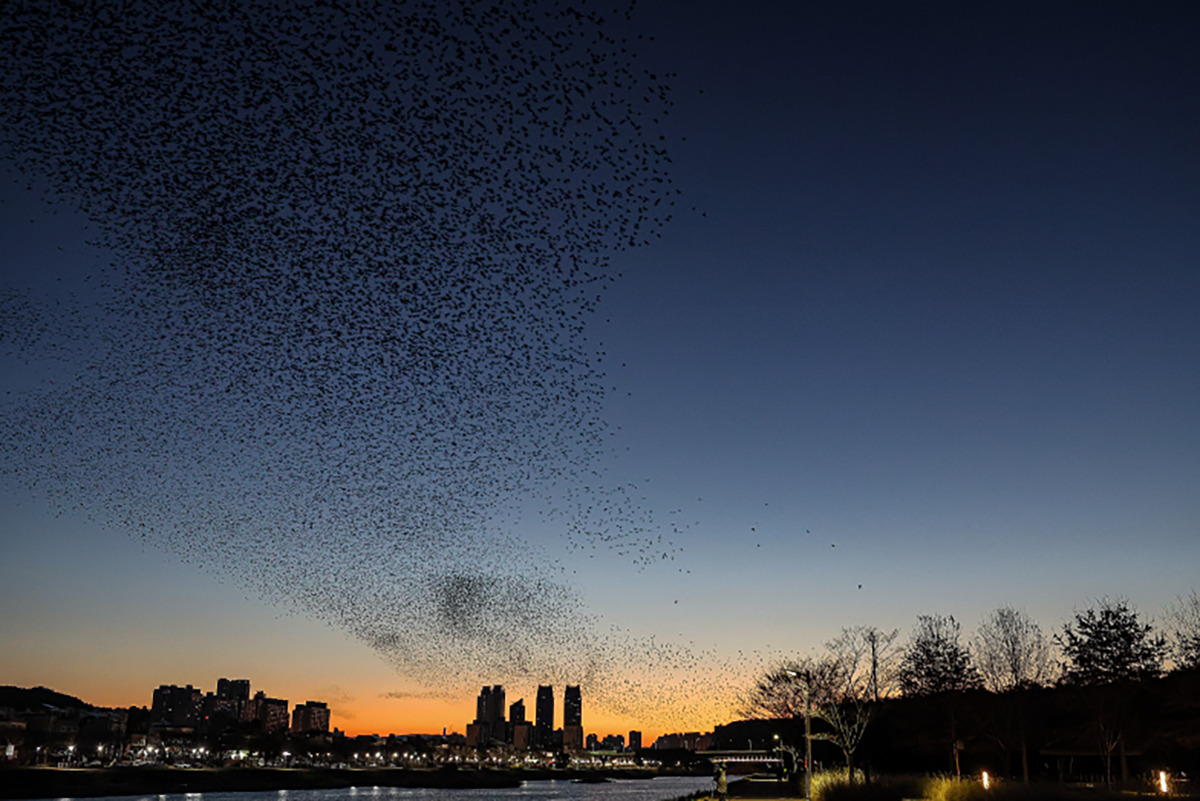
Rooks in flight over the Taehwa River ©Ulsan Biodiversity Center
Ulsan Biodiversity Center, in collaboration with the Ulsan Metropolitan City and Mirae Environment & Energy Co., Ltd. has announced the results of a winter population survey of Rooks (Corvus frugilegus) along the Taehwa River (EAAF150), a designated Flyway Network Site in the Republic of Korea and the launch site of the very first EAAFP Corporate Champion Programme. The survey, conducted from October 2024 to February 2025, aimed to monitor the number and movement of Rooks that have become a symbolic wintering bird in the city, but also exemplifies how local initiatives can contribute to broader biodiversity efforts across the Flyway demonstrating that every survey counts towards a more sustainable future for both birds and people.
During the survey, the maximum number of Rooks was recorded on January 24, 2025, with 83,535 individuals, while the minimum count was observed at the beginning of the season on November 10, 2024, with 44,737 individuals. The average number was 62,483 over the study period, showing no significant change from the previous winter.
Over a five-month period, a total of 10 surveys were conducted every two weeks at two major roost departure points: the eastern part of Samho Bamboo Grove (downstream) and the lawn near the Migratory Bird Park (upstream). The survey team consisted of seven members, including three researchers, two photographers, and two monitoring staff. Each morning, photographers captured the Rook flocks in flight every 10 seconds during their departure for foraging, and population counts were analysed using a photo-based counting program (CountThings from Photos).
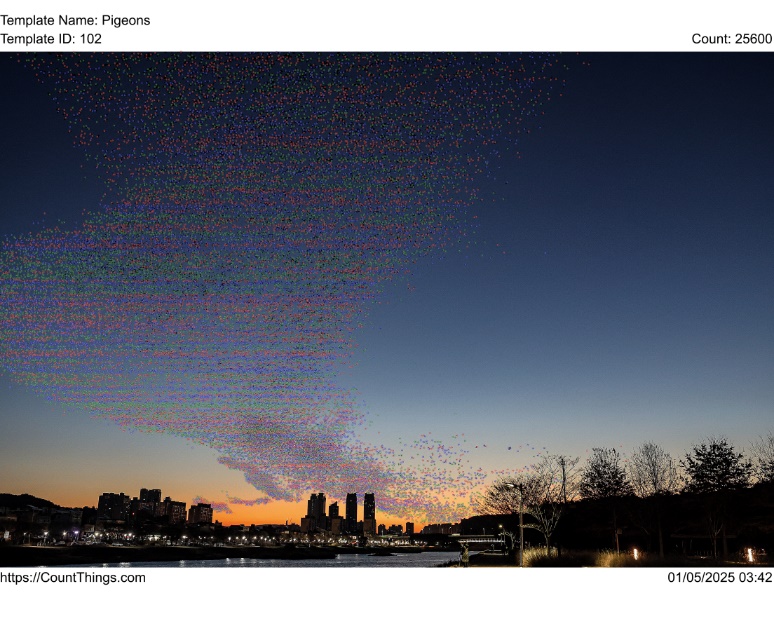
Screenshot of rook counting using ‘CountThings from Photos’ software ©Ulsan Biodiversity Center
The results confirmed that Rooks engage in wide-ranging foraging behavior, with activity recorded not only in Ulsan but also in neighboring Gyeongju, particularly between October and December. This indicates that Rooks utilise broad migratory corridors, rather than being limited to a single roosting or feeding area.
While there have been expert concerns about a gradual decline in Rook populations in recent years, the survey found no notable population decrease compared to last year. However, researchers emphasised the need for continued long-term monitoring to accurately detect trends.
Since 2023, the city of Ulsan has conducted regular monitoring of wintering Rooks along the Taehwa River to promote urban biodiversity conservation and ecotourism. The survey also provides valuable baseline data for future habitat management and migratory bird protection efforts.
According to a representative from the Ulsan Biodiversity Center, as Rooks have been confirmed to forage across a wide area, there are plans to expand future surveys to southern regions such as Yangsan, Busan, and Gimhae. The Center also stated that continuous monthly and annual monitoring will be carried out to track population trends and help create stable wintering habitats for the species.