ⓒ EAAFP Secretariat
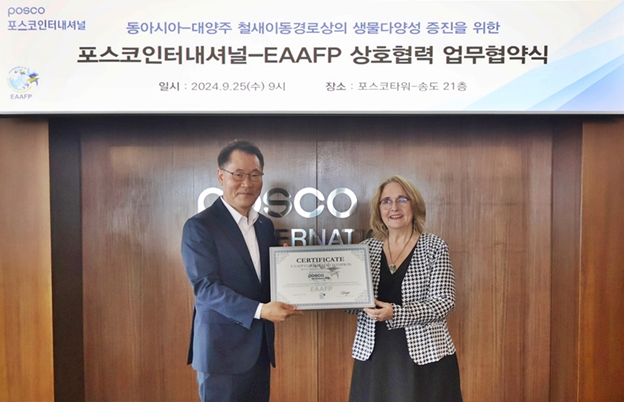
On 25th September 2024, the EAAFP Secretariat and POSCO International gathered to celebrate the designation of POSCO International as a Black-faced Spoonbill Champion under the EAAFP Corporate Champion Programme. The ceremony was held at the POSCO International Headquarters office, including the signing of a Memorandum of understanding and the awarding of a certificate.

ⓒ EAAFP Secretariat
The EAAFP Corporate Champion Programme is our flagship initiative for corporate engagement in migratory waterbird conservation. The programme invites companies to play a significant role in conserving migratory waterbirds and their habitats along the East Asian-Australasian Flyway. By becoming an EAAFP Corporate Champion, the corporation can internationally promote its social and environmental contributions toward conserving migratory waterbirds and their valuable habitats. The Species champion among 3 Champion types is granted the honorable role of an ambassador for specific key species in the EAA Flyway.
POSCO International’s joining to contribute to the conservation of the endangered Black-faced Spoonbill reflects the company’s commitment to environmental sustainability and corporate social responsibility. Partnering with EAAFP means that POSCO International aims to support conservation projects that will have a lasting impact on the preservation of migratory waterbirds, their habitats, biodiversity and people dependent upon them.
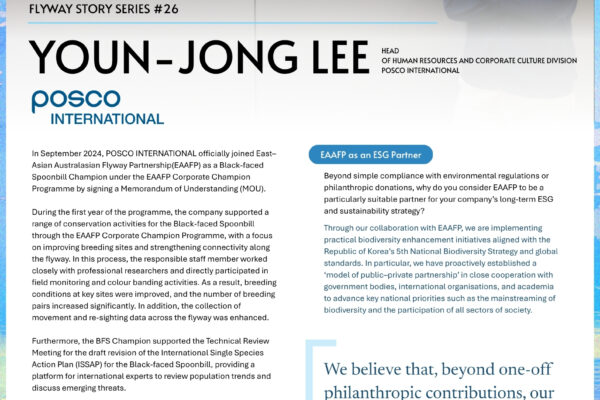
A representative from POSCO International stated, “We have put constant efforts into biodiversity conservation as part of our sustainable management projects. We hope this agreement will help the conservation activities of the Black-faced Spoonbill and the restoration of the ecosystem in the Incheon area, and become a stepping stone for the revival of the ecosystem along the East Asian-Australasian Black-faced Spoonbill migration route.” (From POSCO International Newsletter)

ⓒEAAFP Secretariat
The Black-faced Spoonbill is a globally endangered species with a long neck, legs and distinctively shaped beak that looks like a spoon. The body is covered with white feathers, but the facial skin is bare and black but no feathers around the eye. During the breeding season, the plumage on the head and chest turns yellow and has elongated head feathers. There are just over 6,000 individuals of Black-faced Spoonbill, and they mainly breed in small colonies on islets off the coast near tidal flats on outlying islets of West coast of North Korea, South Korea, and Liaoning province of China mainland, and a few breeding pairs on the east coast of Khanka Lake, Russia. They passage or wintering at the west coast of Korea peninsular, Japan, coastal areas of eastern China. Also, their wintering grounds include Tsengwen Estuary of Taiwan (China), the Deep Bay area of Hong Kong (China), coast of South China, Jeju Island in Republic of Korea, Japan, Vietnam, Cambodia, Thailand, the Philippines. In non-breeding time, they mostly feed in tidal flats and would use artificial wetlands like fishponds. They sometimes can be found in freshwater habitats. The major threat is habitat loss resulting from industrial development and land reclamation. Pollution leading to habitat degradation are ongoing threats; Human disturbance due to recreation, fishing, and collecting shellfish.
Under the Memorandum of Understanding, POSCO International will sponsor the EAAFP with KRW 150 million over three consecutive years. The funding will be used to support various conservation activities for the Black-faced Spoonbill, including habitat management and improvement at key sites, research and monitoring to better understand the species’ migration patterns and threats, and community engagement initiatives to raise public awareness and involve local communities and employees in conservation efforts.
EAAFP and POSCO International will work closely with experts from the EAAFP Black-faced Spoonbill Working Group and local organizations.
Ms. Jennifer George, Chief Executive of the EAAFP Secretariat, highlighted the successful conservation results for the Black-faced Spoonbill, emphasizing the significant increases in their population numbers due to collaborative efforts during the ceremony. She noted the importance of continued partnerships like this one in achieving positive conservation outcomes which helped the population recovered from only a few hundred in the 1990s to over 6000 birds. Mrs. George has also commended POSCO International’s commitment and expressed gratitude for their support, stating that such collaborations are vital for the ongoing conservation of migratory waterbirds along the East Asian-Australasian Flyway.
With the combined efforts of POSCO International, EAAFP, and conservation experts, the partnership aims to enhance conservation activities for the Black-faced Spoonbill. The planned projects are expected to improve critical habitats, increase public awareness, and contribute significantly to the sustainability of the flyway ecosystem and biodiversity.
EAAFP encourages other corporations to follow POSCO International’s lead by participating in the Corporate Champion Programme. Collective efforts are proven essential to ensure the survival of migratory waterbirds and the protection of their habitats along the EAA Flyway.