EAAFP Secretariat at CMS COP15
March 23–29, 2026, in Campo Grande, Brazil
EAAFP’s role in advancing flyway cooperation at CMS COP15
Parties to the Convention on the Conservation of Migratory Species of Wild Animals (CMS) convened in Campo Grande, Brazil, for the 15th Meeting of the Conference of the Parties to CMS (CMS COP15, March 23–29, 2026), where governments agreed on a wide range of conservation measures to strengthen international action for migratory species. For the East Asian–Australasian Flyway Partnership (EAAFP), participation in CMS COP15 was particularly important as the Partnership helps translate global CMS decisions into practical flyway-scale cooperation, especially in a region where CMS Party coverage remains limited. EAAFP brought regional experience and partnership-based solutions to CMS COP15, connecting governments, Partner organisations, and technical experts across the Flyway to support coordinated action for migratory waterbirds and their habitats.
Key outcomes included new or strengthened treaty protections for 40 species and populations of birds, aquatic wildlife, and terrestrial animals, alongside multi-species conservation plans for priority regions. Further details on the outcomes of CMS COP15 are available here.
Bringing flyway perspectives into the CMS agenda
EAAFP contributed to several agenda items at CMS COP15, bringing attention to the value of regional mechanisms, flyway-scale cooperation, and coordinated action for migratory waterbirds and their habitats. Under Agenda Item 26.3 on Flyways, EAAFP made an interventions by expressing support for efforts to strengthen migratory waterbird conservation, while emphasising the importance of building on existing and well-established regional mechanisms within the Flyway. This is particularly important in the East Asian–Australasian Flyway, where only 27% of EAAFP government Partners are Parties to CMS, making EAAFP a key mechanism for implementing flyway- and waterbird-related actions across the region. As a Partner of EAAFP, CMS has worked collaboratively within the Partnership to advance shared conservation goals, with joint efforts reflected in the EAAFP Strategic Plan, single species action plans, successful recovery stories such as the Black-faced Spoonbill, and support for conservation initiatives in the Central Asian Flyway. have also collaborated through initiatives such as World Migratory Bird Day, the Flyways Working Group, the Energy Task Force, the Asia-Pacific Intergovernmental Task Force on Illegal Taking of Migratory Birds, and the Global Partnership on Ecological Connectivity.
Under Agenda Item 26.4 on Action Plans for Birds, EAAFP welcomed progress on bird action plans and shared updates on key species initiatives across the Flyway. These included the adoption of the new 10-year International Single Species Action Plan for the Conservation of the Spoon-billed Sandpiper, progress toward the establishment of a Task Force and Conservation Workplan for the Critically Endangered Masked Finfoot, and ongoing efforts to revise the Black-faced Spoonbill International Single Species Action Plan. Together, these initiatives demonstrated the Partnership’s continued commitment to supporting species recovery through science-based planning, international cooperation, and sustained action across range states.
EAAFP also contributed to discussions on key threats and broader conservation frameworks affecting migratory birds. Under Agenda Item 26.1 on the Prevention of Illegal Killing, Taking and Trade of Migratory Birds, the Partnership welcomed progress made by the Asia Pacific Illegal Taking of Migratory Birds Intergovernmental Task Force and recognised its close cooperation with EAAFP. The intervention also highlighted continuing threats such as mist nets in parts of the region, and supported further work on data collection, guidance, and enforcement support to help address illegal activities affecting migratory waterbirds.
Under Agenda Item 26.3.2 on Seabirds and Marine Flyways, EAAFP strongly supported the resolution, emphasizing the need for coordinated conservation across marine flyways, ocean basins, and areas beyond national jurisdictions. The Partnership also noted the role of the EAAFP Seabird Working Group and World Migratory Bird Day in supporting awareness, collaboration, and action for seabird conservation.
Under Agenda Item 28.2 on Ecological Connectivity, EAAFP highlighted the importance of maintaining connected networks of breeding, stopover, and non-breeding sites. Drawing on examples such as the EAAFP Sister Site Partnership Programme and the recovery of the Black-faced Spoonbill, the Partnership demonstrated how institutional cooperation can help translate ecological connectivity into practical conservation outcomes.
At CMS COP15, EAAFP demonstrated strong engagement across cross-cutting agenda items, reinforcing its role as a practical implementation platform linking CMS with other biodiversity-related conventions, including the Convention on Biological Diversity and the Convention on Wetlands. The Partnership highlighted its strengths in operationalising ecological connectivity and multi-level cooperation across the flyway, including effective engagement with both CMS and non-CMS Parties. Collectively, these contributions underscored EAAFP’s value in translating global policy commitments into coordinated, on-the-ground conservation action.
 |  |  |
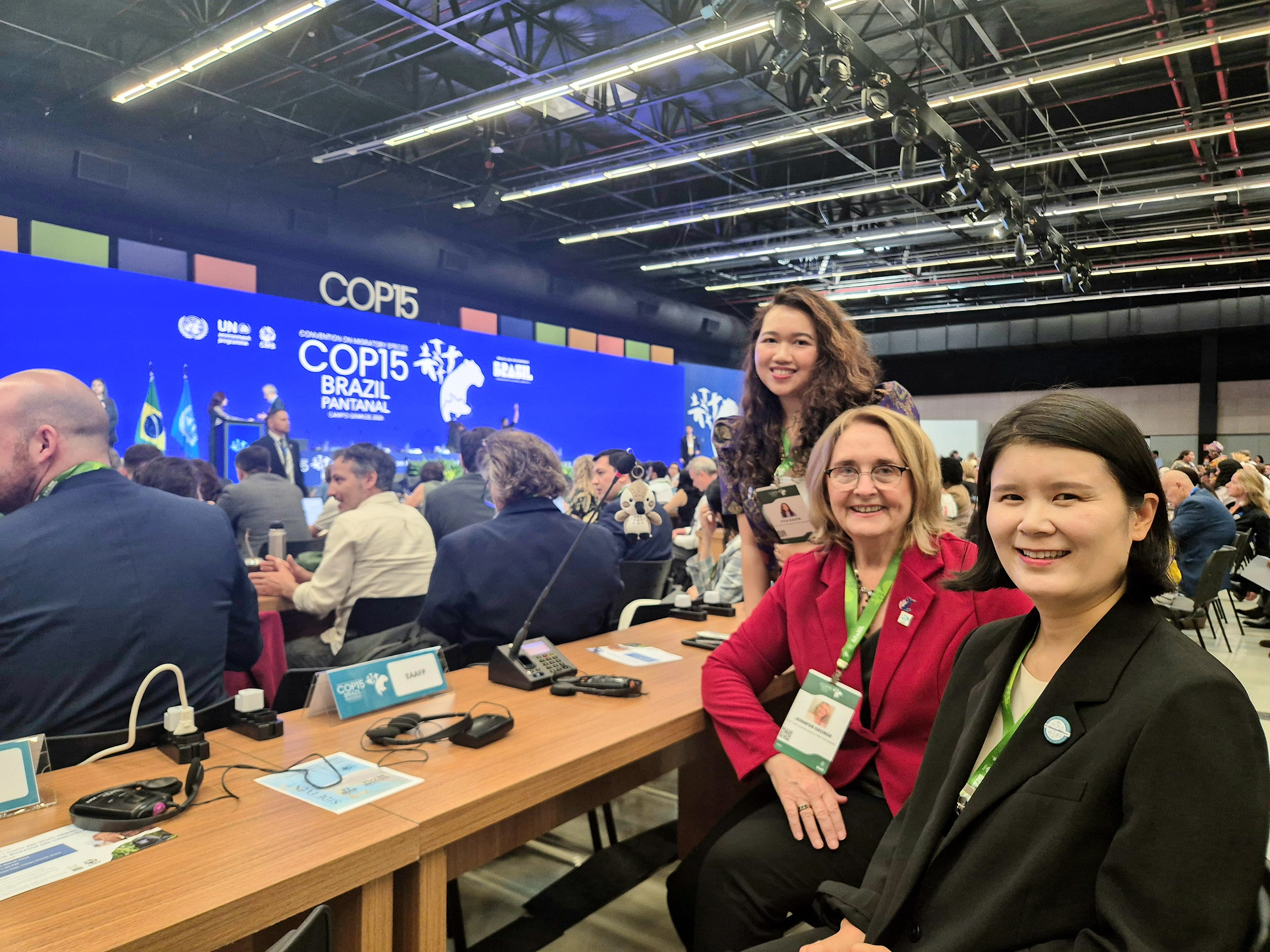
EAAFP delegation at the Committee of the Whole (CoW) © EAAFP
Reinforcing EAAFP’s role as a strategic flyway platform
Strategic engagement was also a central part of EAAFP’s presence at CMS COP15. EAAFP Secretariat held bilateral meetings with senior leaders of major international organisations that are also EAAFP Partners, highlighting shared priorities and continued confidence in the Partnership’s role as a key mechanism for flyway cooperation. These exchanges underscored EAAFP’s continuing strategic value as a credible platform for connecting global conservation processes with coordinated action for migratory waterbirds and their habitats across the East Asian–Australasian Flyway.
Bilateral meetings at CMS COP15: with Bangladesh; with Mongolia; with the Convention on Biological Diversity; with the Convention on Wetlands; with Wildlife Institute of India; with the Global Environment Facility; with Andrew Raine of Australia, the incoming Executive Secretary of CMS:
 With a representative from Bangladesh, Mr. Moyeenuddin Khan, and Dr. Lyu Cai from Beijing Forestry University
 With representatives from Mongolia, Ms. Khandarmaa Batjargal, and MS. Nadia Mijiddorj
 With the Executive Secretary of Convention on Biological Diversity (CBD), Ms. Astrid Schomaker and Mr. Mariano Castro Jimenez
 With the Secretary General of the Convention on Wetlands, Dr. Musonda Mumba and Mr. Njisuh Zebedee
 With Dr. R Suresh Kumar – Wildlife Institute of India
 With Ms. Sarah Wyatt – GEF Secretariat
 With the incoming Executive Secretary of the Convention on Migratory Species, Mr. Andrew Raine
Showcasing practical flyway action at CMS COP15 side events
At the side event “From Partnerships to Practice: Advancing Ecological Connectivity Action on the Ground,” organised by the Global Partnership on Ecological Connectivity (GPEC), Ms Kyle Esperanza Zuleta, Programme Officer at the EAAFP Secretariat, joined as a panellist. The session provided an opportunity to present progress made by GPEC since CMS COP14, while showcasing practical approaches, tools, and collaborative initiatives that support ecological connectivity for migratory species. Through its contribution, EAAFP highlighted how the Flyway Site Network and Sister Site Programme help translate ecological connectivity into action on the ground by supporting relationship-driven partnerships among sites, communities, and sectors. These initiatives encourage shared local visions, strengthen ownership and collective action, and build a sense of connection across countries through the understanding that migratory waterbirds are shared across borders.
At the side event “The World Coastal Forum: Strengthening Cooperation for Coastal Connectivity to Conserve the World’s Migratory Species,” discussions centred on the critical role of coastal ecosystems in sustaining migratory species across different stages of their life cycles. The session showcased the World Coastal Forum’s efforts to connect partners, develop knowledge products, and promote evidence-based approaches for coastal ecosystem management and restoration. It also addressed practical opportunities to reduce biodiversity impacts from coastal development and renewable energy, while supporting coastal communities and economies. Representing the EAAFP Secretariat, Ms Yoon Lee, Deputy Chief Executive, highlighted EAAFP’s newly adopted Tidal Flats Initiative (TFI) as a strategic effort to strengthen the protection, management, and restoration of critical coastal habitats across the flyway. She emphasised the global importance of tidal flats for migratory waterbirds and introduced the Initiative as a practical model to connect science, policy, and on-the-ground action through coordinated, multi-stakeholder collaboration.
 © IUCN
 Ms Yoon Lee (Deputy Chief Executive) and Kyle Esperanza Zuleta (Programme Officer) at CMS COP15 side events © EAAFP
On 22 March, ahead of CMS COP15, EAAFP Secretariat’s Chief Executive, Jennifer George, also presented at the pre-COP meeting “From Dialogue to Coordinated Action: Strengthening Flyway Cooperation,” organised by EAAFP Partner, Hanns Seidel Foundation Korea. The meeting brought together various flyway initiatives to exchange perspectives and identify opportunities for joint implementation and knowledge-sharing across flyways. Discussions focused on strengthening linkages between species-level initiatives, the Flyway Site Network, thematic approaches to addressing threats, and broader ecological connectivity frameworks. The meeting also helped shape key messages for CMS COP15 and explored options for sustaining inter-flyway collaboration beyond the meeting.

 Pre-COP meeting “From Dialogue to Coordinated Action: Strengthening Flyway Cooperation” © EAAFP
Strengthening Partnerships and Visibility at CMS COP15
Creating space for Partner connection and visibility
During the COP15, he EAAFP Secretariat further supported Partner engagement by organising an brochures prepared for the meeting, supporting greater visibility for Partner activities and contributions. About 30 Partners attended the special Partnership dinner, creating a meaningful space to reconnect and deepen relationships across the Flyway.EAAFP Partners who attended CMS COP15 included:
- National governments: Australia, Bangladesh, Mongolia, and New Zealand
- Intergovernmental organisations: Convention on Biological Diversity, Convention on Wetlands, and Food and Agriculture Organization
- International non-governmental organisations: BirdLife International, Hanns Seidel Foundation–Korea, ICLEI Cities Biodiversity Center, Wetlands International, Wildlife Conservation Society, and World Wildlife Fund for Nature
- International organisation: International Union for Conservation of Nature
A special farewell tribute was held during the dinner to honour outgoing CMS Executive Secretary Ms Amy Fraenkel, recognising her steadfast support for the EAAFP. Her commitment has brought great value to the Partnership by affirming the importance of its work and reinforcing shared efforts to conserve migratory waterbirds and their habitats.
 EAAFP Partners at the dinner reception © EAAFP
What does EAAFP’s engagement at CMS COP15 mean for the Flyway?
EAAFP’s engagement at CMS COP15 reflected the Partnership’s continued role in connecting regional priorities with global conservation processes. Across its interventions, side events, bilateral meetings, and Partner engagement, EAAFP emphasized that migratory waterbird conservation depends on both connected habitats and connected institutions.
By connecting ecologically linked but geographically distant sites through long-term cross-border cooperation, the Partnership helps translate connectivity into effective flyway-wide coordinated action, knowledge exchange, and on-the-ground conservation efforts across the East Asian–Australasian Flyway.
View more photos here.